Polymer melt filtration is the removal of solid contaminants, gel particles, and catalyst residues from molten polymer before it is pelletized, spun, cast, or compounded. In a typical line the molten polymer — which at processing conditions behaves as a non-Newtonian fluid with apparent viscosity in the range of roughly 100 to 10,000 Pa·s (100,000 to 10,000,000 centipoise) — passes through a filtration element rated between about 5 and 100 µm for a sintered metal element, or 40 and 500 µm for a woven screen pack, depending on the polymer and the downstream quality requirement. Where woven extruder screen packs are disposable and coarse, a sintered metal filter element polymer line can be cleaned, backflushed, and reused, which is why 316L sintered elements have become the standard for continuous melt filtration in fiber spinning, film extrusion, PET bottle-to-bottle recycling, and masterbatch production. This guide explains how sintered metal filter elements differ from woven screen packs, how to specify them for high viscosity melt filtration, and how to set realistic pressure-drop budgets.
Why Polymer Melt Filtration Is Demanding
Filtration of a molten polymer is fundamentally different from filtering a low-viscosity liquid, and the differences drive every design decision.
High apparent viscosity. At processing temperatures of roughly 200–350 °C, polymer melts are not free-flowing liquids. Typical apparent viscosity at extrusion shear rates runs from several hundred to several thousand Pa·s, and at the low shear rates seen inside a filter housing the apparent viscosity can approach 10,000 Pa·s. A high-viscosity melt does not distribute itself evenly across a filter face the way water or a solvent would; it follows the path of least resistance, so flow distribution, face velocity, and the open area of the element matter far more than in conventional liquid filtration.
Elevated temperature. Melt filtration runs hot. Polypropylene is typically processed near 230 °C, PET near 280–290 °C, and PA (nylon) at 260–300 °C. The element must hold its structural strength and its filtration rating at these temperatures for thousands of hours, and it must survive thermal cycling during start-up, shutdown, and backflush. A 316L sintered element retains useful strength well beyond these temperatures and resists the corrosion and oxidation that hot polymer plus trace degradation products can impose.
High contamination loads. Feed streams — especially recycled material — carry metal fragments, degraded resin char, dust, catalyst residue, and cross-linked gel particles. In recycling service contamination levels can be high enough that a disposable screen pack must be changed every few hours. That is exactly the service for which cleanable sintered elements are designed.
Gel particles. Gels are cross-linked or degraded polymer domains that are similar in density to the melt and often deformable. They are not removed by simple sieve-like interception alone; they are trapped on the surface and within the depth of the medium. This is why a nominally 20 µm sintered element will visibly improve film or fiber quality even when the particles are softer and more deformable than an equivalent solid particle of the same size.
The two filtration approaches used in melt service are frequently confused because both are made of stainless steel mesh. The practical differences are substantial.
| Attribute | Woven extruder screen pack | Sintered metal filter element |
|---|
| Typical rating | 40–500 µm | 5–100 µm (five-layer mesh down to 2–25 µm) |
| Construction | Single or multiple woven mesh layers; pressed | Sintered wire mesh; five-layer sintered mesh; or sintered powder |
| Reusability | Disposable; replaced at each change | Cleanable: backflush; chemical clean; or ultrasonic clean |
| Backflush capability | Not practical | Yes — reverse-flow backflush in continuous systems |
| Gel removal | Limited at fine ratings | Good — depth filtration traps deformable gels |
| Pressure drop growth | Rapid; high as the pack loads | More gradual; predictable ΔP curve |
| Service life | Hours to a shift in dirty service | Weeks to months between full element changes |
| Relative cost per element | Low | Higher first cost; lower lifetime cost |
| Best for | Coarse duty; low-cost change-out | Continuous; fine; or heavily contaminated service |
When a woven screen pack wins. If the line is a simple extruder with low throughput, the polymer is clean virgin resin, the required rating is coarse (above ~100 µm), or the operator wants the lowest possible first cost, a disposable screen pack is the pragmatic choice. It is also the default in many small recycling extruders where the contamination load is so high that even a cleanable element would fill faster than it can be cleaned. For that service the cost and simplicity of a screen changer are hard to beat.
When a sintered metal element wins. Choose sintered elements when you need ratings below roughly 40 µm, when you want continuous operation without stopping to change screens, when gel particles are the quality problem, or when the total cost of ownership matters more than first cost. Continuous candle filter polymer melt systems built around sintered elements are the standard solution for PET recycling lines, fiber spinning, and film extrusion, because they filter fine while the line keeps running.
For a deeper comparison of screen-pack mesh combinations, see our guide on extruder screen pack mesh combinations, and for the pain points that push recyclers off disposable screens, read about recycled plastic extrusion filtration pain points.
Sintered elements are manufactured in three families, and the geometry determines how the element is mounted and cleaned.
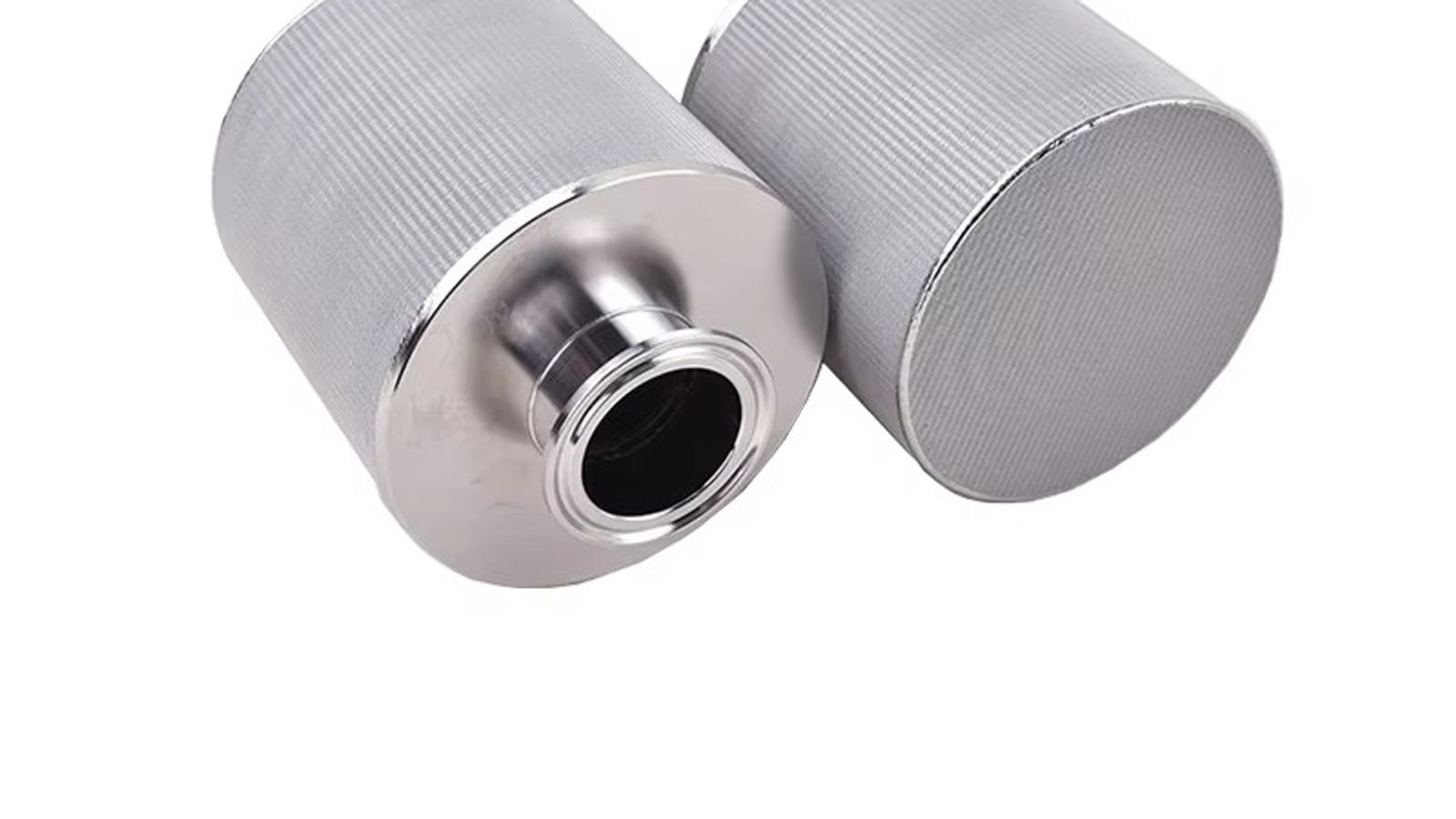
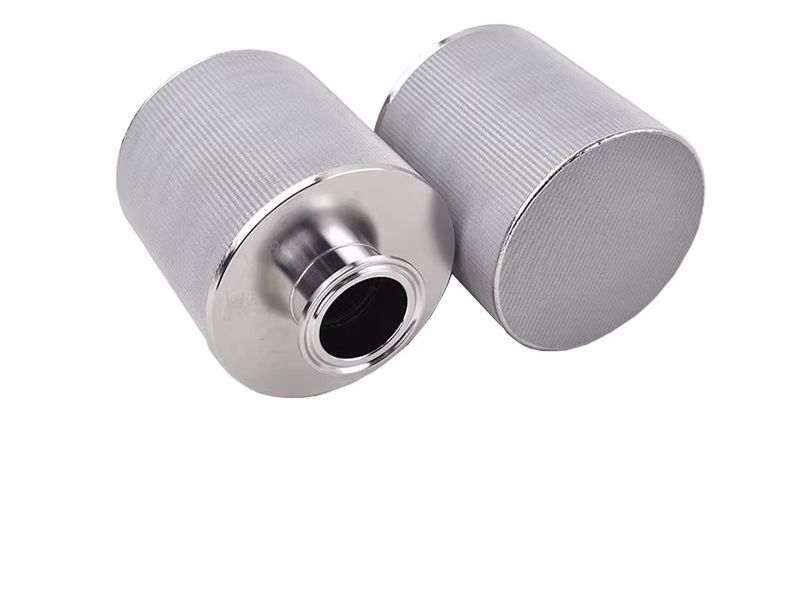
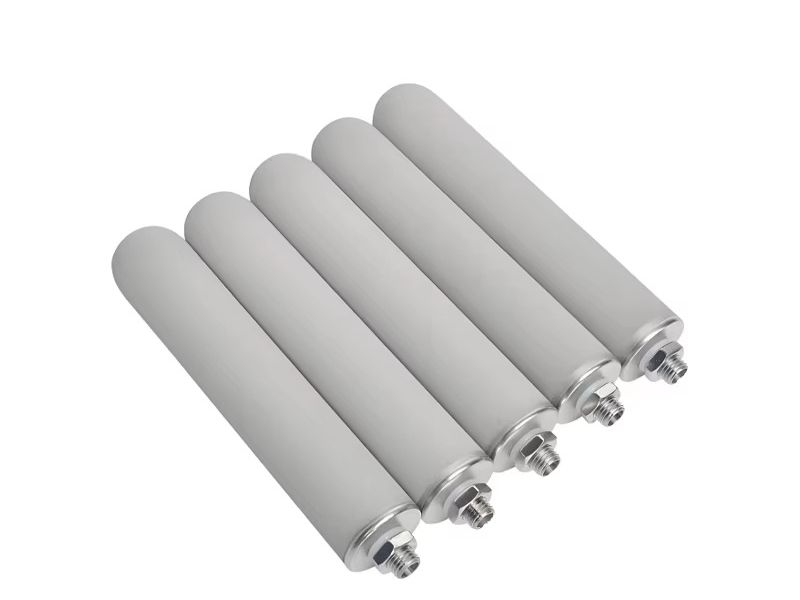
Candle filters. A candle filter is a cylindrical element, closed at one end, that hangs inside a pressure vessel. Melt flows from the outside inward through the cylindrical wall and exits through the open end at the top. Candle filters maximize filter area per unit of vessel volume, which keeps face velocity low and pressure drop manageable in high viscosity melt filtration. Multiple candles are manifolded into a single vessel, and individual groups can be taken offline for backflush while the rest keep producing — the basis of continuous melt filtration. For polymer service, candle elements are commonly built from sintered wire mesh or five-layer sintered mesh wrapped or formed into a cylinder.
Disc and plate filters. Disc filters are flat, stacked circular elements. The melt passes radially through each disc, so the effective area is the sum of all disc faces in the stack. Disc stacks are compact and easy to dismantle, and they are widely used in manual-change applications where the line stops for a filter change. See our range of sintered metal filter discs.
Cartridges and tubes. A sintered cartridge is a self-contained cylindrical element with its own end caps and fittings, often built from sintered powder or sintered wire mesh. The distinction from a candle is largely mounting detail: cartridges drop into a standard housing and are sealed with O-rings or gaskets, which simplifies change-out. These are the elements to consider when the housing is designed around sintered wire mesh filter cartridges.
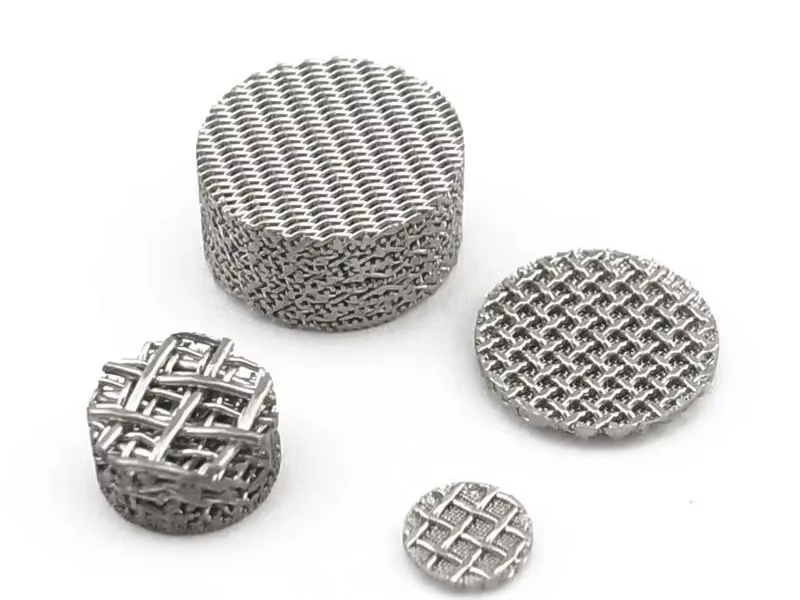
Five-layer sintered mesh construction. The most common melt-service medium is five-layer sintered mesh: a fine protective top mesh, a fine filter mesh that sets the rating, a coarse support mesh, and two outer layers that give the element rigidity and allow it to be formed into cylinders without collapsing under melt pressure. Because the layers are sintered — fused at high temperature — rather than merely stacked, the composite is one metallurgically bonded structure. Five-layer sintered mesh achieves ratings of roughly 2–25 µm with lower pressure drop than a single-layer woven mesh of the same nominal rating, because the depth of the structure distributes the flow and holds retained solids without blinding the surface.
Flow direction. For most melt applications flow is outside-in: contaminated melt hits the largest available surface area, solids collect on the outside, and the cleaned melt exits through the core. This makes outside-in the natural choice for backflushing, because the reverse flow blows the cake off the outer surface. Inside-out flow is used in some compact designs but makes backflush much less effective.
Specifying a melt filter element comes down to four decisions: micron rating, flow area and pressure drop, ΔP budget and change/backflush strategy, and alloy plus certification.
1. Micron rating vs. gel and solids removal
Choose the rating from the downstream quality requirement, not from the feed. Fiber spinning typically demands the finest filtration — 5–20 µm — because a single oversized particle breaks a filament and stops a spinning position. Biaxially oriented film and high-gloss masterbatch also need fine ratings in the 5–25 µm range. PET bottle-to-bottle recycling commonly runs 20–40 µm, and PP/PE compounding often runs 40–100 µm. Remember that a nominal micron rating describes the medium's largest pore or particle-retention characteristic, not a hard cutoff: a 20 µm sintered element will pass some particles above 20 µm and retain many below it, which is why gel-prone processes are usually specified one or two steps finer than the nominal solids requirement.
2. Flow area and pressure drop
For a given throughput and melt viscosity, the pressure drop across a clean element is set by the filtration area: double the effective area and you roughly halve the face velocity and the clean pressure drop. In practice, specify the element so the clean ΔP at operating throughput is no more than about 10–20% of your total ΔP budget, leaving the rest of the budget for dirt loading. A common failure in specifying is choosing a too-fine rating or too-small an element, then watching the ΔP rise to the change point in a fraction of the expected run time. The relationship between flow, element area, and ΔP for sintered media is covered in detail in our article on sintered metal filter pressure drop and flow curves.
3. ΔP budget and change/backflush strategy
Set a clear pressure-drop budget before the element is taken out of service. For melt filtration a practical budget is roughly 10–50 bar (150–700 psi) between a clean element and the change or backflush point, depending on the polymer, the pump rating, and the process. Above that, the risk of collapsing the element, starving the gear pump, or degrading the polymer rises quickly. In a continuous system the sequence is:
- Run on the primary set of candles until the ΔP reaches the setpoint.
- Take one candle group offline, vent or drain it, and backflush it with hot gas or a low-viscosity flush.
- Return the group to service while the next group is cleaned in turn.
Because the clean element consumes only a fraction of the ΔP budget, a well-sized continuous system can run for days or weeks between full element changes even in dirty recycling service, versus hours for a disposable screen pack. Backflush removes the surface cake; for contaminants that have penetrated the medium, the element is ultimately removed and cleaned chemically or ultrasonically.
4. Alloy and certification
Use 316L austenitic stainless steel for hot polymer contact. The low-carbon "L" grade avoids sensitization and chromium-carbide precipitation during sintering and during long hot exposure, preserving corrosion resistance and mechanical strength at melt temperatures. For polymer systems 316L is the default because it resists the sulfur-, chlorine-, and oxygen-containing degradation products that hot polymers can release, and it can be cleaned with the aggressive caustic and acidic chemistries used in melt-filter cleaning baths. Specify elements supplied with EN 10204 Type 3.1 material certificates so that the alloy grade, heat number, and mechanical properties are traceable from the mill to the finished element — important for food-contact, medical, and pharmaceutical polymer lines where alloy provenance is audited.
The table below is a starting point for matching rating and medium to application:
| Micron rating | Filter medium | Typical polymer application |
|---|
| 5–15 µm | Five-layer sintered mesh; sintered powder | Fiber spinning; thin film; high-gloss masterbatch |
| 15–25 µm | Five-layer sintered mesh | PET and PA melt filtration; bottle-to-bottle recycling |
| 25–60 µm | Sintered wire mesh; sintered powder | PP/PE compounding; cast film; sheet extrusion |
| 60–100 µm | Sintered wire mesh | Coarse melt filtration; heavily contaminated recycling feed |
For the underlying construction differences, see our breakdown of five-layer sintered mesh structure and uses and our five-layer sintered mesh product page.
Application Examples Across Polymer Processes
PET (bottle-to-bottle and sheet). PET is processed at 280–290 °C, and recycled flake carries label adhesive, cap fragments, and degraded polymer. Continuous candle filters with 20–40 µm five-layer sintered mesh elements are the industry-standard way to hold IV and keep sheet and preforms free of black specks. Our PET recycling melt filtration guide covers the process in depth.
PP and PE compounding and masterbatch. At roughly 230 °C, PP and PE melts are relatively forgiving, but carbon black and pigment masterbatch production still requires fine filtration to protect downstream film and fiber. Sintered elements at 25–60 µm remove agglomerated pigment and process dirt while the backflush capability keeps a high-tonnage compounding line running continuously.
PA (nylon). PA processing at 260–300 °C combines high temperature with sensitivity to gel formation, especially with high-viscosity grades. Sintered powder or fine five-layer mesh at 15–25 µm removes gels and deposits without the blinding that a single-layer mesh would suffer.
Fiber spinning. Filament breakage is driven by particles and gels larger than the spinneret capillary. Spinning lines therefore run the finest melt filtration in the industry, typically 5–15 µm, on large-area candle or cartridge systems. This is where the low pressure-drop advantage of five-layer sintered mesh matters most, because the ΔP budget is consumed by the spinneret itself.
Recycling lines upgrading from screens to sintered. A common upgrade path is a recycling extruder that today changes woven screen packs every couple of hours. Replacing the screen changer with a continuous candle-filter skid, or adding a sintered polishing element downstream of the screen pack, converts a batch operation into continuous production and improves pellet and film quality at the same time. The upgrade usually pays for itself in reduced polymer loss, reduced operator labor, and higher on-spec output.
FAQ
What micron rating do I need to remove gels in PET melt? For PET bottle-to-bottle and sheet applications, a 20–40 µm five-layer sintered mesh element is the typical starting point. If gels are the dominant defect in film or preforms, specify 15–25 µm, because gel removal is not a hard sieve action and finer depth media retains more deformable gels. For spinning-grade PET, drop to 5–15 µm.
Can sintered metal filter elements be backflushed in polymer service? Yes. Candle and cartridge elements are designed for reverse-flow backflush, which is what makes continuous melt filtration possible. The surface cake is blown off the outer face with hot gas or a flush medium; contaminants that have penetrated the depth of the medium require the element to be removed and cleaned chemically or ultrasonically at a scheduled interval.
How do I choose between sintered wire mesh and sintered powder? Choose sintered wire mesh (especially five-layer) when you want low clean pressure drop, high open area, and good backflush behavior — the priority for most melt applications. Choose sintered powder when you need the finest ratings, maximum gel retention, or a tortuous depth structure, and you can accept a higher clean ΔP for the same area.
What pressure drop should I design for before changing or backflushing an element? Set a ΔP budget of roughly 10–50 bar (150–700 psi) between the clean-element pressure drop and the change or backflush setpoint. Size the element so the clean ΔP at full throughput is only about 10–20% of that budget, leaving the rest for dirt loading.
Can I upgrade my existing recycling line from woven screen packs to sintered elements? Yes. Many recyclers add a sintered polishing element downstream of the existing screen changer, or replace the screen changer entirely with a continuous candle-filter system. The retrofit typically pays off through continuous operation, less polymer waste, fewer operator interventions, and better pellet quality.
Get Your Elements Sized by Process Data
The correct element for your line is a function of polymer, temperature, throughput, contamination load, and required rating — and the difference between an undersized and a correctly sized element shows up as downtime and off-spec product within the first shift. If you send your process details — polymer and grade, melt temperature, throughput in kg/h, feed contamination level, and the filtration rating you need — the engineers at KAIFIL can size the sintered metal filter elements for your housing, recommend a 316L melt filter geometry (candle, disc, or polymer filter cartridge stainless steel), and confirm the flow area and ΔP budget before you spend on hardware. We manufacture sintered elements and custom assemblies in Shijiazhuang, China, and we support melt filtration projects from virgin resin production to plastic extrusion filtration. Contact KAIFIL with your process data for a sizing recommendation.