Wedge wire screens are the workhorse of solid-liquid separation in modern wastewater treatment, combining high open area, precise slot tolerance, and a self-cleaning V-profile geometry that keeps fine screens operating under heavy solids loads. In municipal and industrial plants, wedge wire screens wastewater treatment duties span three critical zones: fine screening at the headworks, sludge dewatering on belt presses and rotary thickeners, and MBR pre-screening ahead of membrane bioreactors. Across these applications, slot sizes typically range from 0.25 mm to 3 mm, with open areas between 20% and 60%, enabling hydraulic capacities that woven mesh and perforated plate cannot sustain without blinding. This guide explains how to select, size, and specify stainless steel wedge wire screen panels for each duty, with the engineering data that EPC contractors and procurement teams need to build a defensible specification.
What Are Wedge Wire Screens in Wastewater Treatment?
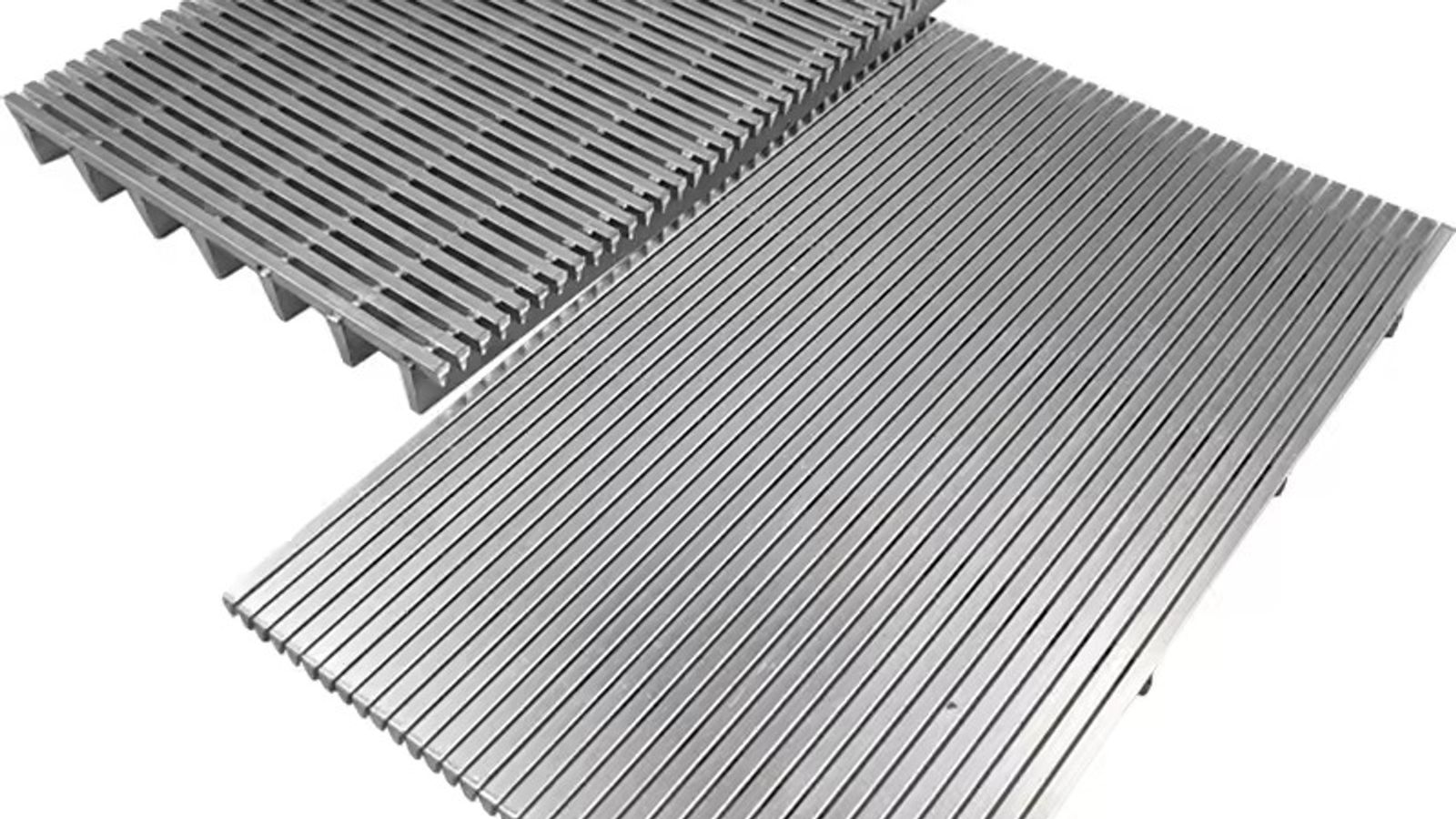
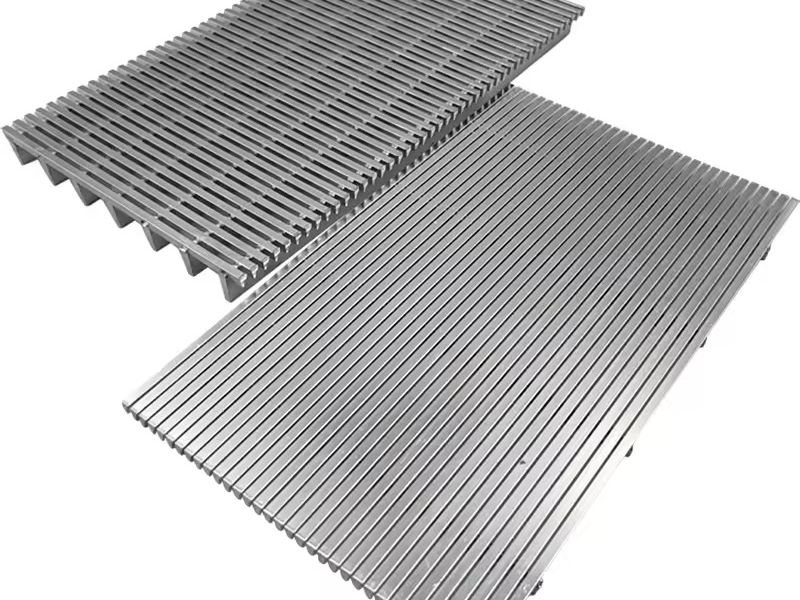
A wedge wire screen is built by wrapping a continuous V-shaped profile wire around a series of longitudinal support rods and welding every intersection. The result is a rigid, all-welded structure in which each slot is formed by the parallel faces of two adjacent profile wires. Because the wire tapers from its wide base to a narrow edge, the slot opening narrows on the water side and widens toward the discharge side. That single geometric detail is the reason wedge wire outperforms other screen media in wastewater service: particles that enter the slot are far less likely to wedge and become trapped, and any material that does lodge can be cleared by backwash, brushing, or mechanical wipers.
For wastewater engineers the practical consequence is straightforward. A V-profile screen can hold a large open area without sacrificing strength. Standard slot widths run from 0.25 mm up to 3 mm, and specialty dewatering panels can be built as fine as 0.1 mm. Open area ranges from roughly 20% to 60% depending on slot width, wire profile, and rod spacing, which directly controls the headloss and the hydraulic capacity of the screen. Because the profile wire and support rods are continuous, welded members, the panel also resists the fatigue and distortion that come with scraping rakes, aggressive backwash, and thermal cycling in chlorinated water.
A well-specified wedge wire screen is not a consumable item bolted into a channel and forgotten. It is a structural component of the treatment train, sized against a specific flow, solids load, and slot size. The balance of this article walks through the three main applications where it earns its place: fine screening, sludge dewatering, and MBR pre-screening.
Fine Screening at the Headworks: When a Fine Screen Is Required
Raw sewage entering a plant carries everything from grit and rags to hair, plastics, and fibrous material. Coarse screens, typically with bar spacings of 6 mm to 25 mm, protect pumps and large equipment but let most suspended and settleable solids pass. The purpose of a fine screen wastewater channel is to take the next cut: removing solids in the 1 mm to 6 mm range so that downstream processes — primary clarifiers, biological reactors, and membrane systems — run at design efficiency rather than fighting excessive solids loading.
Wedge wire fine screens mount as inclined static screens, rotary drum screens, or hydraulically-driven bar screens. In municipal headworks, slot sizes of 1 mm to 3 mm are the common operating band. The choice of slot is a trade-off between solids capture and hydraulic capacity. A 1 mm slot catches substantially more fine material — typically capturing a significant share of suspended solids that would otherwise reach the biological stage — but it generates more headloss and requires more careful cleaning. A 3 mm slot passes more flow with lower headloss and is a common choice where the downstream process is tolerant and the objective is primarily to protect pumps and aerators.
Several hydraulic figures matter at the specification stage. Channel approach velocity in the headworks is normally held between 0.3 m/s and 1.0 m/s so that grit settles out and does not blind the screen face. For fine screens, the through-screen or approach velocity should be kept below roughly 0.8 m/s to avoid pushing fibrous material deep into the slots. Headloss through a clean wedge wire fine screen is typically 150 mm to 300 mm and rises as solids accumulate, which is why automatic cleaning cycles are specified on any fine screen duty. If you are unsure which slot width fits your effluent quality target, the wedge wire screen slot size selection guide lays out the decision matrix in detail.
In practice, plants that upgrade from coarse-only screening to a 1–3 mm wedge wire fine screen consistently report lower downstream maintenance: fewer clogs in primary sludge pumps, less debris in digesters, and reduced screening carryover to the biological reactors.
MBR Pre-Screening: Why 0.5–1 mm Slot Size Matters
Membrane bioreactors are the strictest user of fine screens in the treatment plant. Hollow fiber and flat sheet membranes tolerate very little fibrous debris, which can bridge across fibers, abrade the membrane surface, and accelerate fouling that drives up aeration costs and shortens membrane life. The accepted engineering rule is that the fine screen ahead of an MBR must hold the particle size well below the membrane channel dimensions. In practice, MBR pre-screen slot sizes of 0.5 mm to 1.0 mm are the industry standard.
The 1 mm fine screen is the default for most municipal MBR installations. It removes hair, fiber, and small debris that would otherwise reach the membrane tank, and it does so with manageable headloss. Where the feed contains a high fraction of stringy or fine material — industrial effluent, septage, or combined sewer overflow — many designers step down to a 0.5 mm screen even though it demands more frequent cleaning and a larger screen area for the same flow. The operating cost of that finer screen is usually justified by the reduction in membrane cleaning frequency and chemical consumption downstream.
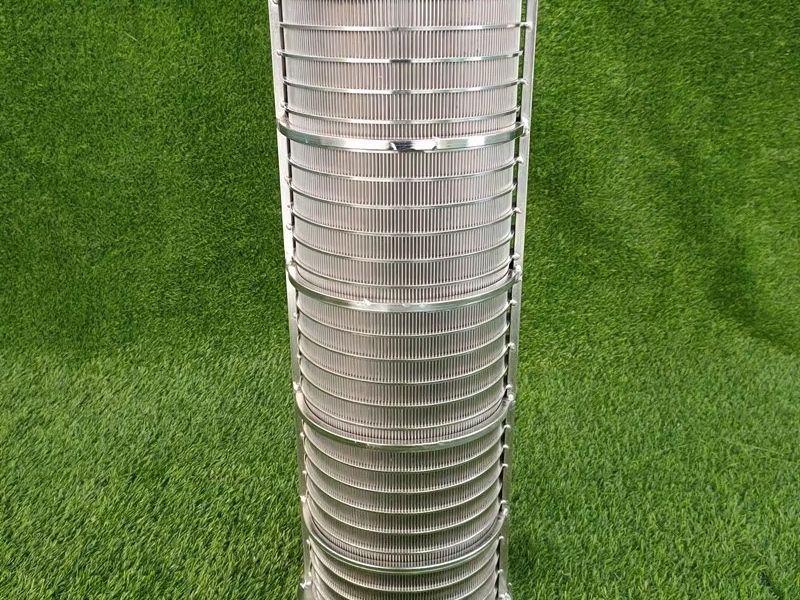
Rotary drum screens and inclined static screens built from wedge wire dominate this application. A drum screen uses a wedge wire screen cylinder rotating on a horizontal axis, with influent entering through the open end and filtrate passing through the slots as the drum rotates above the water line. Spray bars wash retained solids into a collection trough. The continuous cylindrical surface provides a large effective screen area in a compact footprint, which is why drum fine screens are the preferred format for MBR pre-screening at flows from small package plants up to large municipal works.
For the hydraulic design, the approach velocity to an MBR fine screen should stay below about 0.5 m/s to prevent the screen from acting as a solids loader that drives material through the slots under pressure. Because the membranes downstream are sensitive to sudden solids loads, the fine screen duty is usually sized at 150% of average dry-weather flow, with a bypass coarse screen for extreme wet-weather events so the fine screen is never forced beyond its rated capacity.
Sludge Dewatering Screen Panels: Thickeners and Presses
After liquid treatment, the plant must concentrate and dewater sludge, and this is where wedge wire screens earn their reputation as a dewatering screen panel. The same V-profile geometry that resists blinding in screening duty is equally effective at draining water from sludge, because the tapered slots shed captured solids instead of accumulating them between cleaning cycles.
In a belt filter press, the gravity drainage section uses a wedge wire deck underneath the filter cloth to let free water drain rapidly before the sludge enters the pressure zone. Wedge wire panels in this duty are typically fabricated with slot sizes from 0.25 mm to 1.0 mm, chosen to match the smallest particle fraction in the sludge so that solids are captured while water passes. Solids capture across a properly sized dewatering panel is high — commonly 90% to 99% of the suspended solids in the feed — which protects the press from losing fines in the filtrate and keeps return streams from loading the plant headworks.
Rotary drum thickeners, used to concentrate waste activated sludge from around 0.5–1% dry solids up to 4–6% dry solids, rely on a slow-turning wedge wire screen cylinder partially submerged in a sludge tank. Polymer-conditioned sludge releases water as the drum rotates, and the water passes through the slots while the thickened sludge rides on the surface and is scraped off at the top of the rotation. The smooth, continuous weld seam and self-cleaning slot shape keep the drum from blinding even when treating sticky, high-organic sludge.
The same logic applies to flat and curved wedge wire screen panels used in gravity belt thickeners, sludge dewatering boxes, and screw press housings. Because the panels are cut, drilled, and framed to order, they can be produced as flat plates, radiused segments, or wrap-around drums to match an existing press frame. Operators who have run woven mesh decks and switched to wedge wire consistently report longer intervals between cleaning and a measurable reduction in filtrate suspended solids. For a deeper look at the same panels doing mineral-solids duty, see our article on mining dewatering wedge wire screen panels.
Thickener Underdrains and Wedge Wire Screen Pipe
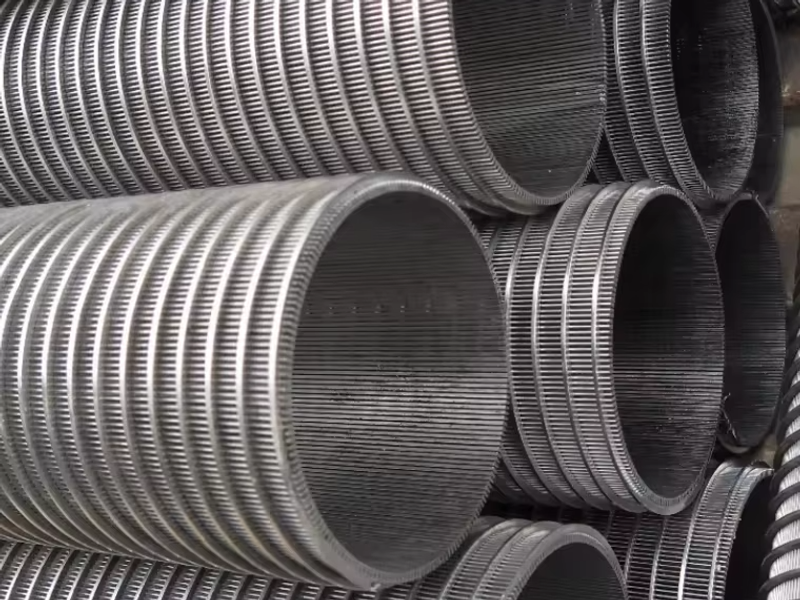
Beyond the visible screens, wedge wire appears inside thickeners as underdrain and distribution components. In circular gravity thickeners, a wedge wire screen pipe or panel array set in the bottom collects clarified supernatant while supporting the sludge blanket. The pipe format is particularly useful because it can be run as a lateral manifold under the tank floor, with the slots oriented to pull clean water downward while keeping sludge and grit out of the collection system. Slot sizes for underdrains are typically 0.5 mm to 1.5 mm, and the high open area of V-profile construction keeps the underdrain from plugging over years of service.
Wedge wire screen pipe is also used for scum removal systems, washwater strainer intakes, and digester recirculation pickups, wherever a process needs a robust, high-open-area strainer element with a precise cut point. Because the pipe is a continuous welded construction rather than a mesh wrap, it can be cut to length, flanged, threaded, or welded into a header as a permanent part of the piping system.
Why V-Profile Resists Blinding Where Mesh and Plate Do Not
Blinding — the progressive accumulation of material in the openings — is the failure mode that forces most screen replacements in wastewater service. The three common screen media behave very differently:
- Woven mesh is made from wire strands interlaced over and under one another. The intersections create recesses and corners where fibers and slimes collect, and the openings are bounded by multiple strands that flex under load. Once material packs into the strand intersections, cleaning rarely restores the original flow area, and the mesh must be replaced.
- Perforated plate has straight-walled, cylindrical or slightly conical holes punched through a solid sheet. A particle close to the hole diameter enters and wedges firmly in the parallel walls, and because the hole is straight, backwash pressure must force the particle back out against the direction it entered. This makes perforated plate prone to permanent plugging in fibrous service.
- Wedge wire presents a slot that is narrowest at the water side and widens toward the discharge side. A particle that enters the narrow mouth is not mechanically gripped; flow and gravity carry it through the widening passage. On the screen face, the flat top of the V-profile leaves no recess for material to lodge, and wipers or spray bars can sweep the face clean in a single pass.
That geometric difference translates directly into operating data. A wedge wire screen holds a stable headloss and flow capacity through a shift of solids loading, whereas a woven mesh or perforated plate screen of the same cut point begins to blind within hours on the same duty. The trade-off is price: wedge wire is more expensive per square meter than mesh or plate. But in applications where blinding means downtime, labor, or lost process capacity, the all-welded V-profile pays for itself quickly.
Wedge Wire vs. Perforated Plate vs. Woven Mesh: Comparison Table
| Property | Wedge Wire (V-Profile) | Perforated Plate | Woven Mesh |
|---|
| Blinding resistance | Excellent — slots widen toward discharge; flat face sheds solids | Poor — straight-walled holes trap particles at size | Poor — strand intersections collect fibers and slimes |
| Open area | 20–60%; slot-width dependent | 10–30%; limited by hole pattern | Up to 40%+; but reduced by blinding in service |
| Structural strength | High — continuous welded bars and rods; self-supporting | High — solid sheet | Low — strands flex and fatigue |
| Slot accuracy | Very high; ±0.05 mm typical; consistent over full panel | Moderate — hole edges deform and wear | Low — opening size shifts with weave tension |
| Cleaning / backwash | Easy — face sweeps clean; backwash clears most lodgings | Difficult — lodged particles must be pushed backward | Difficult — packed intersections resist cleaning |
| Typical lifespan in wastewater | 10+ years with proper material selection | 3–7 years before wear and plugging | Months to a few years depending on duty |
For coarse basket-type duties where extreme flow is more important than a precise cut point, a double-layer perforated mesh wastewater basket is a cost-effective option worth comparing against wedge wire — but for fine screening, dewatering, and MBR protection, the blinding and accuracy advantages of V-profile construction are decisive.
Material Selection and Custom Fabrication
Wastewater is corrosive, abrasive, and biologically active, so material selection is as important as geometry. Type 304 stainless steel is adequate for clean-water and mild wastewater duties at moderate temperatures. For most municipal and industrial wastewater applications, Type 316L stainless steel is the default: its molybdenum content resists chloride pitting and stress corrosion, and the low-carbon grade preserves weld integrity. Where feed is saline, high-chloride, or chemically aggressive, duplex stainless grades offer additional pitting resistance, and where the screen handles abrasion from grit or primary sludge, hardened or coated surfaces extend panel life.
Because nearly every wastewater installation is built to a unique channel or tank, wedge wire components are almost always fabricated to order. Kaifil produces custom wedge wire screen parts as flat panels, curved segments, full cylinders, cones, and pipe, with slot widths from 0.1 mm to 3 mm and support rod spacing sized to the load. Panels can be drilled and tapped for mounting, framed with angle or flat bar, flanged, or assembled into multi-panel arrays that drop into an existing channel. When you send a drawing or a dimensional sketch, the specification should include slot width, open area target, material grade, overall dimensions, and the flow or solids load the screen must handle.
Frequently Asked Questions
What slot size should I use for MBR pre-screening? For membrane bioreactors, use a 1 mm slot as the default and step down to 0.5 mm where the feed contains heavy fine fiber or where the membrane supplier specifies a stricter pre-screen. Slot sizes above 1 mm risk carrying debris to the membrane tank.
Why do wedge wire screens resist blinding better than woven mesh? The V-profile slot is narrowest at the water side and widens toward the discharge side, so particles that enter are carried through rather than wedged. Woven mesh and perforated plate create recesses and straight-walled openings where fibers and slimes pack permanently.
What is the typical open area of a wedge wire screen? Open area is typically 20% to 60%, depending on slot width, profile wire dimensions, and support rod spacing. Higher open area means lower headloss and greater hydraulic capacity for a given screen footprint.
Which stainless steel grade should I specify for wastewater screens? Type 316L stainless steel is the standard for municipal and industrial wastewater because it resists chloride pitting and corrosion. Use 304 for clean water, and duplex grades for saline or chemically aggressive feed.
How long does a stainless steel wedge wire screen last in wastewater service? With correct material selection and routine cleaning, 316L wedge wire screens commonly last 10 years or more in screening and dewatering service, versus months to a few years for woven mesh on the same duty.
Get a Quote for Your Wastewater Screen Specification
Every wastewater plant is different, and screen selection depends on the slot size, open area, flow rate, solids load, and channel geometry that are unique to your design. If you are specifying a fine screen for a headworks upgrade, sizing an MBR pre-screen, or replacing the gravity drainage panels on a belt press, send your wastewater screen specification — slot size, dimensions, material grade, and duty — to the Kaifil engineering team for a quote. We fabricate stainless steel wedge wire screen panels, cylinders, pipe, and custom parts in Shijiazhuang, China, and export worldwide to municipal plants, EPC contractors, and OEMs. Share your drawings or performance requirements and we will respond with a technical recommendation and pricing.