Selection Guide
Conical Strainer vs Basket Strainer: Which to Choose for Piping
Compare conical vs basket strainer on open area, pressure drop, cleaning frequency and cost — send your specs for a free quote today.
Compare conical vs basket strainer on open area, pressure drop, cleaning frequency and cost — send your specs for a free quote today.
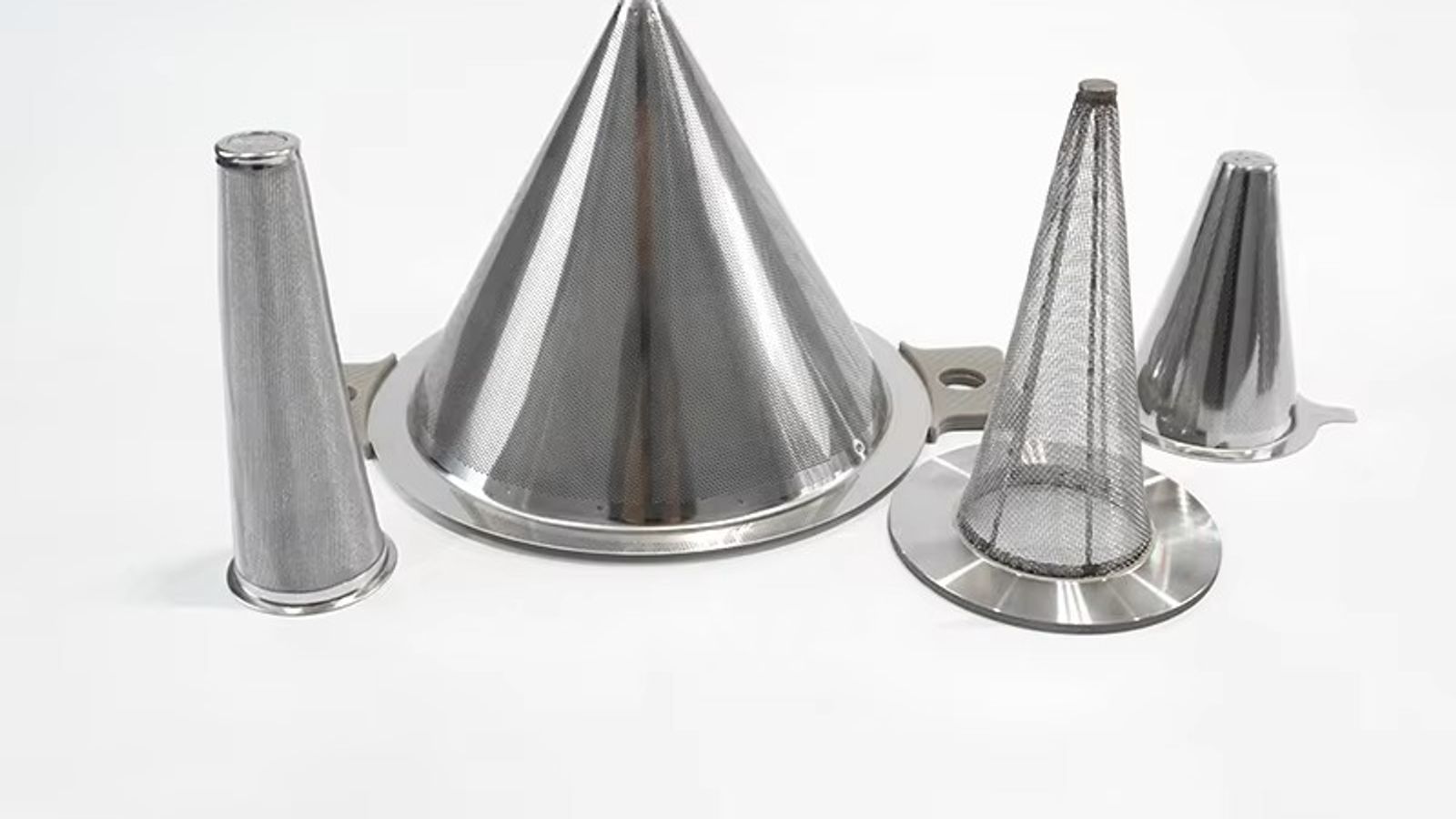
A conical strainer is a temporary, cone-shaped mesh insert clamped between flanges or fitted inside a pipe spool to catch construction debris, weld slag, and scale during the first hours of operation; typical mesh ratings run from 20 to 100 mesh for startup protection and up to 400 mesh for fine commissioning filtration. A basket strainer is a permanent inline filter in which liquid passes through a cylindrical basket of perforated sheet or woven mesh housed in a T- or Y-shaped body, with perforation sizes typically ranging from 1.6 mm to 6 mm (1/16 in to 1/4 in). Both protect pumps, control valves, and flow meters, but for different jobs: a conical strainer is sized so the mesh open area is 1.5 to 3 times the pipe cross-section to keep startup pressure drop low, while a basket strainer offers more dirt-holding volume and a pressure drop you can monitor over the filter's life. This guide compares them on construction, pressure drop, media, cleaning, and cost.
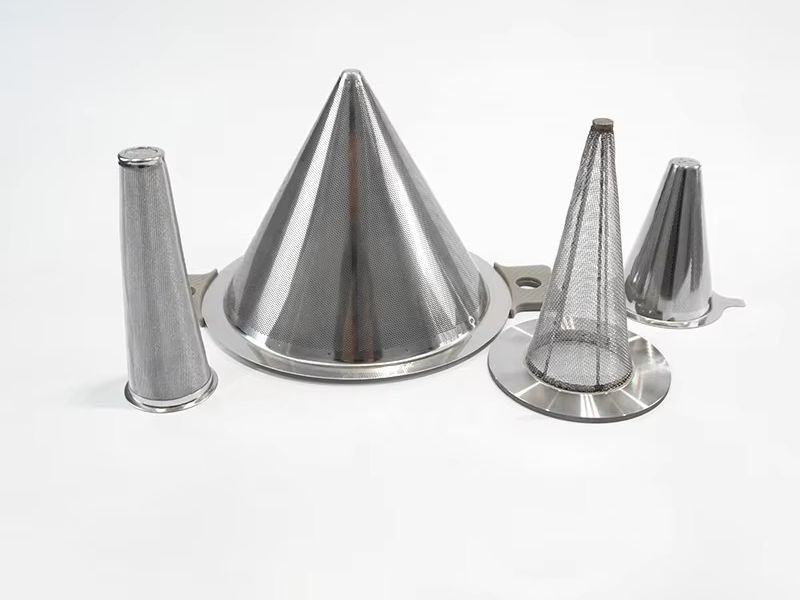
A conical strainer — also called a cone strainer, temporary strainer, or startup strainer — is installed ahead of commissioning. It has no housing of its own: the cone is sandwiched between two flanges or mounted inside a spool, held by the flange bolts, with the apex pointing downstream.
Construction is simple: a formed cone frame in SS304, SS316, or SS316L covered with single- or double-layer woven wire mesh. The most common ratings are 20, 40, 60, and 100 mesh, with fine commissioning screens up to 400 mesh. As a rule, 20 mesh is about 850 microns, 40 mesh about 425 microns, 60 mesh about 250 microns, and 100 mesh about 150 microns — so choose the coarsest screen that still protects the most sensitive downstream component, never finer.
The cone shape is not cosmetic. Spreading flow over a large conical surface keeps velocity through the mesh low; common piping practice calls for a net open area 1.5 to 3 times the pipe cross-section, so the strainer does not starve the pump during the flush. Because there is no access port, the line must be opened to remove the cone — so it suits only startup and commissioning, not permanent duty. For step-by-step sizing, see our temporary conical strainer selection guide.
Typical applications for a conical strainer: protecting pumps, compressors, control valves, and heat exchangers during the first run of new pipework, and trapping weld spatter, scale, hydrotest debris, and pigging debris during the flush.
A basket strainer is a permanent inline filter that protects equipment for the life of the system. The basket sits inside a machined body: T-type for larger line sizes, Y-type for compact or vertical runs. Debris collects inside the basket until cleaning.
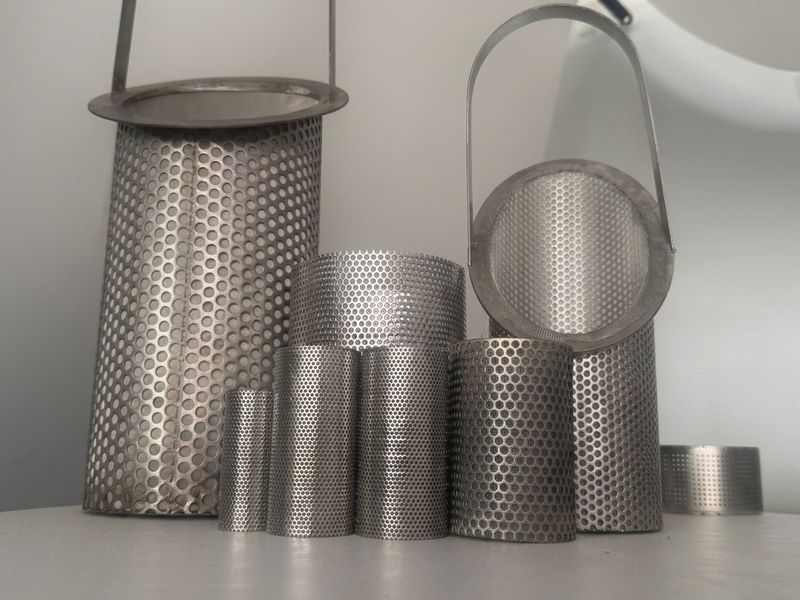
The removable, cylindrical basket is made in SS304 or SS316 — see our stainless steel perforated filter baskets for stock options. Two media styles dominate:
Basket strainers come in simplex and duplex configurations: a simplex unit goes off-line for cleaning; a duplex unit holds two baskets with a switch-over valve, so flow moves to the clean basket without stopping the process. Bodies are flanged to ASME 150# and 300# as standard (higher classes available) in carbon steel, cast iron, or stainless steel. Because the cylindrical basket surface is normally several times the pipe cross-section, a properly sized unit runs long between cleanings.
Typical applications: pump suction protection, flow meter and nozzle protection, and continuous filtration in food and beverage processing, plus SS304 perforated basket units for oil and water systems.
The two devices solve the same problem with different geometries.
A conical strainer is a mesh-only element — no housing, no valve, no cleaning port. Its strengths are simplicity and cost (a frame plus a formed screen); its weakness is that it is only accessible by breaking the flanged joint. Because the cone tapers downstream, flow pushes debris toward the apex rather than blinding the whole face at once.
A basket strainer is an engineered assembly: body, cover, gasket, and removable basket. The cylindrical wall gives a large filtration area in a compact footprint, and the internal volume provides genuine dirt-holding capacity — a cone traps debris on its surface, while a basket holds a bed of debris internally. The basket lifts out through the cover for cleaning, and on a duplex unit the change-over happens without shutting down. The trade-off is price: a basket strainer is a pressure-containing vessel with machined flanges and a cover, and the basket itself is a precision component.
When the duty is permanent protection, the basket's cleanability wins; when it is a one-time startup flush, the cone's simplicity and low cost win.
Pressure drop is the deciding metric in most strainer selections, and the two designs behave differently.
For a conical strainer, pressure drop is set at design time by the open-area ratio. If the mesh open area is 1.5 times the pipe cross-section, velocity through the screen is about two-thirds of line velocity; at 3 times, about one-third. Because drop scales roughly with the square of screen velocity, doubling the open-area ratio roughly quarters the dynamic component of the drop — a cone sized to 2:1 in a 6-inch line at 2 m/s adds only a fraction of a bar when clean. The catch: a cone has no dirt-holding volume, so as debris builds, the effective open area shrinks and the drop climbs fast. That is acceptable in a startup screen removed within hours or days.
For a basket strainer, the basket surface is several times the pipe cross-section, so clean-basket drop is low — often 0.05 to 0.15 bar (1 to 2 psi) for a properly sized unit in liquid service. The internal volume stores debris while the drop climbs gradually, so cleaning can be scheduled. A common trigger is to clean a simplex basket when the differential reaches 0.2 to 0.35 bar (3 to 5 psi), and to switch a duplex unit at the same setpoint. Finer media and higher velocity both push the drop up, so media choice and flow rate must be sized together.
Practical rule for both: keep liquid velocity through the strainer below about 2–3 m/s (7–10 ft/s), and size the open area so the clean differential is a small fraction of the system's available head.
Choosing between woven mesh and perforated sheet is a question of particle size, strength, and cleanability.
Woven mesh (for cones and basket liners) gives micron-level control. In the 20–100 mesh band, one mesh step roughly halves the opening: 20 mesh ≈ 850 microns, 40 mesh ≈ 425 microns, 60 mesh ≈ 250 microns, 100 mesh ≈ 150 microns, 200 mesh ≈ 74 microns. Finer mesh captures more but clogs faster and is harder to clean, so pick the coarsest mesh that still protects the most sensitive component — a valve seat, pump impeller, or spray nozzle. For startup protection, 20 to 100 mesh covers nearly all commissioning debris. Check our mesh count vs micron rating conversion chart before locking a mesh number.
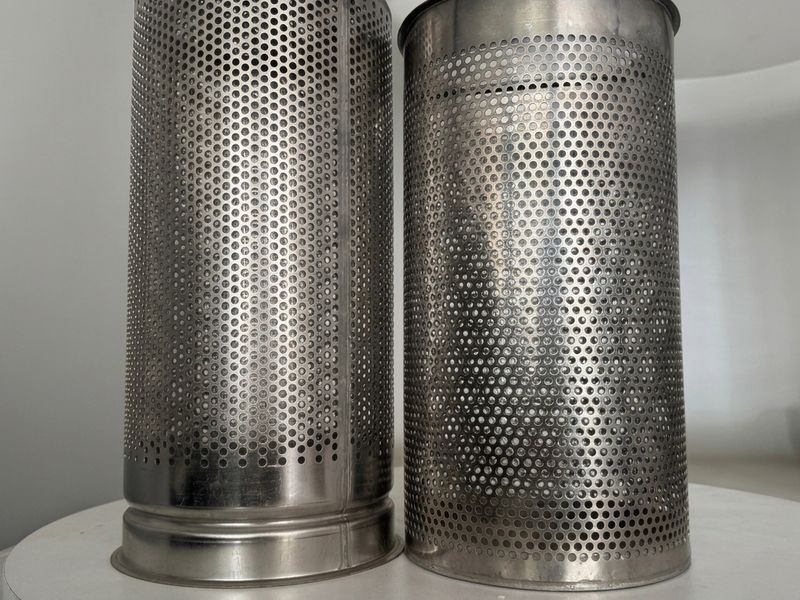
Perforated sheet (for basket walls) works in the 1.6–6 mm range, far coarser than even 20 mesh (≈0.85 mm opening). Perforated baskets suit heavy, high-flow service where the target debris is large — weld scale, sand, rust flakes, loose media — and they hold up to physical abuse and hose down easily, but they cannot catch fine particles. When an application needs both strength and fine filtration, the answer is a lined basket: perforated shell plus mesh liner, such as the double-layer perforated mesh baskets used in wastewater and other high-load services.
General rule: if the smallest particle you must catch is above about 1 mm, perforated sheet alone is usually enough; below that, use mesh — and a lined basket if flow or pressure could buckle an unsupported mesh liner.
Cleaning strategy differs more than any other operating characteristic.
A conical strainer is cleaned by removal. With no access port, maintenance means breaking the flanged joint, lifting the cone out, and either rinsing and reinstalling it or discarding it. For a commissioning flush this is done once or twice, then the cone is removed entirely once the system is verified clean. Plan this in advance: many plants remove the cone after the flush differential shows a plateau, or after a set run time, rather than risking a plugged cone mid-startup.
A basket strainer is cleaned in place. On a simplex unit, isolate the strainer, open the cover, lift out the basket, and rinse or brush it; mesh liners may need replacement once blinded or deformed. On a duplex unit, switch flow to the clean basket and clean the dirty one at leisure, with no shutdown. Use the differential gauge as your trigger: clean at a 3–5 psi (0.2–0.35 bar) rise. If the drop returns to normal after cleaning, the media is healthy; if not, replace the liner or basket.
Unit cost favors the conical strainer; total cost of ownership favors the basket strainer — in the right application.
A conical strainer is among the cheapest filters you can buy: a formed frame, a screen, and no pressure-containing body. But it is a one-off expense plus installation labor, and a heavy debris load can destroy it.
A basket strainer carries a higher first cost because the body is a pressure vessel with flanged ends, a cover, and a machined basket. That cost is amortized over years of continuous duty, and only the internals (basket, liner, gasket) wear. When a process runs continuously, the basket strainer usually wins on cost per year of service.
Material choice matters on both. SS304 suits neutral and mildly corrosive service; SS316 and SS316L add molybdenum for chloride and acid resistance — important in marine, chemical, and many food duties.
| Factor | Conical Strainer | Basket Strainer |
|---|---|---|
| Geometry | Cone-shaped mesh insert; no housing | Perforated/mesh basket in T- or Y-type body |
| Typical media | 20–100 mesh woven wire (up to 400 mesh) | 1.6–6 mm perforations; optional mesh liner |
| Open area vs pipe | 1.5:1 to 3:1 of pipe cross-section | Basket surface ≈ 2–4× pipe cross-section |
| Pressure drop | Low at clean; rises fast as debris builds | Low clean; gradual; monitorable rise |
| Dirt holding | Surface only; low capacity | Internal volume; high capacity |
| Cleaning | Remove from line; rinse or discard | Pull basket; duplex allows online change-over |
| Cost | Low unit cost; one-off | Higher first cost; low lifecycle cost in continuous duty |
| Typical duty | Startup; commissioning; flush protection | Permanent; continuous liquid filtration |
| Best use case | Protecting pumps/valves during first run | Ongoing pump; meter; and nozzle protection |
Use this sequence rather than picking by habit:
A conical strainer is a temporary, mesh-only cone installed between flanges for startup and commissioning protection; it has no housing and is removed once the system is clean. A basket strainer is a permanent device with a body and a removable perforated or mesh-lined basket for continuous liquid filtration.
Use a conical strainer for first-run protection of new pipework, weld debris, and hydrotest or pigging residue, then remove it once the system is verified clean. Use a basket strainer whenever you need ongoing protection without frequent flange breaks.
Match the media to the smallest particle the downstream equipment tolerates. Use perforated sheet (1.6–6 mm) for coarse debris and high flows, woven mesh (20–400 mesh, ≈850 µm down to ≈38 µm) for finer capture, and a lined basket — perforated shell plus mesh liner — when you need both strength and fine filtration.
Clean when differential pressure rises roughly 3–5 psi (0.2–0.35 bar) above the clean reading, or per your maintenance schedule. If the drop returns to normal after cleaning, the basket is healthy; if it stays high, replace the liner or basket.
Yes, but it is usually not economical. A basket strainer provides permanent, cleanable protection and is the better choice when debris recurs. For a one-time startup flush, a conical strainer is cheaper and simpler.
Send your line sizes, flow rate, operating pressure, and target particle size — or simply a copy of your P&ID or strainer drawing — and KAIFIL's engineers will confirm whether a conical strainer or a basket strainer fits your duty and provide a drawing-matched quotation. Sampling lead time is typically 7–10 days, and there is no MOQ pressure on a first inquiry, so you can validate the design before you commit.
Temporary cone strainers and startup screens made to pipeline size, flange fit and debris load.
Made-to-drawing SS304, SS316 and SS316L perforated baskets for liquid straining, equipment protection and removable process screens.
SS304 perforated pre-strainer basket for removing solid debris upstream of oil-water separation equipment.
Send drawings, dimensions, material, environment or operating conditions, and we will help confirm the right specification.
Uploaded reference files are included with the inquiry. For larger CAD packages, reply to the confirmation email or send them here:
Our team typically replies within 24 business hours.