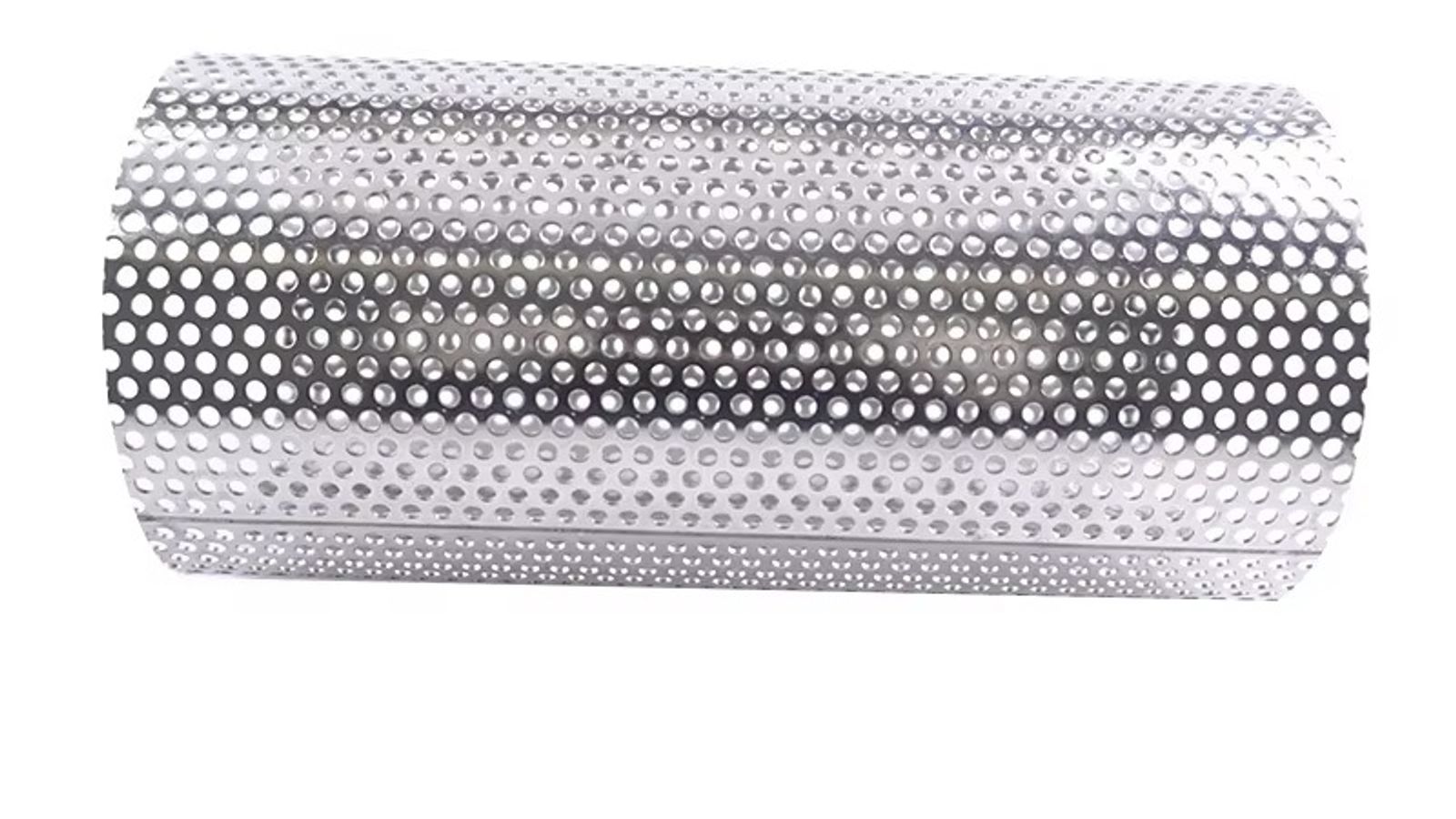
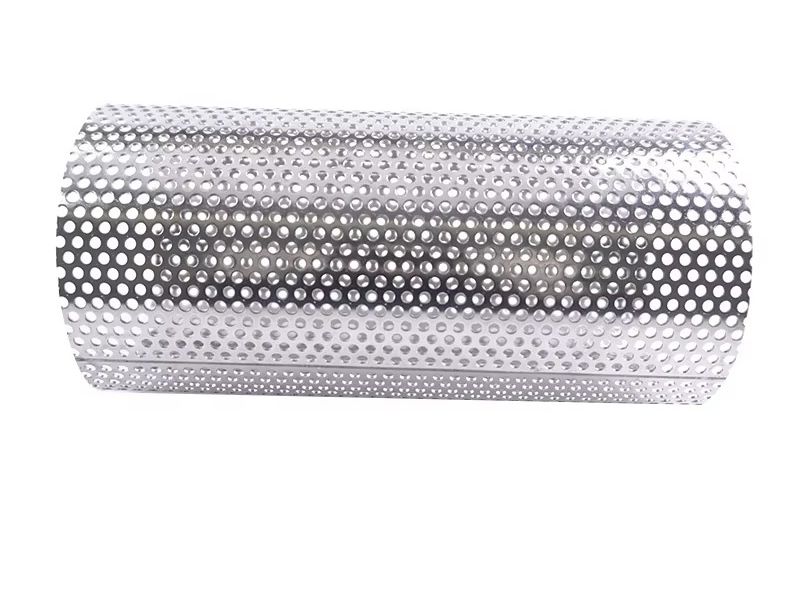
A stainless steel filter support tube is a perforated or slotted rigid cylinder that fits inside a filter bag, pleated cartridge, strainer basket, or filter candle to hold the filter medium open, keep pleats and seams in place, and prevent the media from collapsing under differential pressure. Most support tubes are rolled from 304 or 316L sheet with round holes from 1.5 mm to 6 mm in diameter, staggered to achieve open areas in the 30–50% range, and formed into tubes with outside diameters (OD) from roughly 19 mm to 219 mm and wall thicknesses from 1.0 mm to 3.0 mm — up to 5 mm for high-pressure duty. Because the support tube dictates pressure drop, collapse resistance, and service life of the entire element, pairing it correctly with your bag or cartridge is one of the highest-leverage decisions in filter system design. This guide walks through when a support tube is required, how to size OD, ID, and length, how to choose hole patterns and materials, and how to order custom stainless steel perforated filter tubes that match your drawing.
When Is a Stainless Steel Filter Support Tube Required?
Not every filter needs an internal support tube, but most industrial bag and cartridge systems perform poorly without one. The support tube is the load-bearing skeleton that the filter medium wraps around. Its job is to resist collapse from operating pressure, keep the medium's full surface area available for filtration, and prevent the media from being forced into the outlet flow path.
You will typically need a support tube in four configurations:
Bag filter retainers in pressure vessels. A filter bag is a soft fabric or felt sleeve. Under flow, differential pressure pushes the bag inward. Without a rigid perforated core behind it, the bag collapses, pleats flatten, and the effective filtering area drops sharply. The perforated retainer tube — often called a filter bag support core — holds the bag open for its full length and distributes flow evenly across the media.
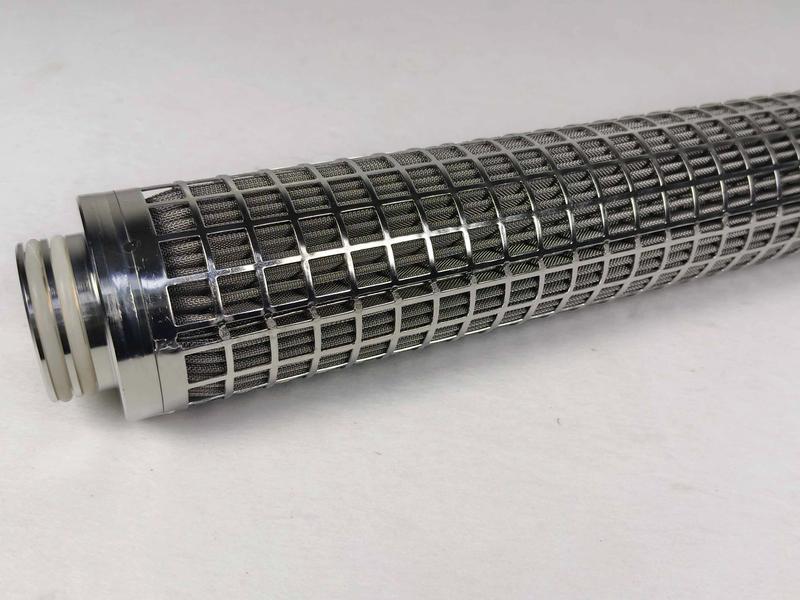
Pleated cartridge cores. Pleated filter cartridges are built around a central perforated core. The core supports the pleat pack, prevents the media from touching adjacent pleats, transfers end-cap loads, and provides the clean-side flow path. On 2.5-inch and 4.5-inch pleated filter cartridges, the core OD is a fixed design parameter: too large and pleat depth shrinks; too small and flow is choked.
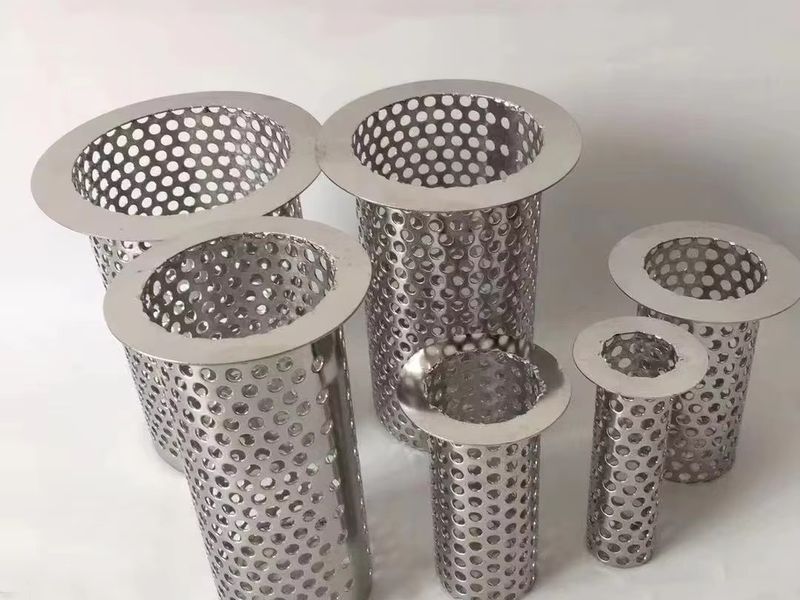
Strainer basket liners. In suction strainers, Y-strainers, and basket-type line strainers, the outer basket is often coarse perforated plate lined with a fine wire mesh. A perforated support tube acts as the liner's backing so the fine mesh does not balloon or tear when a surge of differential pressure hits. For heavy-duty applications, check the range of stainless steel perforated filter baskets available off the shelf.
Filter candles. Candle filters used in chemical and water treatment wrap a perforated core with cloth or sintered mesh. The core must keep its roundness under the full vessel pressure because a deformed candle leads to media bypass and poor cake discharge.
The common thread in all four cases: the support tube exists so the medium never carries a structural load it was not designed for. If your element shows media collapse, crushed pleats, or repeated blinding at the support points, an undersized or under-specified support tube is usually the first place to look.
How to Size a Filter Bag Support Core and Cartridge Core
Sizing a support tube comes down to three numbers: outside diameter, wall thickness, and length. Inside diameter follows from OD minus two wall thicknesses, and it matters mainly for flow area and for sliding over a center rod or mandrel.
Outside diameter. The OD is dictated by the bag or cartridge it supports. For a pleated cartridge, the core OD is effectively fixed by the cartridge OD and required pleat depth. As a rule of thumb:
| Element | Element OD | Typical support tube OD |
|---|
| 2.5-inch pleated cartridge | 69 mm (2.7") | 25 mm (1") |
| 4.5-inch pleated cartridge | 115 mm (4.5") | 69 mm (2.7") |
| Standard 7" filter bag (#1/#2) | 178 mm (7") | 102–152 mm (4"–6") |
For a filter bag support core, the tube OD should be 10–25 mm smaller than the bag's ID so the bag slides over it without stretching or bunching. If the bag is sized against the tube rather than the vessel, the tube OD becomes the controlling dimension, and the bag's gasket and handle must still reach the vessel flange.
Wall thickness and ID. Wall thickness is a function of collapse pressure. For a given OD, thicker walls and smaller holes resist more pressure. Most filter service runs 1.0–2.0 mm; high-pressure vessels and large-diameter cores go to 3.0–5.0 mm. The ID must clear the flow path: for a 25 mm core on a pleated cartridge, the ID of roughly 20–21 mm leaves room for the center rod and still gives adequate clean-side flow.
Length. Length must match the element's overall length, not just the media length. Standard pleated cartridges come in 10", 20", 30", and 40" (254, 508, 762, and 1016 mm); standard bags are #1 at roughly 420 mm and #2 at roughly 810 mm overall. Order the tube length to the element length plus any required sealing allowance — commonly +0 / −3 mm so the tube seats without standing proud of the end caps.
Tolerances. Practical machining tolerances for support tubes are: OD ±0.5 mm, length +0/−3 mm, and roundness within 1% of OD. If your housing seals against the tube rather than the media, tell your supplier; that changes the tolerance and the surface finish requirements.
When you are replacing an existing element, the fastest way to size correctly is to measure the old core's OD, ID, length, hole diameter, and hole pattern — then send those numbers, or better, the original drawing.
Hole Pattern and Open Area: What to Specify
The perforation pattern controls two competing properties: open area (flow capacity) and mechanical strength. More holes and larger holes mean less pressure drop, but also less metal left to carry the collapse load.
Hole diameter. For support tubes, 1.5–6 mm round holes cover almost all bag and cartridge duty. Smaller holes (1.5–2.5 mm) are used where the media is fragile or where a large hole could allow the media to extrude into the opening. Larger holes (4–6 mm) are common in basket liners and coarse strainers where the mesh does the filtering and the tube only provides backing.
Open area. Typical support tubes are specified at 30–50% open area. The practical rule at selection level: the support tube's open area should be at least two to three times the filter media's own open area so the tube is never the flow bottleneck. A media-rated flow is only achievable if the core can pass it. Where strength is critical — high-pressure vessels, large diameters, thin media with high collapse risk — designers drop open area to the 20–30% band. There is a full treatment of filter tube support core open-area design in our engineering blog if you need the calculation methods.
Pattern. A staggered (triangular-pitch) pattern gives higher open area for a given hole size and distributes stress more evenly than an inline (rectangular-pitch) pattern, so it is the default for support tubes. Inline patterns are used where debris must pass straight through or where the media seam must align with a hole-free land. Specify the hole diameter, center-to-center spacing (pitch), and pattern type; the supplier will then lay out the pattern so it fits the circumference evenly.
Stainless Steel Filter Support Tube Material Selection: 304 vs 316L vs Duplex
The three materials that cover the great majority of support tube service are 304, 316L, and duplex 2205. The choice is almost always a corrosion and cost trade-off, since the mechanical job — resisting collapse — is handled by geometry rather than alloy strength in most cases.
| Property | 304 | 316L | Duplex (2205) |
|---|
| Corrosion resistance | Good general resistance; vulnerable to pitting and chloride stress-corrosion cracking | Superior pitting/chloride resistance (PREN ≈ 24 vs ≈ 19 for 304) | Excellent chloride and SCC resistance (PREN ≈ 35); withstands sour and seawater service |
| Cost | Baseline | Roughly 15–25% higher than 304 | Roughly 30–60% higher than 316L |
| Availability | Excellent; standard stock in all sizes | Excellent; standard for pharma and marine duty | Good; but longer lead times for small quantities |
| Typical duty | Water; solvents; mild chemical; general industrial | Chemical; food; pharma; seawater; chloride-bearing streams | High-pressure vessels; offshore; sour gas; hot chloride service |
316L is the default for most process filtration because the extra pitting resistance is cheap insurance against chloride pitting at weld seams and perforation edges, which are the two most common failure sites on a support tube. 304 remains a sound economic choice for clean water and non-chloride service. Duplex earns its premium where yield strength (roughly twice that of 304/316L) lets you use a thinner wall at high collapse pressure, or where chlorides and elevated temperature rule out austenitics. For hygienic and pharmaceutical duty, also confirm that the material certificate, surface finish, and weld records meet your validation requirements — this is standard practice in pharmaceutical and chemical processes.
Temperature and pressure are the other two selection anchors. 304 and 316L support tubes are suitable for continuous service up to roughly 400 °C (750 °F) in oxidizing media, with the pressure rating derated as temperature rises. Collapse ratings depend on wall thickness, OD, and hole size; typical bag and cartridge cores are rated to 10 bar (145 psi) differential, and heavier-wall designs extend well beyond that. If your process operates above 400 °C or at high differential pressure, duplex or a heavier austenitic wall — or both — should be in the conversation. Many high-pressure applications originate in oil and gas and petrochemical plants, where collapse ratings are verified on every core.
Welded vs Seamless Support Tubes
Support tubes are made two ways, and the difference matters more than most buyers expect.
Rolled-and-welded (welded) tubes. A sheet of perforated plate is rolled to the target OD and the longitudinal seam is TIG welded, usually with a flanged or flush joint. This is the standard construction for filter cores because it is economical, available in virtually any diameter, and the weld can be located in a solid land between holes. A good weld leaves a smooth, fully penetrated joint that does not trap fibers or create a crevice. For most bag, cartridge, and basket service, welded is the correct choice.
Seamless (drawn) tubes. Seamless stainless tubing has no longitudinal weld, which eliminates weld-seam corrosion, weld wicking, and the risk of a defective seam. It also gives tighter tolerances and a smoother bore. The cost is meaningfully higher, and seamless tube with custom perforations requires drilling or laser perforation of an already-expensive blank. Choose seamless only for high-integrity hygienic duty, high-pressure cores where the weld is a design concern, or where a mandrel must slide precisely inside the bore.
For completeness, the same design logic applies to the surrounding structure: when your element includes a mesh sleeve over a perforated tube, the assembly is a welded wire mesh filter assembly in its own right, and the tube/mesh interface should be designed together, not separately.
Connection Options: Flange, Threaded, and Tri-Clamp
A support tube rarely floats free; it has to anchor into a housing, a header, or a manifold. The connection defines how the tube is retained and sealed, so choose it with the housing in mind.
Flanged connections. A tube welded to a flange bolts into the housing or between vessel flanges. This is the standard for bag filter retainers and for cartridge housings that need positive location. Specify the flange standard (ANSI, DIN/PN, JIS) and pressure class; the flange and tube should be supplied as one weldment to keep concentricity.
Threaded connections. Male or female NPT or BSP threads suit small cores, drop-in replacements, and tubes that screw into a housing baseplate. Threads are machined on the tube ends or on welded nipples. Provide the thread size and whether the thread must be on the OD or ID.
Tri-clamp (sanitary) connections. Tri-clamp ferrules welded to the tube ends allow quick disassembly and clean-in-place, which is why they dominate food, beverage, and pharmaceutical housings. A tri-clamp support tube mates with standard sanitary fittings and clamps.
Beyond these three, common options include center rods for hanging cartridges, welded tabs or lugs for bolt-through retention, and bayonet or twist-lock seats for quick-change housings. Whatever the connection, the seat that takes the pressure load should be a solid, unperforated band — never a row of holes — so the seal face stays clean and leak-free.
How to Order Custom Stainless Steel Support Tubes
Most support tubes are custom because bags, cartridges, and housings come in so many dimensions. Ordering is straightforward when you provide complete information, and it is fastest when you order from a drawing.
What to send. At minimum, a supplier needs: outside diameter, inside diameter (or wall thickness), overall length, hole diameter, hole pitch and pattern (staggered or inline), material grade (304, 316L, duplex, or other), connection type and size, and quantity. If you have a drawing — even a sketch with the dimensions above — send it; dimensions on a drawing remove almost all ambiguity about tolerance and intent. A practical walkthrough of ordering custom stainless steel screen filter parts from a drawing is available if you have never ordered this way.
Tolerances and finish. State the tolerances that matter for your housing: OD fit, length seating allowance, roundness, and any surface finish requirement on seal faces (typically a brushed or ground finish). If the tube will see hygienic service, specify the finish and whether the longitudinal weld must be ground flush on the OD and ID.
Other details that avoid rework. Tell the supplier whether the tube slides over a center rod (clearance needed on the ID), whether end caps are welded by the tube maker or by your own assembly house, whether the holes must avoid a specific land area (for O-rings or welds), and the operating temperature and differential pressure so wall thickness is verified against collapse. Volume and lead time also matter: small prototypes are often cut from perforated sheet stock in days, while duplex and large-diameter runs can take several weeks.
Frequently Asked Questions
What is a stainless steel filter support tube used for? It is a perforated rigid cylinder that fits inside a filter bag, pleated cartridge, strainer basket, or filter candle to keep the filter medium open and prevent it from collapsing under differential pressure. It also distributes flow evenly and provides the clean-side flow path.
How do I choose between 304 and 316L for my support tube? Use 304 for clean water and non-chloride service where cost matters. Use 316L when chlorides, chemicals, food, or pharmaceutical duty are involved — its higher pitting resistance protects the perforation edges and weld seam, which are the most common corrosion starting points.
What open area should my filter bag support core have? Aim for 30–50% open area as a starting point, and make sure the support tube's open area is at least two to three times the filter media's open area so the core does not restrict flow. Drop to 20–30% only where collapse strength forces the trade-off.
Can support tubes be made for non-standard bag or cartridge sizes? Yes. Because support tubes are fabricated from perforated sheet and tube stock, OD, ID, length, hole size, and connection type can all be matched to non-standard elements and housings. Supply the element dimensions or a drawing, and the tube is made to fit.
What is the difference between welded and seamless support tubes? Welded tubes are rolled from perforated sheet with a longitudinal TIG seam — economical, available in any diameter, and correct for most filter service. Seamless tubes have no weld and give tighter tolerances and better corrosion integrity, at a higher cost, which suits hygienic and high-pressure duty.
Get a Quote for Your Support Tube
Whether you are replacing a collapsed core, prototyping a new pleated cartridge, or standardizing on a support tube for a battery of bag filters, the fastest path to a correctly paired part is to send your drawing — or your bag or cartridge dimensions — to our engineers. Include the OD, ID, length, hole size and pattern, material, and connection, and we will confirm collapse rating, open area, and tolerance against your operating conditions, then quote machined or fabricated stainless steel filter support tubes to your exact spec. Send your drawing today and get a same-week quotation for your project.