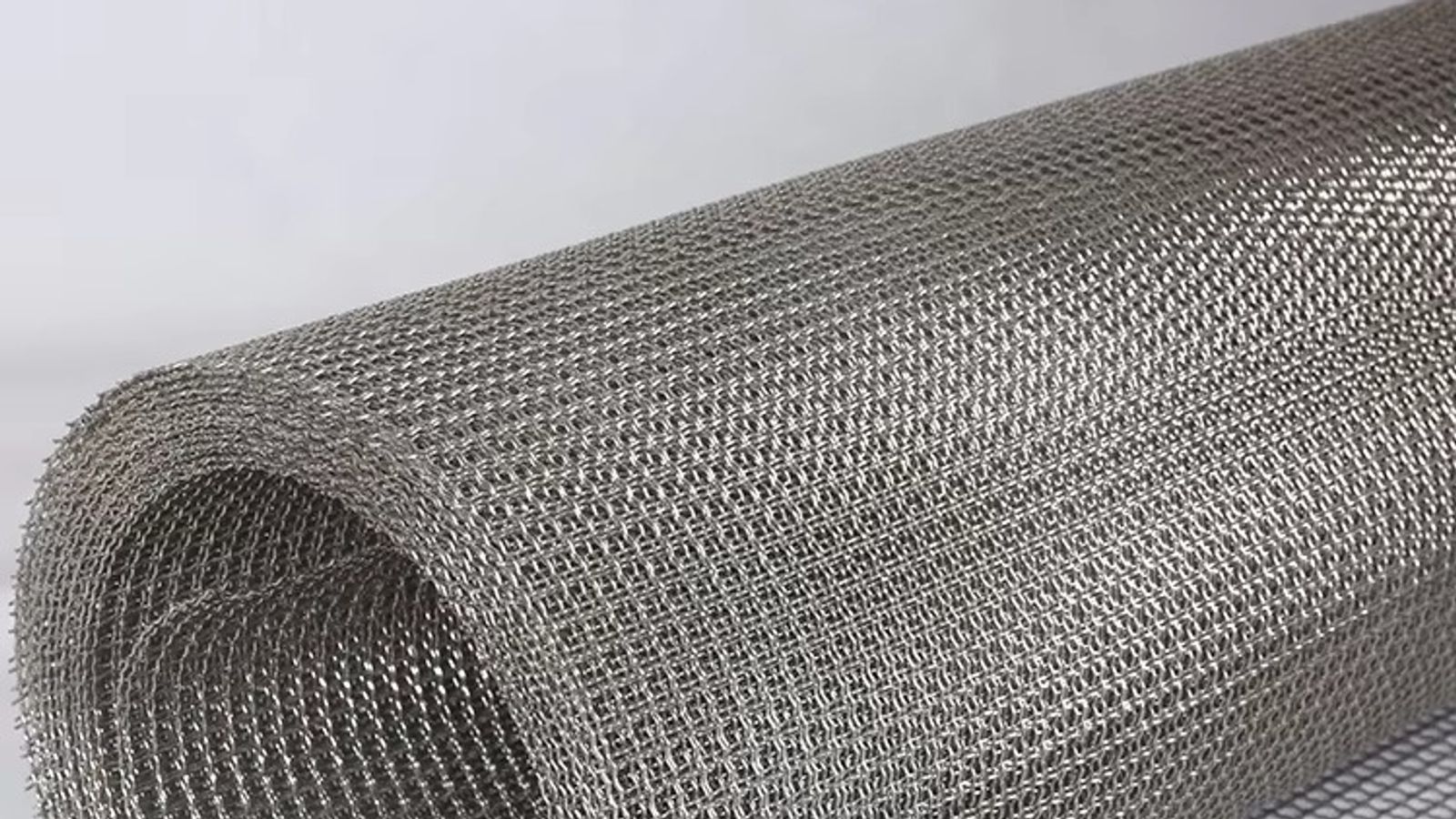
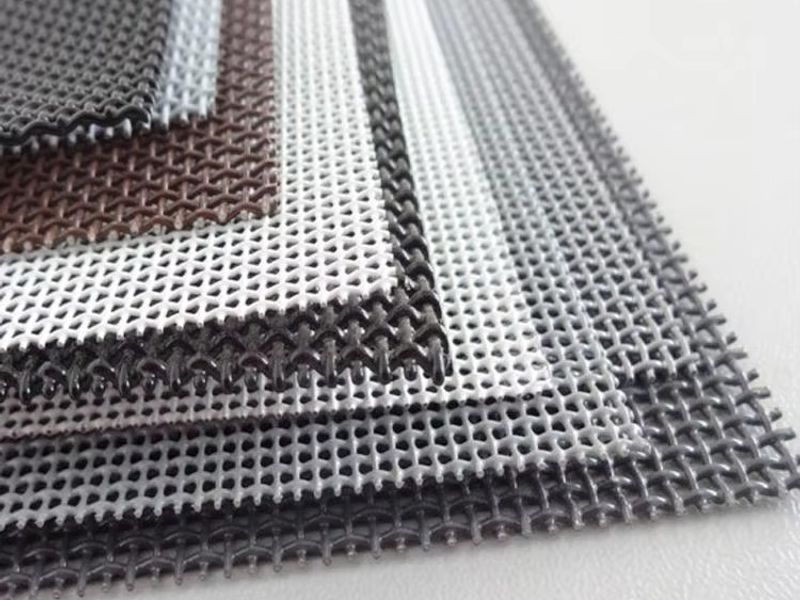
Every engineer who specifies woven wire mesh encounters the mesh-count-to-micron question at some point — usually when a supplier asks for a micron rating and the drawing says 100 mesh, or vice versa. The two measurements describe related but different properties: mesh count is the number of wires per linear inch, while micron rating is the size of particle the mesh will retain. Converting between them requires knowing the wire diameter — and getting the conversion wrong leads to orders arriving with the wrong filtration performance.
This guide explains the relationship, provides a conversion table for common stainless steel woven wire mesh specifications, and tells you exactly what information belongs on an RFQ to avoid ambiguity.
The Relationship: Mesh, Wire Diameter, and Aperture
For square-mesh weaves, the aperture (opening size) is determined by a simple geometric relationship:
Aperture (µm) = (25,400 / Mesh Count) − Wire Diameter (µm)
Where 25,400 is the number of microns in one inch. This formula makes the critical point immediately visible: aperture size depends on both mesh count and wire diameter. Two meshes with the same mesh count but different wire diameters will have different apertures — and therefore different filtration performance.
Example: A 100-mesh screen woven from 0.10 mm (100 µm) wire: Aperture = (25,400 / 100) − 100 = 154 µm. The same 100-mesh screen woven from 0.065 mm (65 µm) wire: Aperture = 254 − 65 = 189 µm. Two "100-mesh" screens — one stops particles larger than 154 µm, the other stops particles larger than 189 µm. A 35 µm difference in wire diameter produced a 35 µm difference in filtration cutoff. If your process requires 150 µm absolute retention, the heavier-wire version works; the lighter-wire version doesn't.
Mesh-to-Micron Conversion Table — Plain Weave, SS304/316
| Mesh Count | Wire Diameter (mm) | Wire Diameter (µm) | Aperture (µm) | Open Area (%) | Typical Application |
|---|
| 4 mesh | 1.60 | 1600 | 4750 | 56% | Heavy scalping / architectural |
| 10 mesh | 0.70 | 700 | 1840 | 52% | Coarse strainer baskets |
| 20 mesh | 0.40 | 400 | 870 | 47% | General industrial screening |
| 30 mesh | 0.28 | 280 | 567 | 45% | Standard filter support layer |
| 40 mesh | 0.22 | 220 | 415 | 43% | Extruder screens — coarse |
| 60 mesh | 0.16 | 160 | 263 | 39% | Extruder screens — medium |
| 80 mesh | 0.125 | 125 | 193 | 37% | Extruder screens — fine / fuel filtration |
| 100 mesh | 0.10 | 100 | 154 | 37% | Hydraulic strainers / dust filtration |
| 120 mesh | 0.08 | 80 | 132 | 39% | Fine dust / powder screening |
| 150 mesh | 0.065 | 65 | 104 | 38% | Paint / coating filtration |
| 200 mesh | 0.053 | 53 | 74 | 34% | Pharmaceutical sieving |
| 250 mesh | 0.040 | 40 | 62 | 37% | Analytical test sieves |
| 325 mesh | 0.036 | 36 | 42 | 29% | Precision sieving — finest square mesh |
| 400 mesh | 0.030 | 30 | 34 | 28% | Finest standard square-mesh weave |
Values are for plain-weave stainless steel with typical commercial wire diameters. Actual specifications vary by manufacturer. Dutch weaves and twill weaves follow different relationships — see the Dutch weave specifications below. Open area percentage is calculated based on the geometric relationship for square-mesh weave and may vary ±3% depending on weave tension and crimp profile.
Dutch Weave: A Different System Entirely
The mesh-count-to-micron formula applies only to square-mesh weaves with uniform wire diameters. Dutch weaves, with their asymmetric warp and weft wire diameters, require a different specification framework — and the micron rating cannot be calculated from mesh count alone. Dutch weaves are specified by their warp × weft mesh count (e.g., 30 × 150), and the effective filtration rating is determined by porometry testing, not geometric calculation. The following ranges are typical for common commercial specifications.
| Dutch Weave Specification | Type | Warp × Weft Count | Nominal Filtration (µm) | Common Application |
|---|
| 12 × 64 | Plain Dutch | 12 × 64 | 200–250 | Coarse hydraulic suction strainers |
| 24 × 110 | Plain Dutch | 24 × 110 | 100–140 | Hydraulic return-line filters |
| 30 × 150 | Plain Dutch | 30 × 150 | 60–90 | Standard hydraulic / lube oil filtration |
| 50 × 250 | Plain Dutch | 50 × 250 | 30–50 | Fine hydraulic / fuel filtration |
| 80 × 400 | Plain Dutch | 80 × 400 | 20–35 | Polymer melt — medium |
| 80 × 700 | Twill Dutch | 80 × 700 | 10–25 | Polymer melt — fine / gas filtration |
| 165 × 800 | Twill Dutch | 165 × 800 | 10–18 | High-pressure gas / steam filtration |
| 165 × 1400 | Twill Dutch | 165 × 1400 | 5–10 | Pharmaceutical sterile filtration |
| 200 × 1400 | Twill Dutch | 200 × 1400 | 5–8 | Aerospace hydraulic — critical |
| 325 × 2300 | Twill Dutch | 325 × 2300 | 5–8 (absolute) | Finest woven wire mesh — light-proof |
Filtration ratings are nominal unless stated as absolute. Actual retention depends on particle shape, fluid viscosity, and operating conditions. Always request a porometry test certificate for critical filtration applications.
Absolute vs. Nominal Ratings — Why the Distinction Matters
A woven wire mesh has no single micron rating — it has a pore-size distribution. The aperture calculated from mesh count and wire diameter is the nominal opening — the expected clear space between wires. In practice, the weaving process produces a distribution of apertures around this nominal value, with variation driven by wire tolerance, weaving tension, and crimp profile.
Nominal rating (60–90% efficiency): the mesh will retain 60–90% of particles at the stated size. This is the typical rating for general industrial screening where occasional oversized particles are not a process risk.
Absolute rating (98–100% efficiency): the mesh will retain ≥ 98% of particles at the stated size, as measured by bubble-point testing (ASTM E1282, ISO 4003) or multi-pass filtration testing (ISO 16889). Absolute ratings are essential for hydraulic, fuel, pharmaceutical, and aerospace filtration, where a single oversized particle causes component damage. Only Dutch weaves can achieve absolute ratings below approximately 60 µm.
RFQ rule: never specify only a micron rating without stating whether it is nominal or absolute. An 80-mesh Dutch weave with a 60 µm absolute rating costs a different amount than an 80-mesh plain weave with a 60 µm nominal rating — and a supplier who assumes the wrong one will ship the wrong product.
What to Include on an RFQ
To eliminate ambiguity and ensure you receive the correct mesh, include the following on every woven wire mesh purchase specification:
- Mesh count (wires per inch) — or warp × weft count for Dutch weaves.
- Wire diameter — in mm or µm. Without this, aperture cannot be verified.
- Weave type — plain, twill, plain Dutch, or twill Dutch.
- Aperture or filtration rating — in µm, with nominal vs. absolute stated explicitly.
- Material grade — SS304, SS316, SS316L, or specialty alloy.
- Dimensions — roll width × length, or cut-piece dimensions, or finished-element dimensions.
- Edge condition — raw shear-cut, laser-cut, folded, or framed.
Kaifil supplies woven wire mesh in all four weave types, from 2 mesh to 400 mesh in plain weave, and from 12×64 to 325×2300 in Dutch weave specifications. Standard material grades include SS304, SS316, and SS316L, with specialty alloys available on request. If you have a target micron rating but are unsure of the optimal mesh specification, send us your filtration requirements — our engineering team will recommend the correct mesh count, wire diameter, and weave type for your application.