Technical
Abrasion-Resistant Wedge Wire Filter Tubes for Iron Ore Slurry
How abrasion-resistant wedge wire screen pipe survives iron ore slurry: V-profile self-cleaning, open area optimization, slot sizing 0.25–2 mm. Get a quote.
How abrasion-resistant wedge wire screen pipe survives iron ore slurry: V-profile self-cleaning, open area optimization, slot sizing 0.25–2 mm. Get a quote.
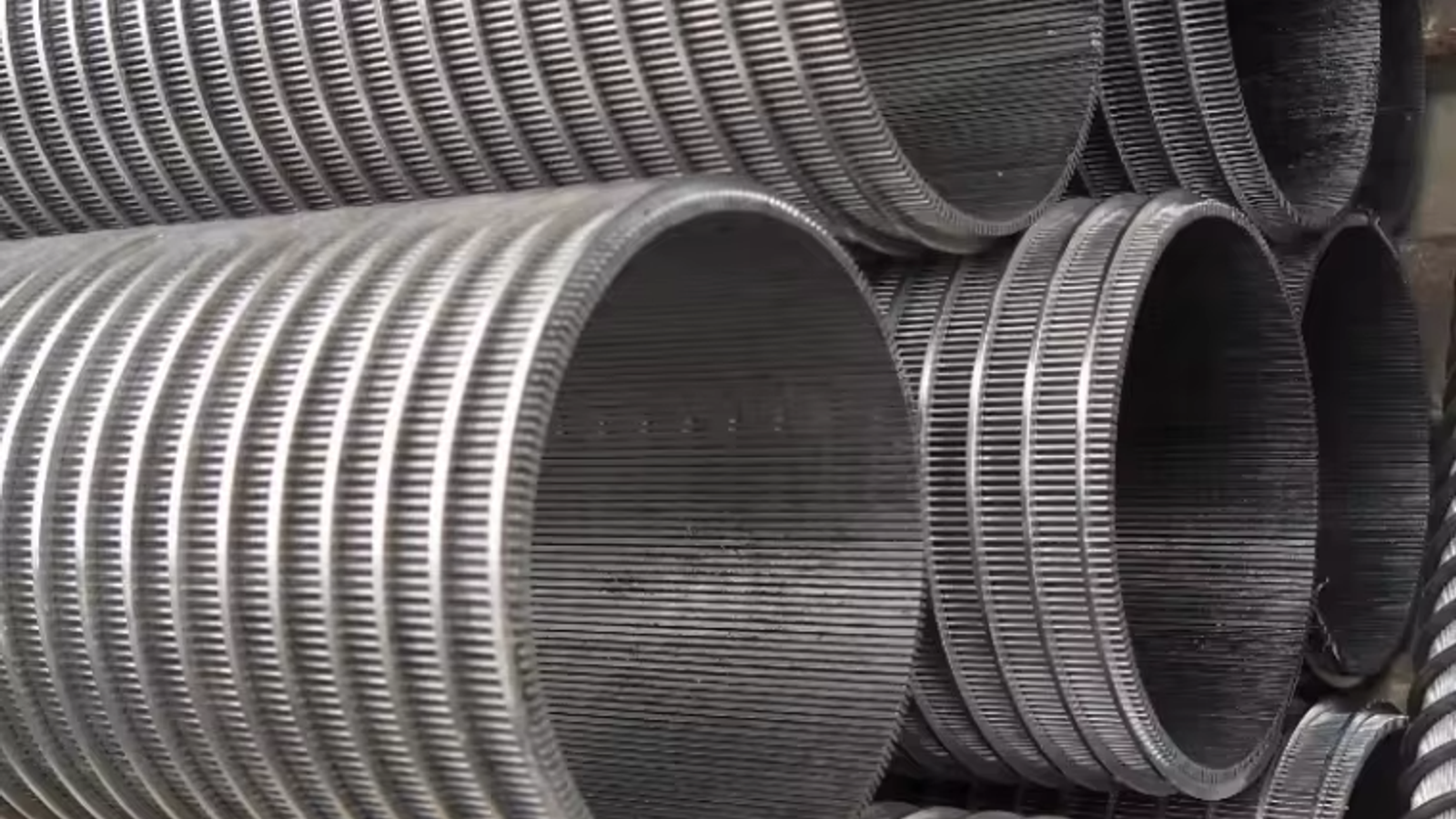
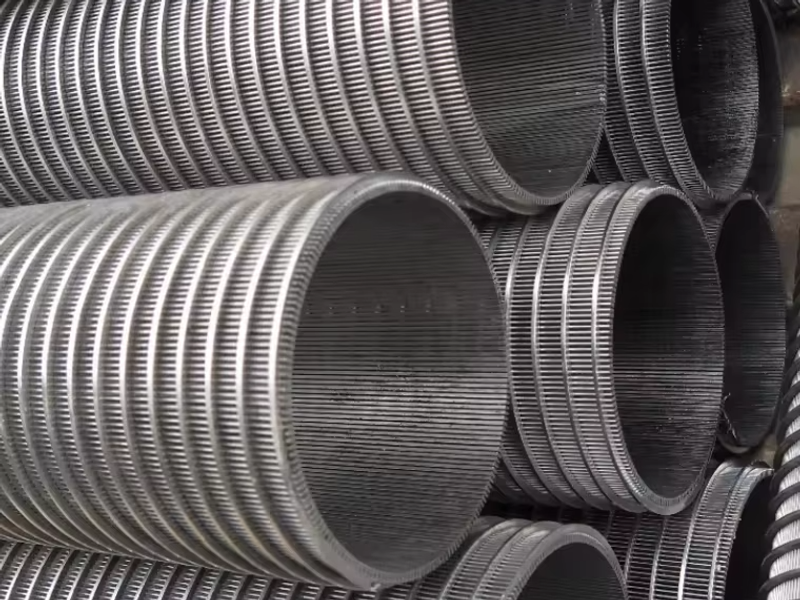
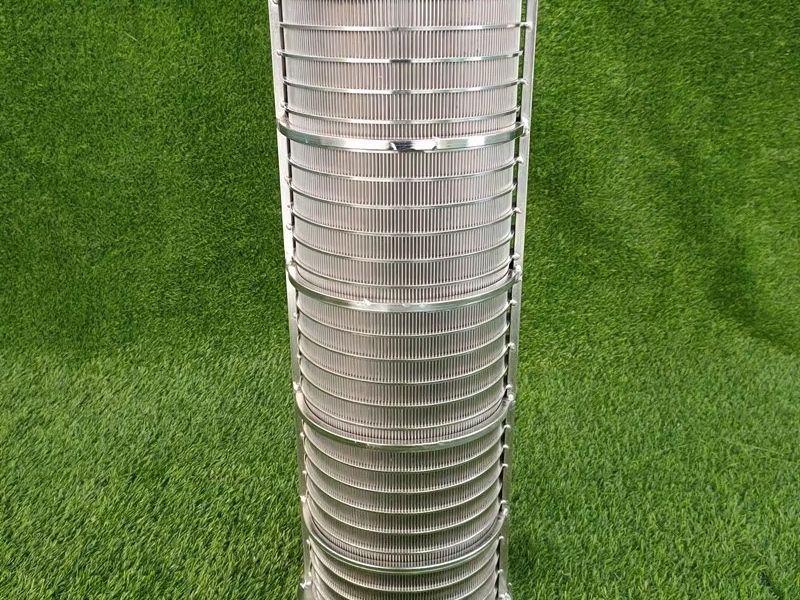
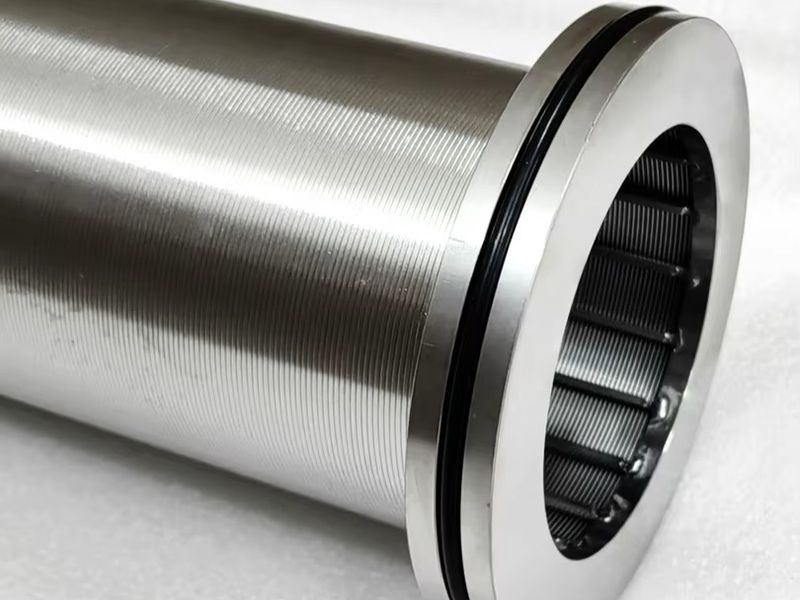
Wedge wire screen pipe is a type of continuous-slot filter tube made by wrapping a V-shaped (wedge or Johnson) profile wire around a set of longitudinal support rods and resistance-welding each wire at every intersection. The result is a rigid, self-supporting cylinder whose slot openings run parallel to the pipe axis and widen inward — the narrowest point of each slot sits on the outside flow surface. In iron ore and mineral beneficiation service, wedge wire filter tubes are used for cyclone underflow dewatering, spiral concentrator product thickening, tailings filtration, media recovery, and pressure/vacuum filter internals, with typical slot widths of 0.25–2.0 mm and open areas of 5–15% depending on wire profile and pitch. This article explains why abrasive ore slurry destroys woven mesh and perforated tube, how the V-profile geometry resists erosion and plugging, how to size slots against your ore particle size distribution, and how to select stainless steel grades for acidic process water — with a practical comparison of the three screen formats and a slot-selection workflow for process engineers.
Iron ore beneficiation slurry is one of the most punishing filtration environments in the mineral processing industry. The medium is a dense suspension of hematite, magnetite, silica, and clay gangue, with solids loadings frequently exceeding 40–60% by weight and particle sizes spanning everything from 100-micron slimes to 10 mm crushed feed. Pumped at 2–5 m/s through hydrocyclone and sump circuits, the slurry carries fine, sharp-edged particles that behave like an abrasive lapping compound.
Woven wire mesh fails in this environment for two reasons. First, erosion: each strand of a woven screen is round in cross-section, so it presents a small, high-curvature target to the impinging particles, and the weave openings expose the wire to direct blast on both sides. Abrasive particles wear through the thin strand crowns quickly, and once one strand fails the whole cloth unravels within days. Second, plugging: round wires create converging-diverging apertures in three dimensions, so near-size particles and fibrous slimes wedge between intersecting strands and blind the screen surface. Field experience in magnetite tailings service commonly shows woven mesh blinding and wearing out in a fraction of a season.
Perforated tube — sheet metal with punched round or slotted holes — is more robust than mesh but still structurally weak in thin-gauge form, and its holes are perpendicular to the flow direction, which means particles strike the hole edge head-on. The punched burr and sharp edges accelerate localized erosion; as the hole diameter enlarges, the tube loses its separation cut point and oversized solids pass through. Because the holes are drilled or punched in a solid sheet, perforated tube also has a lower effective open area at the flow surface than an equivalent wedge wire construction.
Wedge wire screen pipe solves both failure modes at the geometry level. The V-profile wire is welded continuously to support rods, so there are no crimped intersections to fatigue or unravel, and the slot is a clean, non-clogging aperture that stays dimensionally stable for the life of the screen. For these reasons wedge wire screen cylinders and pipe are the standard internal for iron ore dewatering and media recovery across the mining industry. If you are evaluating screen media for a new flow sheet, the mining and aggregate screening application page summarizes where continuous-slot screens fit in a beneficiation circuit.
The defining feature of a Johnson screen mining element is the wedge-shaped cross-section of its outer wire. The wide face of the wedge is presented to the flow, and the slot is formed between the flat trailing edge of one wire and the flat leading edge of the next. Three consequences follow from this geometry.
1. Erosion is spread across a flat wear surface. Because the profile wire presents a broad, flat face to the slurry, the kinetic energy of impacting particles is distributed over a much larger area than on a round wire of the same gauge. In erosive slurry service this is the difference between life measured in months and life measured in years — the wear face simply has more sacrificial material to give before the slot widens and the cut point is lost.
2. The slot widens inward, so nothing wedges. Each slot is wider on the inside of the pipe than on the outside surface. A particle that enters the slot meets progressively more room as it passes through, so near-size solids that would wedge in a parallel-sided perforation or a woven aperture are pushed through by the flow rather than jammed in place. This is the mechanism behind the "self-cleaning" reputation of V-wire screens: continuous-slot screens keep their open area under backwash and high-velocity slurry where woven mesh blinds. This working principle — flow from outside to inside, solids rejected at the surface, and clean recovery through the slot — is covered in detail in our explainer on the Johnson screen working principle and applications.
3. The wire is continuously welded. Each wrap of profile wire is resistance-welded to every support rod it crosses, producing a rigid, monolithic cylinder. There are no crimps, no cloth edges, and no seams that can fatigue in a vibrating or pressure-cycling dewatering application. The pipe can be built to tight tolerances on diameter and roundness, which matters when it is fitted inside a pressure vessel or rotating basket.
The practical result is a 3–5× service-life multiple over perforated tube and dramatically better uptime than woven mesh in the same ore slurry. Life is, of course, a function of slot size, wire profile, and alloy — but the geometry advantage is structural, not a coating that can wear off.
Slot sizing is the single most consequential design decision for an iron ore dewatering screen. Get the cut point right and you maximize water removal while keeping the fine fraction in the underflow; get it wrong and you either lose recoverable iron to the overflow or pass slimes that contaminate the filter cake.
For iron ore and mineral beneficiation slurry, the practical slot range is 0.25–2.0 mm:
The general rule for any continuous-slot screen is to select the largest slot that still rejects the target particle size — typically the slot width should be roughly 70–90% of the minimum particle you want to retain, because a slot retains particles smaller than its nominal width by a factor related to particle shape and orientation. For spherical ore particles, a particle will pass a slot only when its diameter is smaller than the slot width, so a 1.0 mm slot effectively removes essentially all particles above ~1.0 mm and most above ~0.7 mm. This is exactly the logic covered in our wedge wire screen slot size selection guide, which walks through slot selection against sieve analysis curves.
Open area must be balanced against mechanical strength. On wedge wire filter tubes, open area is controlled by the wire profile (the width of the V face) and the pitch between wires. Typical open area for wedge wire screen pipe in ore service is 5–15% — lower than a woven mesh, but with a crucial difference: the open area that is present stays open. Woven mesh can nominally reach 30–40% open area, but once slimes blind 50–80% of those apertures, its effective open area collapses below that of a wedge wire tube. In pressure filtration, a blinded woven mesh also raises the differential pressure across the medium, which increases pump energy and accelerates erosion of the whole circuit.
| Screen format | Typical open area | Typical slot/aperture | Erosion resistance | Plugging/blinding | Service life in ore slurry |
|---|---|---|---|---|---|
| Wedge wire pipe (V-wire) | 5–15% (stable) | 0.25–2.0 mm continuous slot | High — flat wear face; welded joints | Very low — inward-widening slot self-cleans | 3–5× perforated tube |
| Woven wire mesh | 30–40% (nominal; drops when blinded) | 0.05–3 mm square apertures | Low — round strands erode and unravel | High — near-size solids wedge at weave intersections | Weeks to months |
| Perforated tube | 8–20% | 0.5–5 mm round/slot punches | Medium — hole edges erode and enlarge | Medium — parallel-sided holes jam with slimes | Baseline (1×) |
For a first-pass estimate, map your sieve analysis to a target cut point, select the slot from the range above, then let your media supplier confirm the profile geometry. KAIFIL's engineering team can recommend a starting slot from a simple particle size distribution chart — the same 70–90% slot-to-particle logic used for water well screens transfers directly to ore slurries.
The two failure mechanisms in iron ore slurry filtration are mechanical (abrasion) and chemical (corrosion). In most dry or near-neutral pH circuits, mechanical abrasion dominates and a 304-grade austenitic stainless steel is the economic choice. But iron ore process water is frequently aggressive: recycled water can drop below pH 4 where sulfide oxidation or flotation reagent chemistry is involved, and chloride in make-up water drives pitting and crevice corrosion under a scale or settled-slime layer.
The practical selection matrix for wedge wire filter tubes is:
| Material grade | Typical application | Abrasion performance | Corrosion performance | Relative cost |
|---|---|---|---|---|
| SS304 (1.4301) | Dry/near-neutral slurry; standard dewatering | Good — adequate hardness; work-hardens slightly in service | Good in neutral water; limited in acid/chloride | Baseline |
| SS316 / 316L (1.4401/1.4404) | Acidic or mildly chlorinated process water; flotation circuits | Good | Much better in dilute acid and chloride; 316L resists weld sensitization | ~1.3–1.5× |
| Duplex 2205 (1.4462) | Low-pH acidic slurry; high-chloride water; severe erosion | Better — higher yield strength resists flex wear and fatigue | Excellent in acid + chloride combinations | ~2–2.5× |
Note that "abrasion resistant screen" performance is not only about alloy hardness. The V-profile geometry does most of the abrasion work; the alloy's job is to keep the wire from thinning by corrosion that accelerates mechanical wear. Corrosion can remove the protective oxide film and expose fresh metal, and abrasion then strips it faster — the two attack modes are synergistic. If your process water pH is below 5 or chlorides exceed a few hundred ppm, step up from 304 to 316L; if you have both low pH and high chlorides (common in regrind and pyrite-rich circuits), duplex 2205 is the robust engineering answer and usually pays back in avoided downtime.
For a direct comparison of how wedge wire and perforated tube behave in abrasive and corrosive service — including what actually wears first — our wedge wire vs perforated tube comparison article runs through the engineering evidence side by side.
Wedge wire filter tubes are rarely off-the-shelf components. They are engineered to fit a specific vessel, cyclone, or filter basket, which is why fabrication details matter as much as the screening geometry.
Because every iron ore flow sheet differs, the correct approach is to specify your duty and let the manufacturer engineer the element: bore and outside diameter, length, slot width, wire profile, support-rod pitch, alloy, and end connection. KAIFIL manufactures custom wedge wire screen parts to drawing, with sample tubes available before series production so you can validate the cut point and throughput on-site. For standard elements, the wedge wire screen pipe product line covers the common diameters and slot sizes used across mineral processing.
What slot size should I choose for iron ore slurry dewatering? Start with 0.25–0.5 mm for fine concentrate and tailings filtration, 0.75–1.0 mm for standard coarse dewatering and media recovery, and 1.0–2.0 mm for scalping and trash removal. Select the largest slot that still rejects your minimum target particle — roughly 70–90% of the smallest particle you want to retain.
Why does wedge wire last longer than perforated tube in abrasive ore service? The V-profile presents a flat wear face to the slurry instead of a thin hole edge, and the wire is continuously welded to support rods so there are no joints to erode or unravel. In similar abrasive slurry service, wedge wire filter tubes typically deliver 3–5× the service life of perforated tube.
What is the difference between wedge wire and woven wire mesh for slurry filtration? Woven mesh achieves higher nominal open area (30–40%) but blinds quickly in ore slimes because near-size particles wedge between round strands. Wedge wire has a lower but stable open area (5–15%), and its inward-widening slots push particles through rather than jamming, so effective open area stays high in service.
Which stainless steel grade is best for acidic ore process water? Use SS316L when pH drops below 5 or chlorides are elevated, and duplex 2205 when low pH and high chlorides occur together. SS304 is adequate for dry or neutral-pH slurry where abrasion is the only significant wear mechanism.
What open area do wedge wire filter tubes typically have? Most wedge wire screen pipe for ore service is designed with 5–15% open area, controlled by the width of the V-profile wire and the pitch between wraps. That open area remains stable over the life of the screen because the slots do not blind.
Every iron ore flow sheet is different, and the difference between a screen that lasts a season and one that lasts years is usually a few engineering decisions made up front: slot width against your particle size distribution, profile geometry for your solids loading, and an alloy matched to your process water chemistry. KAIFIL manufactures abrasion-resistant wedge wire screen pipe, cylinders, and custom filtration parts in SS304, SS316L, and duplex 2205, with slot sizes from 0.25 mm upward and open-area optimization done per application. Send us your flow rate, particle size distribution, solids concentration, and process water pH — our engineers will recommend a slot and profile, confirm the cut point with sample tubes, and quote a production run. Contact KAIFIL today for a quote on custom wedge wire filter tubes for your iron ore or mineral beneficiation process.
Continuous-slot screen pipe for wells, vessel internals, resin traps and dewatering systems.
Screen cylinders / pipes / baskets for intake, resin traps, strainers and distributor internals, supplied to drawing with material, size and packing details confirmed at RFQ stage.
Custom wedge wire screens / shaped panels / assemblies for non-standard dewatering, intake and separation equipment, supplied to drawing with material, size and packing details confirmed at RFQ stage.
Send drawings, dimensions, material, environment or operating conditions, and we will help confirm the right specification.
Uploaded reference files are included with the inquiry. For larger CAD packages, reply to the confirmation email or send them here:
Our team typically replies within 24 business hours.