Selection Guide
Wedge Wire Screen Pipe vs Perforated Filter Tube: Full Guide
Wedge wire screen pipe vs perforated filter tube: compare open area, clogging resistance, strength, flow and cost. Get a quote from KAIFIL today.
Wedge wire screen pipe vs perforated filter tube: compare open area, clogging resistance, strength, flow and cost. Get a quote from KAIFIL today.
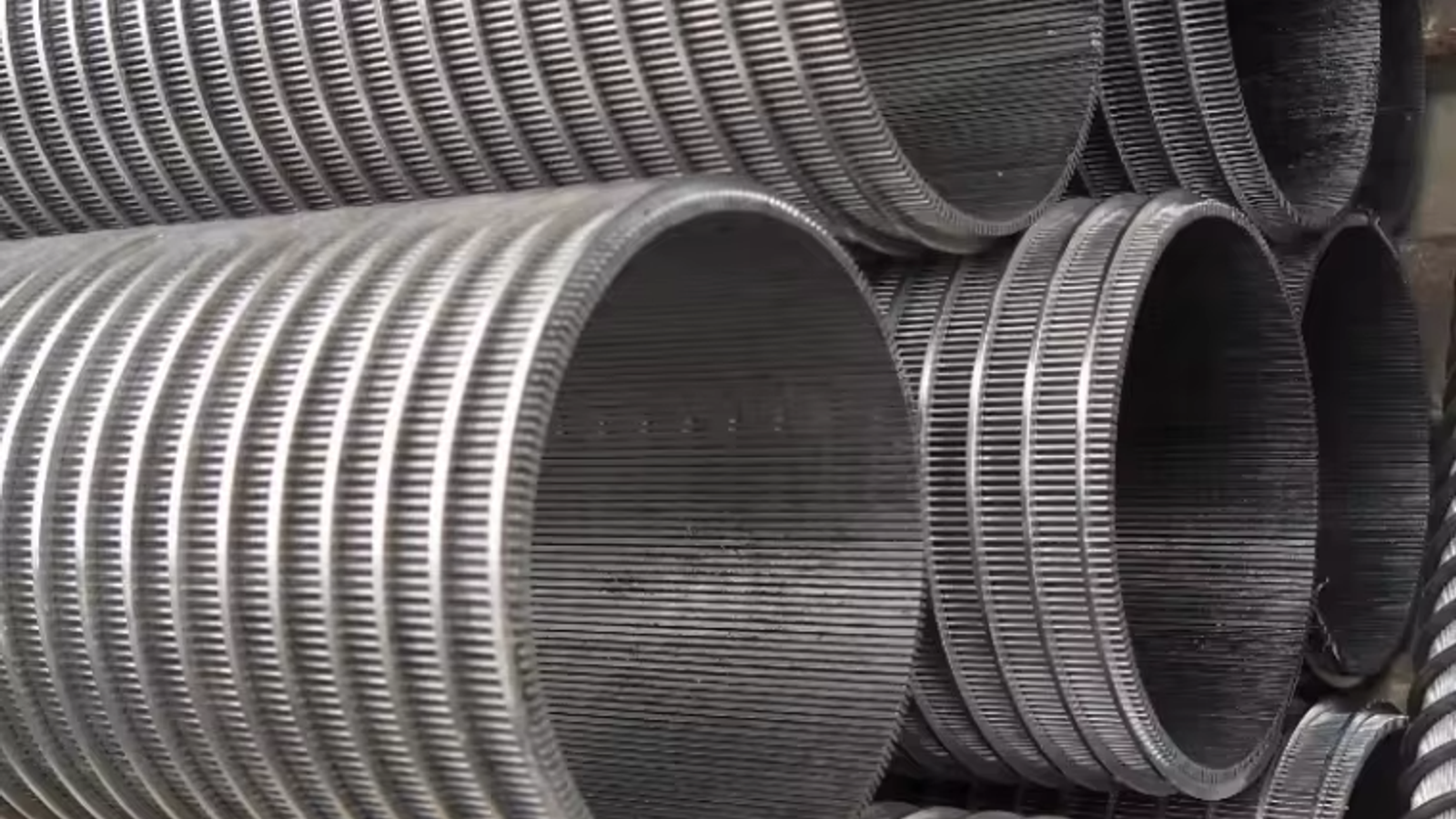
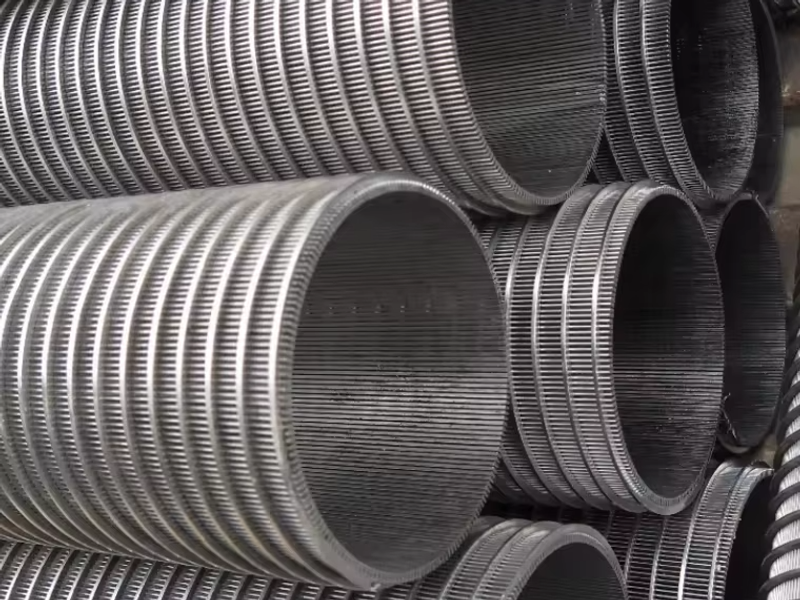
A wedge wire screen pipe is a cylindrical filter element built from V-profile wire wound helically around longitudinal support rods and resistance-welded at every crossing, producing continuous slots typically 0.1–3 mm wide along the full length of the element. Often called a Johnson screen pipe after the manufacturing family that made the design standard, it is the direct competitor of the perforated stainless steel filter tube — a sheet-metal cylinder punched or drilled with round holes and rolled to diameter — as the support and collection element in water wells, resin traps, intake screens, dewatering risers and oil and gas sand control.
The two elements look similar at a distance and fail in the field for very different reasons. This is a side-by-side engineering comparison of open area, clogging resistance, structural strength, flow capacity and cost, written for the engineers who have to pick one and justify it.
If your duty is fouling-prone, requires backwash regeneration, or depends on a precise particle size cut-off inside a structural member, the wedge wire screen pipe is usually the right element. If the duty is light, cost-sensitive, needs very high open area, or the tube is only a mechanical support core inside a sintered mesh cartridge, the perforated filter tube is usually the smarter buy.
Everything below explains why that split exists — and where the gray zone is.
Wedge wire screen pipes are built by winding V-profile wire around a set of longitudinal rods and resistance-welding every wire-to-rod intersection. The slot width is set by the pitch of the helical winding, so the manufacturer can hold a continuous, uniform opening of anywhere from 0.1 mm up to 3 mm across the whole surface. The distinctive V profile is the design's core trick: the opening is narrowest at the outer face and widens toward the inside of the pipe. A particle that is smaller than the slot passes straight through; a particle that is larger can only sit on the surface, never wedge into a parallel-walled channel.
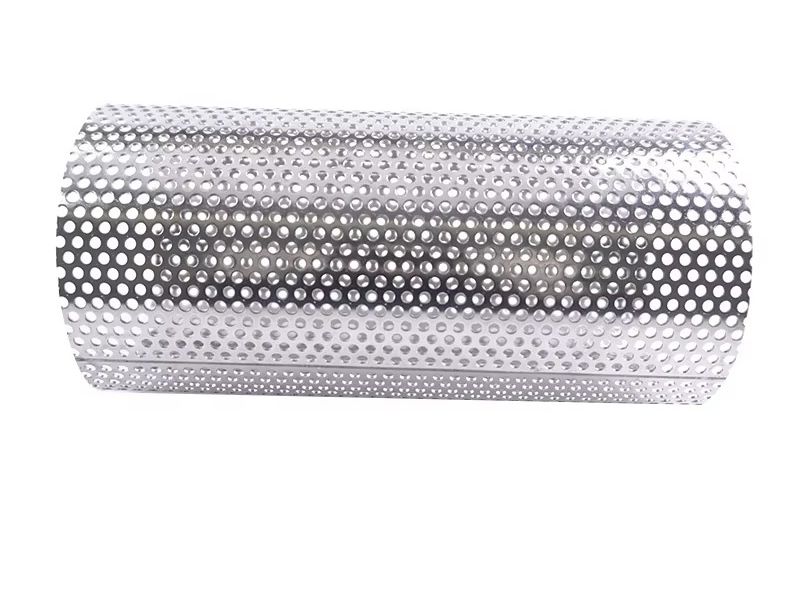
Perforated stainless steel filter tubes start as a flat sheet that is punched or drilled with a staggered pattern of round holes, then rolled to diameter and seam-welded into a cylinder. Hole diameters typically run from about 1 mm to 10 mm depending on the pattern, and the effective opening is a short cylindrical bore through the sheet thickness — geometrically the opposite of the wedge wire's V. Both families are commonly produced in SS304, SS316/316L and duplex 2205, so alloy selection rarely decides the argument by itself.
For the geometry comparison in detail, the stainless steel perforated filter tubes product range and the wedge wire screen pipe range show how each is finished and welded.
Open area is the first number engineers reach for, and it is where perforated tubes look strongest on paper.
| Attribute | Wedge Wire Screen Pipe | Perforated Stainless Steel Tube |
|---|---|---|
| Manufacturing method | V-profile wire resistance-welded to longitudinal rods | Punched/drilled sheet rolled and seam-welded |
| Aperture shape | Continuous V-shaped slot | Round hole with parallel bore |
| Aperture size range | Slot width 0.1–3 mm | Hole diameter typ. 1–10 mm |
| Typical open area | 5–15% | 5–40% |
| Flow distribution | Even along full length; continuous | Concentrated at discrete hole rows |
| Clogging behavior | Self-cleaning V-profile; particles cannot lodge inside the slot | Particles lodge inside the hole bore; bridges form at the entrance |
| Backwash regeneration | Excellent — captured solids release under reverse flow | Fair — reverse flow must push particles back out of a parallel bore |
| Collapse strength | Engineered lattice; typical ratings ~0.7–20.7 MPa (100–3;000 psi) by profile; diameter and rod spacing | Governed by sheet gauge and open-area ratio; lower at equal thickness |
| Cut-off precision | Slot width held to ±0.05 mm | Hole diameter varies with punch/drill wear |
| Relative cost | Higher per metre | Lower per metre |
| Lead time | Custom wound; typically several weeks | Faster for standard sizes |
| Best duty | Fouling media; backwash service; well screens; sand control | Light duty; high open area; support cores; low cost |
A typical wedge wire screen pipe carries 5–15% open area because the wire pitch, rod size and profile height are balanced for strength; pushing open area beyond that starts to cost collapse resistance. A perforated tube can legitimately reach 30–40% open area with fine hole spacing — on paper, three times the flow surface.
The catch is that open area is not the whole story. The wedge wire's continuous slot spreads the flow evenly along the entire element, so velocity stays low and uniform across the screen. The perforated tube concentrates flow at each hole, producing high local velocity through a small opening. In a well screen, that local velocity is what pulls fines toward the hole and starts bridging — one of the main reasons a higher-open-area perforated tube can still foul faster than a lower-open-area wedge wire screen in the same formation. If flow capacity per metre is your only metric, the perforated tube wins; if usable flow over the life of the element is the metric, the wedge wire screen often wins.
This is the decisive difference, and it comes straight from geometry.
In a wedge wire screen pipe, the slot is narrow at the surface and widens inward. A particle sized below the slot width drops through freely. A particle sized above it rests on the two contact edges of the V and nothing holds it there. Under backwash or even a surge in forward flow, captured solids release readily, which is why wedge wire screens are specified again and again for resin traps, intake screens and aquifer wells that must be regenerated in place. The slot geometry also resists the "wedge-in" failure mode: there is no parallel-walled channel anywhere in the flow path for a grain to jam into.
In a perforated filter tube, each round hole is effectively a short pipe. A grain slightly smaller than the hole can enter the bore and stick there; a grain slightly larger sits on the rim and acts as the seed of a bridge that grows across the opening as more fines arrive. Because the hole bore has parallel walls, reverse flow has to push every lodged particle back out through the channel it entered — so fouling is both faster to start and harder to reverse. For clean, non-fouling service this rarely matters; for anything with sand, silt, scale or biological growth, it is the difference between an element that regenerates and one that is pulled for replacement.
Structural behavior is the second big differentiator. The wedge wire screen pipe is a welded lattice: every wire crosses a longitudinal rod at a welded node, and load is shared across dozens of parallel load paths. The continuous slot means there is no row of perforations to concentrate stress, so the pipe keeps most of its hoop and collapse strength. Published collapse ratings for wedge wire well screens typically fall in the 0.7–20.7 MPa (100–3,000 psi) range depending on wire profile, diameter and rod spacing, and heavier profiles push higher — which is why deep wells and high-pressure reservoirs default to wedge wire.
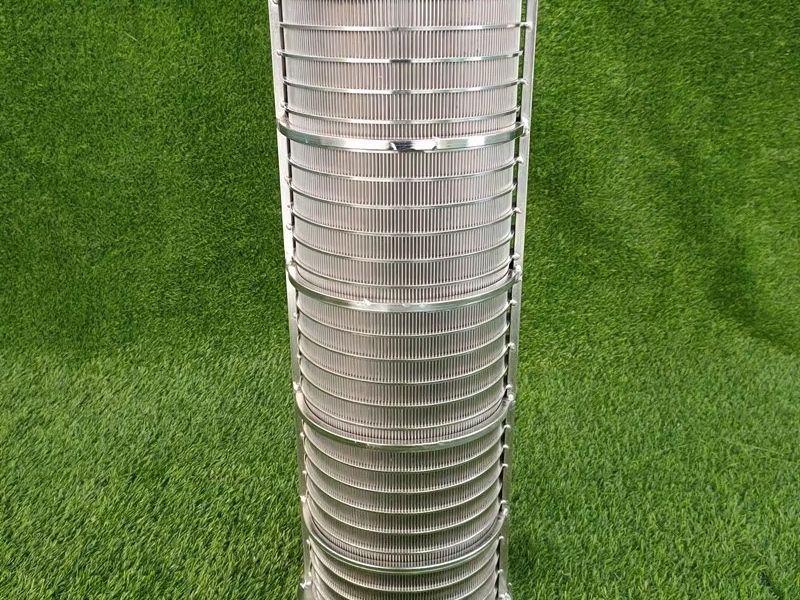
The perforated tube, by contrast, is a sheet with a grid of holes; each hole edge is a stress raiser, and every row of holes removes load-carrying material from the hoop path. Collapse and buckling resistance are governed by sheet gauge and by how aggressively the pattern maximizes open area — the two goals fight each other. A thin-gauge, high-open-area perforated tube is a perfectly good support core, but it is not a structural sand-control element for a deep well. Cylindrical forms of both families — wedge wire screen cylinders and perforated metal filter cylinders — are available with welded flanges and end caps when the element must double as a pressure boundary.
Material selection follows the same logic for both: SS304 for general water duty, SS316/316L where chlorides are present, and duplex 2205 where seawater or high-chloride process streams demand pitting and stress-corrosion resistance.
Perforated filter tubes are cheaper per metre and faster to produce. The process is sheet stock, a die or drill pattern, rolling and one seam weld — simple, repeatable and cheap at volume. For a light-duty strainer or a support core, they are the economically correct choice, full stop.
Wedge wire screen pipes cost more because each element is wound and resistance-welded node by node, and because slot width is a custom dimension rather than a catalog punch. The offset is service value: a screen that regenerates instead of blinding, and a slot held to precision, frequently pays for its premium in the first backwash cycle. For a fair comparison, engineers should cost the element over its service life including cleaning and replacement downtime, not just on the PO line. If you are comparing supply options, KAIFIL's custom wedge wire screen parts cover non-standard diameters, lengths and end fittings on either geometry.
Water wells and intake screens. For aquifer wells and river/cooling-water intakes, the wedge wire screen pipe is the default. Slot sizing is matched to the formation's sand analysis — finer slots for silty formations, wider for gravel-pack designs — and the self-cleaning slot keeps specific capacity from decaying between redevelopments. See the water treatment well screens application pages for typical well geometries.
Resin traps. Ion-exchange and softener vessels use wedge wire screens precisely because the slot width can be held slightly below the resin bead size while keeping open area high enough to avoid pressure drop — and because a resin bed that slumps into the screen releases cleanly on backwash. A perforated tube in the same position will tend to trap broken beads in the hole bores.
Dewatering. Riser and collector screens in dewatering systems favor wedge wire for the combination of fine slots and high collapse strength in a narrow-diameter member.
Oil and gas sand control. Completion screens that must survive high differential pressure and abrasive fines are overwhelmingly wedge wire, often as the outer layer of a premium screen assembly. The oil & gas petrochemical section covers the higher alloy and pressure ratings involved.
When the perforated tube is the better choice. Pick the perforated filter tube when the element is a support core inside a sintered wire-mesh cartridge — the sintered media does the filtration and the perforated tube only has to hold it up — or in light-duty straining where high open area and low first cost matter more than self-cleaning behavior, and where a plugged element is cheap to replace rather than expensive to backwash.
When you move to a spec, decide the following in order:
Supply both your operating pressure and your regeneration method with the inquiry — collapse rating and backwash performance are the two numbers a manufacturer needs to validate, and they are the two most commonly left off RFQs.
Is a Johnson screen pipe the same as a wedge wire screen pipe? Yes. "Johnson screen" is the traditional name for a wedge wire screen — V-profile wire wound around longitudinal rods and resistance-welded. Both terms describe the same continuous-slot construction.
Which has higher open area, wedge wire or perforated tube? Perforated tubes can reach 30–40% open area with dense hole patterns, while wedge wire screens typically run 5–15%. But open area alone is not flow capacity: wedge wire distributes flow uniformly along continuous slots, which often delivers better usable flow in fouling service.
Why is wedge wire better at resisting clogging? The V-profile slot is narrowest at the surface and widens inward, so particles cannot wedge inside the opening and captured solids release easily during backwash. A perforated hole is a parallel-walled bore that traps particles and allows bridging at the entrance.
When should I choose a perforated filter tube instead of wedge wire? When the element is a light-duty strainer or a support core behind sintered mesh media, when you need maximum open area at minimum cost, or when a plugged element is cheap to replace rather than expensive to backwash.
What alloys are available for both types? Both wedge wire screen pipes and perforated tubes are produced in SS304, SS316/316L and duplex 2205, with matching weld wire and end fittings.
Neither element is universally better — the right answer depends on your particle size, fouling tendency, pressure, alloy and budget. KAIFIL (kaifil.com) manufactures both wedge wire screen pipes and perforated stainless steel filter tubes from the same Shijiazhuang facility, so you get an unbiased comparison rather than a one-product pitch. Send your duty details — media, particle size, open area target, pressure, diameter and length — and our engineers will recommend the element, confirm the collapse rating, and provide a quotation. Contact KAIFIL today for engineering support and a custom quote.
Continuous-slot screen pipe for wells, vessel internals, resin traps and dewatering systems.
Perforated tubes / cylinders / sleeves for filter cores, protective sleeves and liquid strainer supports, supplied to drawing with material, size and packing details confirmed at RFQ stage.
Screen cylinders / pipes / baskets for intake, resin traps, strainers and distributor internals, supplied to drawing with material, size and packing details confirmed at RFQ stage.
Send drawings, dimensions, material, environment or operating conditions, and we will help confirm the right specification.
Uploaded reference files are included with the inquiry. For larger CAD packages, reply to the confirmation email or send them here:
Our team typically replies within 24 business hours.