Technical
Duplex 2205 Wedge Wire Screens for Seawater: Why 2205 Beats 316L
Duplex 2205 wedge wire screens resist seawater chloride pitting far better than 316L. Compare PREN and CPT, then get a custom screen quote from KAIFIL.
Duplex 2205 wedge wire screens resist seawater chloride pitting far better than 316L. Compare PREN and CPT, then get a custom screen quote from KAIFIL.
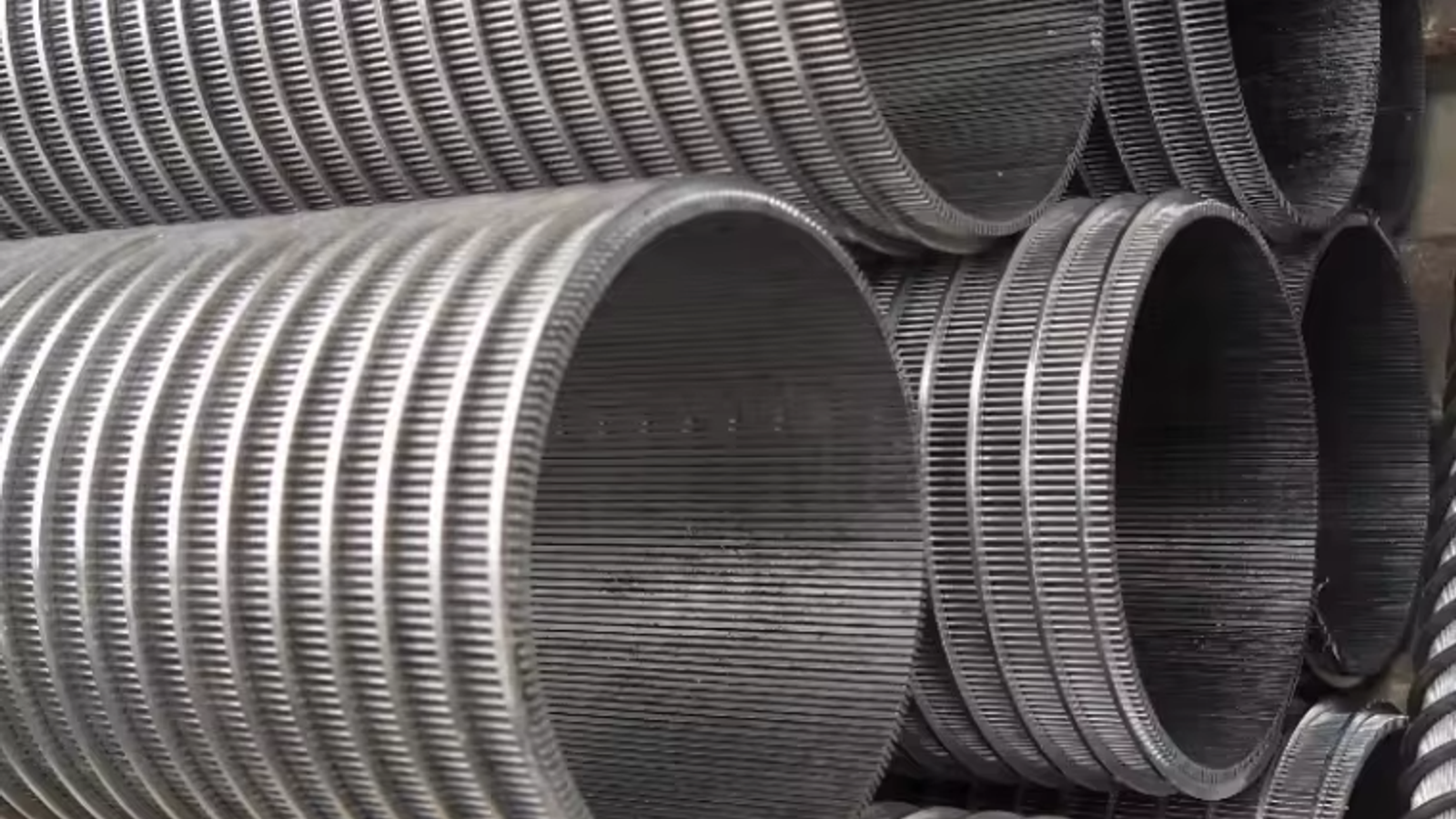
Duplex 2205 wedge wire screens are continuous-slot filter elements manufactured by helically wrapping V-shaped 2205 duplex stainless steel wire (UNS S31803/S32205) around longitudinal support rods and welding every wire-to-rod contact into a single, precisely gapped cylindrical or flat profile. They are engineered for the most aggressive marine environments, where ordinary 304 or 316L stainless steel fails prematurely: seawater intake screens, desalination plant wedge wire laterals and strainers, offshore platform sand screens, and marine water treatment trains. The two-phase microstructure of 2205 — roughly equal proportions of austenite and ferrite — combines the chloride pitting resistance of a highly alloyed austenitic steel with the strength and stress-corrosion-cracking resistance of a ferritic steel. With a PREN (pitting resistance equivalent number) of approximately 33–35, versus 24–26 for 316L, 2205 tolerates the roughly 19,000–20,000 ppm chloride content of natural seawater at service temperatures where 316L is no longer dependable.
Seawater is one of the most corrosive naturally occurring environments for stainless steel, and the failure mechanism is nearly always localized rather than uniform. Chloride ions attack the thin chromium-oxide passive film that protects stainless steel, and the attack concentrates at points where the film is weakest or where shielded geometry traps aggressive solution.
Chloride pitting. Pitting is initiated when chloride ions breach the passive film and propagate as small, deep cavities that can perforate a screen wall in months. Pitting is strongly temperature-dependent, which is why the critical pitting temperature (CPT) is the single most useful specification for seawater service. Standard 316L has a CPT of approximately 25–30 °C in ferric-chloride immersion testing. Natural seawater in tropical intake basins routinely reaches 28–32 °C, which places 316L right at or above its pitting threshold — precisely the conditions that produce pin-hole leaks through 1 mm screen wire. Duplex 2205 raises the CPT above 35–40 °C, giving a comfortable margin over the warmest seawater a coastal intake will ever see.
Crevice corrosion. Under marine fouling, sand deposits, gaskets, or the weld root of a screen connection, the shielded crevice environment depletes oxygen and acidifies, and chloride concentrates. Crevice corrosion in seawater attacks at lower temperatures than pitting, which makes it the usual first failure mode for 316L screens in cold but fouled seawater. The higher chromium, molybdenum, and nitrogen content of 2205 extends crevice-resistant service to higher temperatures, so the duplex alloy stays intact even when the screen crevice is a barnacle.
Stress corrosion cracking (SCC). Austenitic 316L is susceptible to chloride stress corrosion cracking at temperatures above roughly 60 °C, which arises in warm brine lines, heat exchanger splash zones, and offshore process services rather than cold intake water. The ferrite phase in 2205 interrupts crack propagation, giving the duplex alloy markedly superior SCC resistance and making it the default choice where seawater screens sit near warm process streams.
Microbially influenced corrosion (MIC). Biofilms shelter sulfate-reducing bacteria that produce hydrogen sulfide directly under the fouling layer. MIC accelerates attack on both 316L and 2205, but the consequence is different: on 316L, a small colony becomes a pitting or crevice initiation site within a year; on 2205, the higher PREN prevents the underlying localized attack from propagating.
For practical design purposes, the rule of thumb is simple: 316L is considered reliable for continuous immersion in natural seawater only below about 10–15 °C, whereas 2205 is suitable for continuous seawater service up to roughly 35–40 °C. Above that, even duplex grades reach their limit and the super-duplex 2507 (PREN ≈ 40–43) takes over.
The decision between 304, 316L, 2205, and 2507 for a wedge wire screen is a decision about chloride resistance, strength, and total cost of ownership. The table below summarizes the properties that drive seawater screen selection.
| Property | 304 | 316L | Duplex 2205 | Super-duplex 2507 |
|---|---|---|---|---|
| UNS designation | S30400 | S31603 | S31803/S32205 | S32750 |
| Chromium (approx. %) | 18 | 16.5 | 22 | 25 |
| Molybdenum (approx. %) | — | 2.1 | 3.1 | 4 |
| PREN (Cr + 3.3Mo + 16N) | 18–20 | 24–26 | 33–35 | 40–43 |
| Critical pitting temperature (ASTM G48) | < 15 °C | 25–30 °C | 35–40 °C | 50 °C+ |
| Yield strength (approx.) | 210 MPa | 220 MPa | 450 MPa | 550 MPa |
| Continuous seawater temp. limit | Not recommended | 10–15 °C | 35–40 °C | 45–50 °C |
| Chloride SCC resistance | Moderate | Moderate | High | Very high |
| Relative material cost | Low | Low | Medium | High |
Two points in this table carry the most engineering weight. First, the PREN gap between 316L and 2205 — a jump from 24–26 to 33–35 — is exactly the difference between a screen that pits within a year or two in warm seawater and one that survives decades. Second, the yield strength of 2205 is roughly double that of 316L, which means a duplex screen can use thinner support rods and lighter wall sections while still withstanding the handling, backwashing, and pressure differentials of a working intake or desalination system.
The practical engineering comparison between 304/316L and 2205 for seawater service comes down to this: 304 should not be specified for any seawater contact at all, 316L only for cold, clean, low-chlorine duty, and 2205 as the standard material for anything that will touch natural or concentrated seawater. For the most demanding brine and high-temperature marine services, 2507 is the upgrade path.
Every stainless steel submerged in seawater becomes a substrate for biofouling; there is no stainless grade that repels barnacles, mussels, algae, or slime. The material decision determines not whether fouling occurs, but whether fouling destroys the screen. On a 316L screen, marine growth creates oxygen-depleted crevices and differential aeration cells that drive chloride concentration — and within a season the fouled areas are the sites of pitting and crevice corrosion. On a 2205 screen, the same fouling layer does not initiate the same localized attack, so the screen can be cleaned and returned to service instead of being replaced.
The geometry of the wedge wire profile reinforces this advantage. A V-shaped wire screen presents a smooth, continuous slot with no woven cross-over points, blind pockets, or sharp crevices where debris and organisms lodge. The slot opens outward in the direction of flow, which makes backflushing effective: when flow reverses, accumulated marine growth lifts off the narrowing slot and is swept away. This self-cleaning characteristic is why a biofouling resistant screen in seawater service is almost always a V-wire profile rather than a woven mesh.
Operating practice matters as much as material. Recommended approach velocities across seawater intake screens are kept low — generally 0.15–0.3 m/s — to prevent impingement and entrainment of marine organisms, while in-line strainers and laterals should be sized for enough through-flow to avoid stagnant zones where fouling accelerates. Chlorination, either continuous or intermittent, remains the standard biofouling control measure, and a duplex 2205 screen tolerates residual chlorine and periodic acid pickling far better than 316L, which can itself pit in over-chlorinated water.
Slot width is the primary design parameter for any wedge wire screen, and seawater applications span a broad range depending on what the screen must retain. Slots are manufactured from approximately 0.1 mm up to 3 mm, and the selection follows the particle or organism size that must be excluded.
| Slot width | Typical seawater application |
|---|---|
| 0.1–0.3 mm | Offshore well completion sand screens; media retention in filter underdrains |
| 0.2–0.5 mm | Desalination wedge wire laterals; brine strainers; sand filter underdrain laterals |
| 0.5–1.5 mm | Marine intake strainers; pump protection screens; process water filters |
| 1–3 mm | Seawater intake screens; coarse trash and debris screening; fish-friendly intakes |
For a seawater intake screen, the objective is to exclude seaweed, shellfish, and debris while keeping hydraulic resistance and approach velocity low — typically a 1–3 mm slot with a high open area. For desalination plants, the picture splits into two distinct duties: intake screens (1–3 mm) protecting the pump station, and the fine laterals inside media filters that support sand or anthracite beds and distribute backwash — commonly 0.2–0.5 mm. Offshore, the critical duty is the sand screen inside the completion string, where 0.1–0.3 mm slots retain formation sand while the slotted cylinder must withstand collapse pressure and production flow without eroding. Each duty requires a different slot, profile, and open area, and the full method for translating a required cut-off to a slot width is covered in our wedge wire screen slot size selection guide.
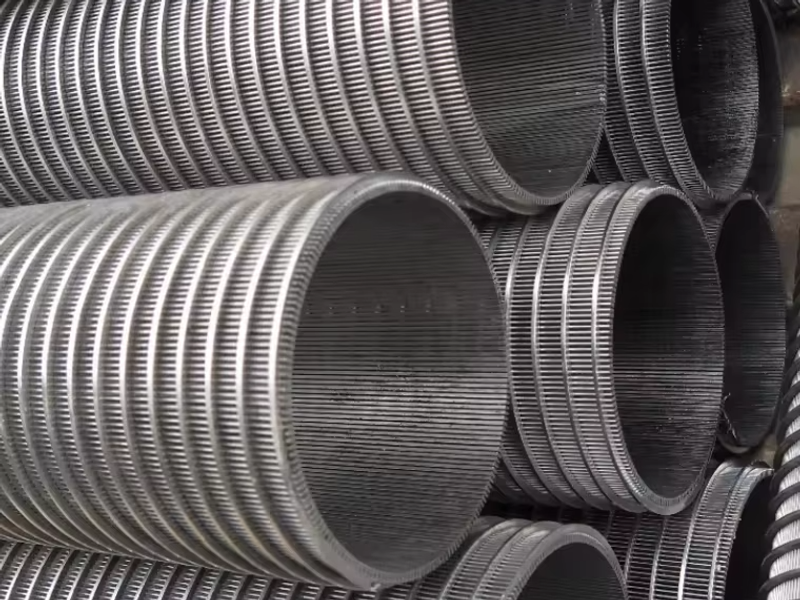
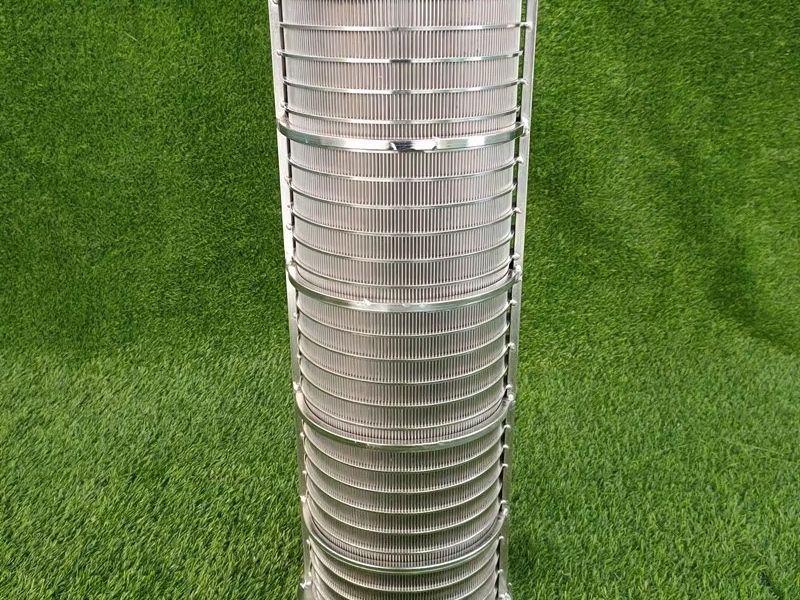
The cylindrical form factors used across these duties are the wedge wire screen pipe and wedge wire screen cylinders, which can be produced in 2205 with support rod spacing, wire profile, and end connections tailored to the process. Intake screening hydraulics for coastal water treatment are detailed further in our guide to wedge wire screen water treatment intake design.
The corrosion performance of duplex 2205 does not survive careless fabrication, and this is where many seawater screen projects go wrong. Duplex alloys are sensitive to welding in a way that austenitic 304 and 316L are not, because the ferrite–austenite balance — and therefore the PREN that actually protects the screen — is set during welding.
Heat input and interpass temperature. Duplex weld procedures specify a moderate heat input (roughly 0.5–1.5 kJ/mm) with a maximum interpass temperature of about 150 °C. Excess heat input or slow cooling lets the heat-affected zone drift to high ferrite, which drops corrosion resistance and toughness. Wedge wire screens present a particular challenge because each screen contains thousands of small weld points — one at every wire-to-rod intersection — and every one of those micro-welds is a potential weak point if the heat balance is wrong.
Filler metal and shielding. The correct filler for 2205 is ER2209, a duplex filler with added nitrogen that preserves the austenite fraction in the weld. Nitrogen in the shielding gas is also beneficial. Using a 316L filler to weld a 2205 screen, or allowing nitrogen loss during welding, produces a weld zone with the PREN of an inferior alloy — and a screen that pits at the welds.
Phase balance and heat tint. Duplex material specification usually requires a ferrite–austenite balance in the range of 35–65% ferrite after welding, verified by magnetic or metallographic measurement. Slow cooling through the 600–950 °C range risks precipitating sigma phase, which embrittles the alloy and removes molybdenum from solid solution, locally destroying pitting resistance. After welding, heat tint must be removed by pickling and passivation so the protective film is restored over every weld.
Quality control. For a seawater screen that may cost far more to replace than to build, positive material identification (PMI) of the incoming wire and rods, verification of the PREN, documented weld procedures, and weld inspection at the thousands of intersections are non-negotiable. Screens destined for offshore and desalination projects are typically supplied with material certificates traceable to the original mill heat. A manufacturer with controlled fabrication processes is the difference between a 2205 screen that lives up to its PREN and one that corrodes like a 316L. The same fabrication discipline applies across our custom stainless steel screen filter parts and custom wedge wire screen parts programs.
The economic argument for duplex 2205 is a life-cycle cost argument, not a first-cost argument. A 2205 wedge wire screen costs more than an equivalent 316L screen, but the gap is modest compared with the consequences of premature failure. A seawater intake screen or desalination lateral that pits through in two years takes a process line down, forces divers or line isolation, and is replaced at several times its initial cost once labor, downtime, and lost production are counted. In practice, 316L screens in warm seawater often fail within 1–3 years, while a correctly fabricated 2205 screen in the same duty is designed for a 20–30 year service life with routine cleaning. Over the design life of a desalination plant or offshore platform — typically 25 years or more — specifying 2205 at the outset nearly always delivers the lowest total cost of ownership. Because 2205 is roughly twice as strong as 316L, designers can also reduce wall thickness and structural weight, which partially offsets the higher unit material cost.
Why use duplex 2205 instead of 316L for seawater wedge wire screens? 2205 has a PREN of 33–35 versus 24–26 for 316L and a critical pitting temperature above 35–40 °C versus 25–30 °C. In natural seawater at roughly 19,000–20,000 ppm chloride, 316L is reliable only below about 10–15 °C, while 2205 resists pitting, crevice corrosion, and stress corrosion cracking through warm seawater service and offers roughly double the yield strength.
What is the PREN of duplex 2205? Duplex 2205 (UNS S31803/S32205) has a PREN of approximately 33–35, calculated as %Cr + 3.3 × %Mo + 16 × %N from its nominal 22% Cr, 3% Mo, and 0.17% N composition.
What slot size should a desalination wedge wire lateral use? Media filter laterals and underdrain screens in desalination plants typically use 0.2–0.5 mm slots to retain sand or anthracite while distributing backwash. Coarse desalination intake screens upstream normally use 1–3 mm slots.
Does duplex 2205 resist marine biofouling? No stainless steel repels marine growth. The advantage of 2205 is that fouling and its associated crevice conditions do not initiate localized corrosion on the higher-PREN alloy, so the screen can be cleaned by backwashing, chlorination, or acid pickling and returned to service instead of failing.
How long do 2205 wedge wire screens last in seawater? With correct material certification and welding, a duplex 2205 screen is typically designed for a 20–30 year service life in seawater intake, desalination, and offshore duty, versus 1–3 years for a 316L screen in warm, fouled conditions.
Seawater service demands more than a standard product: it demands the right material grade, the right slot, and weld quality you can trace. KAIFIL manufactures wedge wire screens in duplex 2205, super-duplex 2507, and conventional stainless grades, with slots from 0.1 mm to 3 mm and a full range of intake, desalination, and offshore forms. Our engineers can review your seawater conditions — chloride concentration, service temperature, biofouling load, and flow velocity — and recommend the exact material and slot configuration. Explore our water treatment and well screens applications, or send your specification to KAIFIL for a quote and a life-cycle comparison against 316L before you commit to a material.
Continuous-slot screen pipe for wells, vessel internals, resin traps and dewatering systems.
Screen cylinders / pipes / baskets for intake, resin traps, strainers and distributor internals, supplied to drawing with material, size and packing details confirmed at RFQ stage.
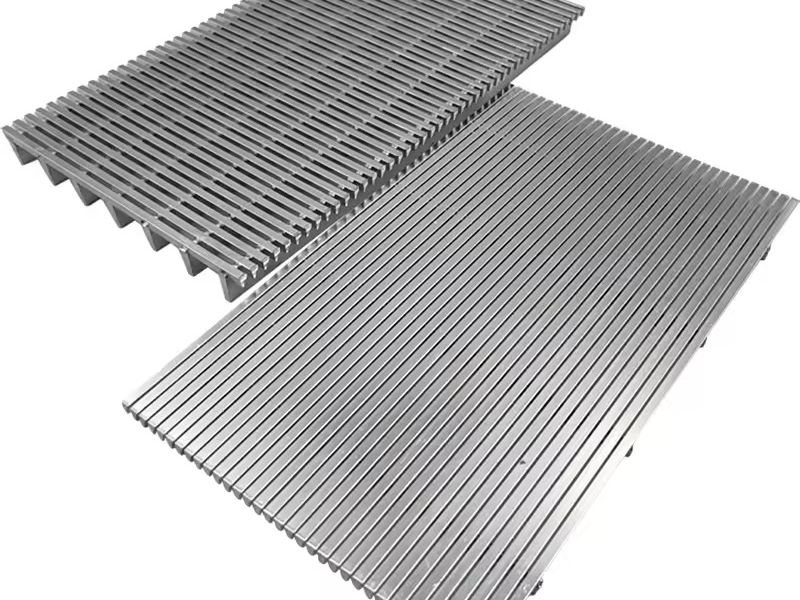
Flat panels / sieve bends / framed panels for dewatering, sizing and solid-liquid separation, supplied to drawing with material, size and packing details confirmed at RFQ stage.
Send drawings, dimensions, material, environment or operating conditions, and we will help confirm the right specification.
Uploaded reference files are included with the inquiry. For larger CAD packages, reply to the confirmation email or send them here:
Our team typically replies within 24 business hours.