A water well screen slot size is the width of the opening between adjacent screen wires or perforations that controls which aquifer particles are allowed to enter the well. It is typically expressed in inches (0.006–0.040 in) or millimetres (0.15–1.0 mm), and it is the single most important design decision on a well screen. Get it right, and the well produces clean, sand-free water for decades. Get it wrong, and sand grinds down pump impellers, settles out in the casing, and quietly shortens the well's useful life. Slot selection is not guesswork: it follows directly from a laboratory sieve analysis of the aquifer, using grain-size statistics such as D10, D60, and the uniformity coefficient Cu = D60/D10. This guide explains how to read those numbers, how to convert them into a practical slot opening, when a gravel pack is required, and how to verify that the screen you specify will perform as intended for your water treatment and well screens application.
No aquifer is made of a single grain size. Every formation has a grain-size distribution, and the standard way to measure it is a sieve analysis carried out to methods such as ASTM D6913 or ISO 17892-4. A dried, weighed sample of formation material is shaken through a stack of nested sieves with progressively finer openings, and the mass retained on each sieve is recorded. Plotting cumulative percentage passing against sieve opening produces the grain-size distribution curve, and from that curve you read the values that drive slot selection:
- D10 — the grain size at which 10% of the sample by mass is finer (90% is coarser). This is the fine end of the formation's load-bearing skeleton and the most important single number for slot sizing.
- D50 — the median grain size; half the sample by mass is finer and half coarser.
- D60 — the grain size at which 60% of the sample by mass is finer, used together with D10 to characterize sorting.
- Uniformity coefficient, Cu = D60/D10 — a single number that describes how well sorted the formation is.
The sample itself matters as much as the test. A representative sample should come from the water-bearing zone that will actually be screened — drill cuttings from the producing interval, or an undisturbed split-spoon sample where possible. A sample mixed from several aquifers, or taken from surface soil, will produce a curve that has nothing to do with the zone your screen must serve.
How to interpret Cu:
- Cu < 3 — uniform, well-sorted formation, such as a clean beach-type sand. Natural well development is usually viable.
- Cu 3–6 — moderately graded; design carefully, natural development may still work.
- Cu > 6 — well-graded, non-uniform formation with a wide spread of fine and coarse grains. A gravel pack is typically recommended.
Why does D10 matter so much? Because the smallest grains determine whether the well runs sand-free. If the slot retains the D10 fraction, it retains the grains that hold the formation open. The finer silt- and clay-sized material that wants to keep moving is allowed out during development, while the skeleton stays put.
The Slot Sizing Rule: 50–60% of D10
For a naturally developed well in a uniform formation, the most widely used rule is to select a slot opening equal to 50–60% of the formation's D10.
Worked example: a sieve analysis of a clean medium sand returns D10 = 0.35 mm. Fifty to sixty percent of that is 0.175–0.21 mm. The nearest standard slot — 0.20 mm (0.008 in) — is the right choice. If D10 = 0.60 mm, the calculation gives 0.30–0.36 mm, so you select a 0.30 mm (0.012 in) slot. If D10 lands between two standard sizes, round down to the finer opening; it is safer to retain a little extra sand skeleton than to start the well producing fines.
Why 50–60% rather than 100% of D10? The screen does not need to hold every grain. By retaining roughly half the D10 fraction, you let the well develop a natural filter pack: during development, fine material near the screen is drawn out, the coarser grains bridge across the slot, and the annular zone reorganizes into a more permeable, self-built filter envelope. This raises yield and reduces drawdown while still preventing continuous sand entry.
The rule is often stated in its conservative form as well: the slot opening should be smaller than the smallest formation particle you want to retain. For a naturally developed well that means the slot is always smaller than D10 — usually close to half of it. Two aquifers can share an identical D10 and still need different screens because their Cu values differ, which is why a competent manufacturer will ask for the full grain-size curve rather than a single number. For a broader look at available slot values, tolerances, and how opening width relates to flow, see our guide to wedge wire screen slot size selection.
Gravel-Packed Wells: A Different Sizing Logic
When the formation is non-uniform (Cu > 6), very fine, or made of thin interbedded layers, natural development cannot reliably form a stable filter pack. The standard solution is a gravel pack: a carefully graded envelope of sand and gravel placed between the formation and the screen. With a gravel pack, the screen no longer has to retain the formation — it only has to retain the gravel, and the gravel does the sand-control work.
Sizing a gravel-packed well takes two steps:
- Size the gravel to the formation. A common field rule is a gravel D50 of 4–6 times the formation's D50 (some methods size on the D30 fraction at 4–9 times). The gravel must be fine enough to hold back formation fines, yet coarse enough to stay permeable and avoid becoming the flow bottleneck itself.
- Size the slot to the gravel. The same 50–60% rule now applies to the gravel pack: set the slot opening at 50–60% of the gravel's D10 so the smallest gravel grains bridge cleanly across the opening without passing through.
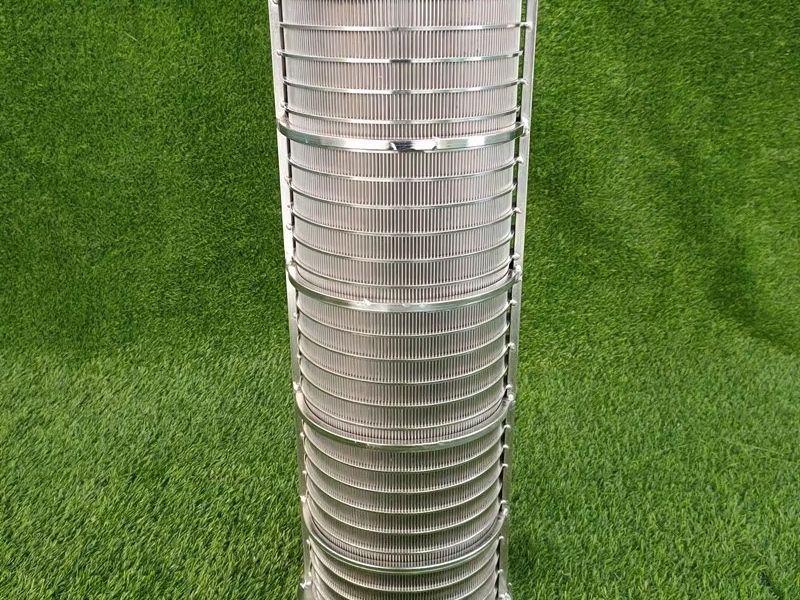
A gravel pack adds a valuable tolerance margin: if the formation changes slightly between the test hole and the drilled well, the pack absorbs the difference. Typical pack thickness in the annulus is 75–150 mm (3–6 in). For high-capacity municipal and industrial wells, a screen built as wedge wire screen cylinders with a surrounding gravel pack is a proven, widely used configuration.
Drillers and consultants usually start from a quick-reference table, then refine with the measured sieve curve. The values below are typical field starting points for uniform, naturally developed formations; always confirm them against 50–60% of the measured D10.
| Formation type | Typical grain size (D50) | Typical slot (in) | Typical slot (mm) | Notes |
|---|
| Very fine sand / silt | < 0.10 mm | 0.006 | 0.15 | Usually requires a gravel pack |
| Fine sand | 0.10–0.25 mm | 0.008–0.010 | 0.20–0.25 | Verify with sieve analysis; uniform fine sand is demanding |
| Medium sand | 0.25–0.50 mm | 0.010–0.020 | 0.25–0.50 | The most common municipal and irrigation well range |
| Coarse sand | 0.50–1.0 mm | 0.020–0.040 | 0.50–1.0 | Check open area for high-yield designs |
| Gravel | > 1.0 mm | 0.040–0.080+ | 1.0–2.0+ | Often gravel-packed or left naturally developed |
Keep in mind that these are starting points, not substitutes for a sieve analysis. A "medium sand" label in one driller's log can carry a very different D10 from the same label in another. The grain-size curve is the truth; the classification name is only a shortcut.
Slot width controls sand control, but open area and entrance velocity control yield and service life.
Open area is the percentage of the screen's cylindrical surface that is actual opening. Continuous-slot wedge wire screens typically deliver roughly 15–40% open area depending on slot width and wire profile, compared with only about 5–15% for a perforated pipe of similar structural strength. Higher open area means less head loss across the screen and a smaller pressure drop between the aquifer and the pump.
Entrance velocity is the rate at which water crosses the screen surface: pumping rate divided by the open area of the screened section. AWWA A100 recommends keeping screen entrance velocity at or below 0.1 ft/s (0.03 m/s) for sand-free, non-corrosive water. Above that limit, several problems accelerate in parallel:
- Fines are pulled into and through the slot, producing sand pumping.
- Iron and calcium carbonate scale deposit faster wherever water accelerates, speeding up incrustation.
- Localized turbulence promotes corrosion at the slot edges.
A worked example shows how quickly the limit binds: a 6-inch (152 mm) screen, 10 ft (3 m) long, with 20% open area, pumping 200 gpm, produces an entrance velocity of about 0.14 ft/s — above the AWWA ceiling. To comply, you lengthen the screen, increase open area, or both. This is exactly why slot size, screen length, and screen diameter must be selected together: a slot chosen purely to stop sand can force an impractically long screen, and a slot chosen purely for yield can destroy the well.
Screen Type and Stainless Steel Grade: SS304 vs SS316
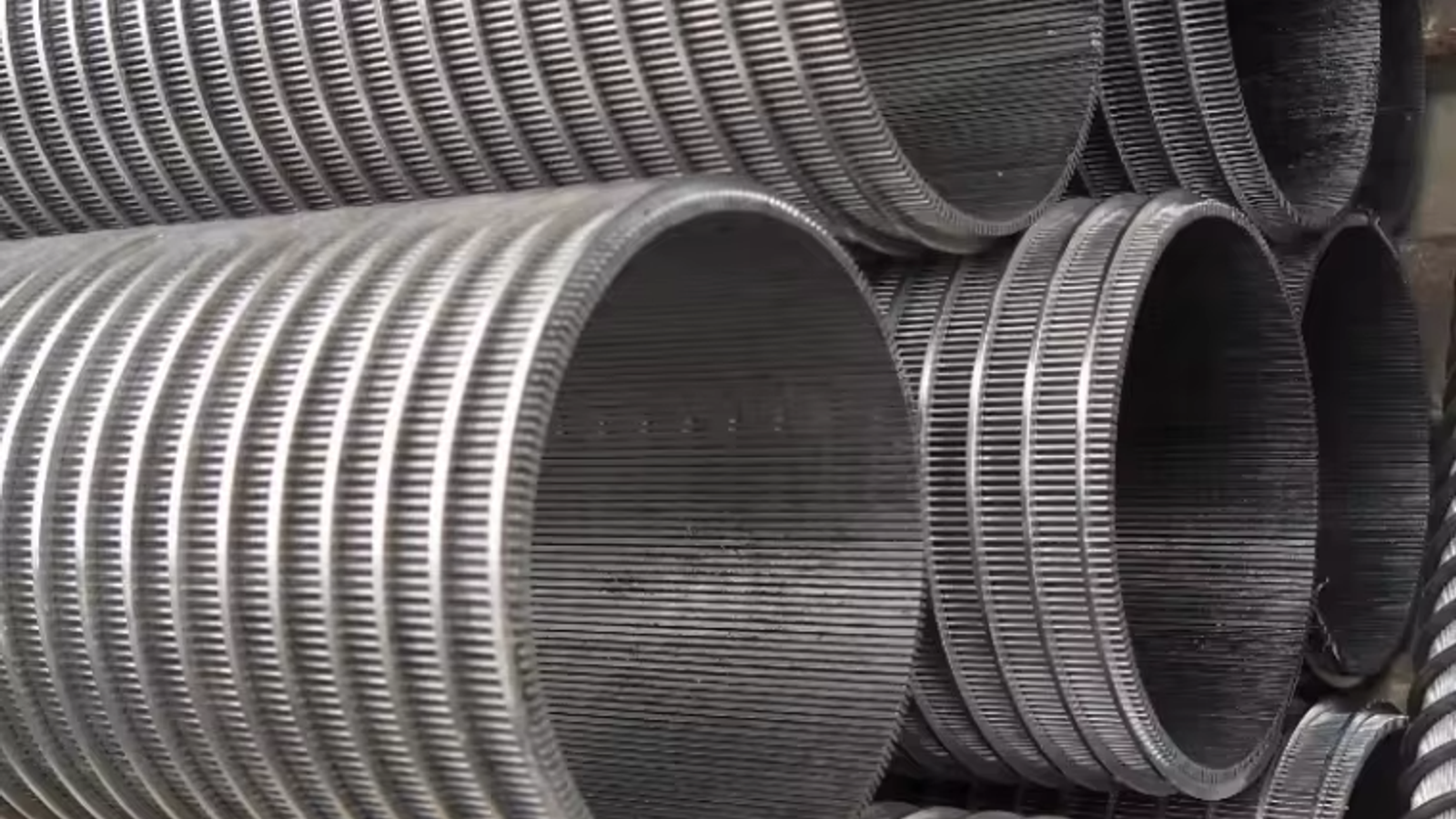
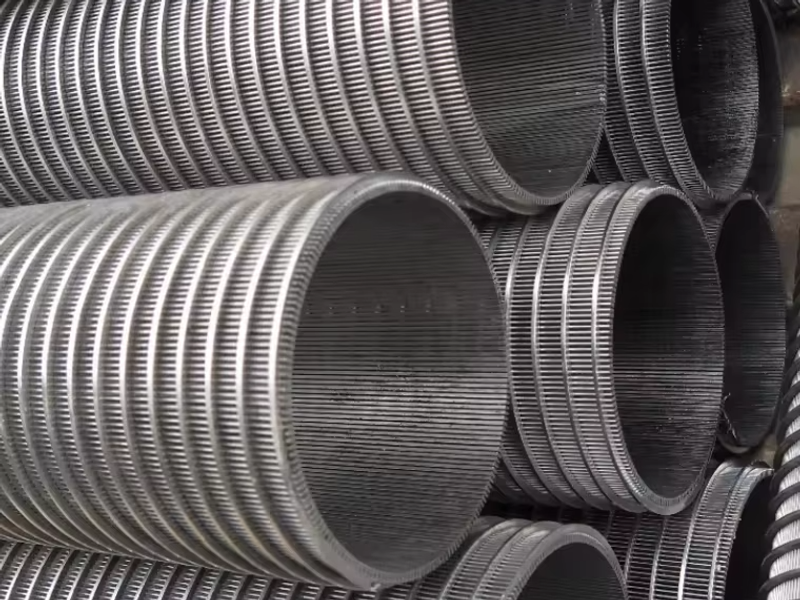
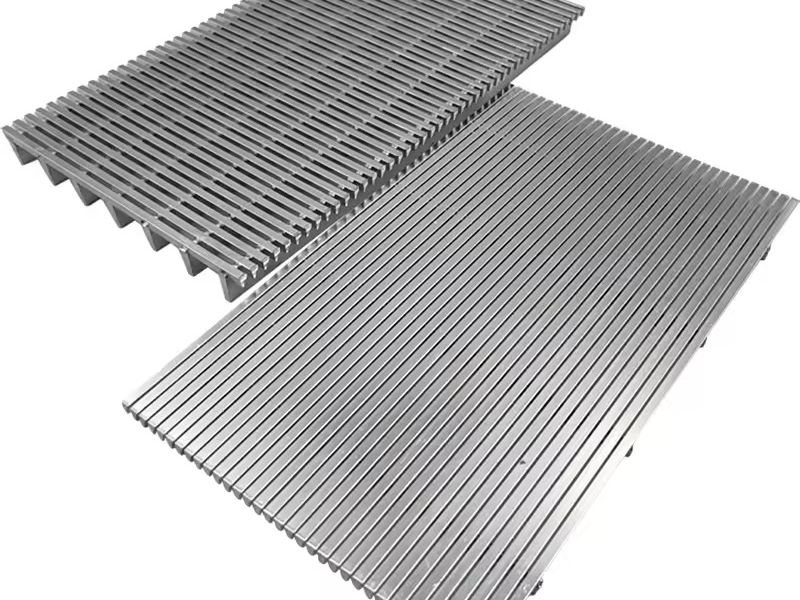
For water wells, the dominant screen geometry is the continuous-slot screen built from V-shaped (trapezoidal) wires — the design popularized as the Johnson screen. The V-profile narrows toward the outside of the screen, so a particle small enough to enter the slot passes straight through, while larger grains bridge on the outer surface and never wedge inside the opening. This self-cleaning, anti-clogging behavior is why continuous-slot screens outperform plain perforated pipe in sandy formations. You can read about how Johnson screens work for the mechanism, and about wedge wire vs woven mesh for water wells for the geometry trade-offs. For deep production strings, screens are typically supplied as wedge wire screen pipe sections with flush, threaded, or welded connections.
Material selection is driven by water chemistry, not by availability:
- SS304 — the economical default for fresh water, non-corrosive aquifers, and standard municipal or irrigation wells. It resists general corrosion well and is suitable for most inland groundwater.
- SS316 / SS316L — required for saline, brackish, or chloride-rich water, coastal aquifers, and aggressive chemistry. The molybdenum content provides markedly better pitting and crevice corrosion resistance, which matters enormously for a screen expected to stay in service for decades.
If there is any doubt about water chemistry, run a water analysis early in the project. Paying the modest premium for 316 on a well that will encounter chlorides is far cheaper than pulling and replacing a screen that pitted through after a few years. In highly corrosive or low-pH water, even higher-alloy options exist, but for the large majority of wells the decision reduces to 304 versus 316.
Well Development, Anti-Clogging, and Common Mistakes
Sizing is only half the job. A correctly sized screen still needs proper well development — surging and pumping after installation to remove fine material from the annulus and let the natural filter pack form. Skipping development is one of the most common reasons a "failed screen" turns out to be an installation problem rather than a design problem.
Beyond development, avoid these recurring mistakes:
- Oversizing the slot to maximize yield. The predictable result is chronic sand pumping, worn pump internals, and casing damage — usually requiring an expensive screen replacement.
- Undersizing the slot "to be safe." Excessively small openings raise entrance velocity, accelerate incrustation and corrosion, and can starve the pump even though the aquifer has plenty of water.
- Sizing from D50 or a formation label instead of D10 and the full curve.
- Ignoring the uniformity coefficient. Uniform and non-uniform formations with the same D10 need different approaches (natural development versus gravel pack).
- Assuming slot tolerances the manufacturer does not hold. Slot openings are manufactured to tight tolerances and verified against the specification — on V-wire screens, actual slot width is checked at multiple points around the circumference and along the length, with typical tolerances of ±0.001–0.002 in at the design opening. Confirm the tolerance statement in the quotation before you accept the screen.
When in doubt, ask the screen manufacturer to review your sieve curve and well log before steel is cut. A good supplier will push back on an over-sized or under-sized slot rather than simply fabricate what you wrote down.
FAQ
What is a good slot size for a water well screen? There is no universal value. Most water well screens use slots between 0.006 in (0.15 mm) and 0.040 in (1.0 mm), and the specific choice follows from the sieve analysis — commonly 50–60% of the formation's D10, or 50–60% of the gravel pack's D10 in a gravel-packed well.
How do I choose the slot size from a sieve analysis? Run a sieve analysis (ASTM D6913 / ISO 17892-4), read D10 from the cumulative distribution curve, and multiply by 0.5–0.6. Round down to the nearest standard slot size. If the formation is non-uniform (Cu = D60/D10 above 6) or very fine, plan a gravel pack and size the slot to the gravel instead of the formation.
What is D10 in well screen sizing? D10 is the grain size at which 10% of the aquifer sample by mass is finer. It represents the fine end of the formation's load-bearing skeleton and is the standard reference for slot sizing, because retaining the D10 fraction is what keeps a naturally developed well sand-free.
What happens if the screen slot is too large or too small? Too large, and sand and fines enter continuously, wearing the pump and casing until the well has to be pulled. Too small, and entrance velocity climbs, the screen incrusts and clogs faster, and yield drops below what the aquifer can deliver. Either failure traces back to a slot that was not matched to the grain-size curve.
Do I always need a gravel pack? No. In uniform formations (Cu < 3), natural development is usually sufficient. Gravel packs are recommended for non-uniform (Cu > 6), very fine, or layered formations, or when you want extra tolerance against variability between the test hole and the completed well.
Slot selection is a hydrology problem, not a catalog-picking exercise — and the fastest way to get it right is to let an engineer look at your actual data. Send KAIFIL your well log, sieve analysis, and target yield, and we will recommend a slot size, open area, and screen geometry matched to your aquifer, then fabricate the screen to match in SS304 or SS316 with custom lengths, diameters, and connections. From production strings built as wedge wire screen pipe to custom wedge wire screen parts for retrofit and repair, we build continuous-slot screens to your formation — not the other way around. Contact us with your formation data, and let's size your screen correctly the first time.