Technical
How to Choose Blow Film Extruder Screens for LDPE, LLDPE & HDPE
Blow film extruder screen selection guide: mesh counts for LDPE/LLDPE/HDPE, gel thresholds, and 80–120 bar pressure change triggers. Get a quote from KAIFIL.
Blow film extruder screen selection guide: mesh counts for LDPE/LLDPE/HDPE, gel thresholds, and 80–120 bar pressure change triggers. Get a quote from KAIFIL.
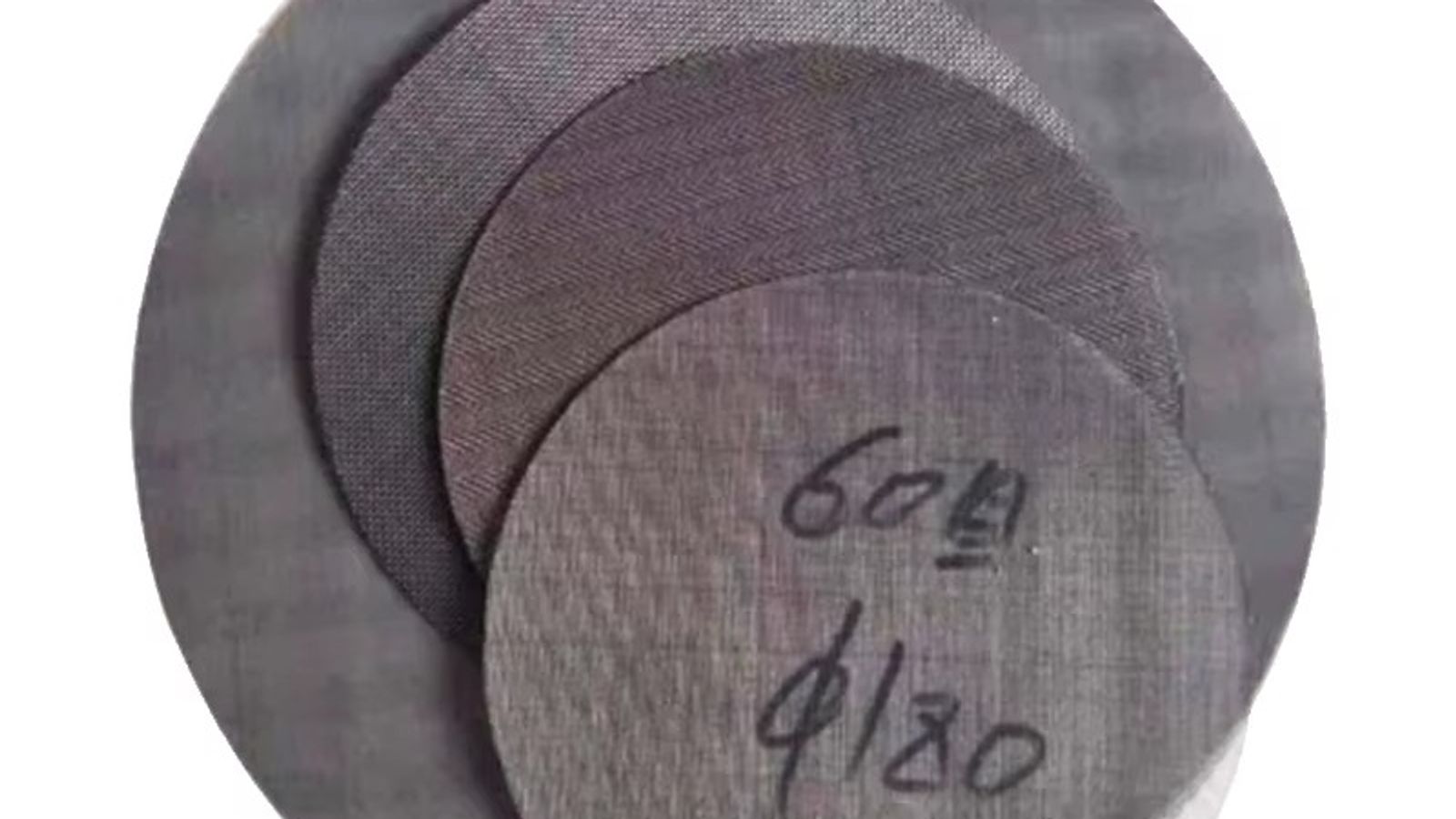
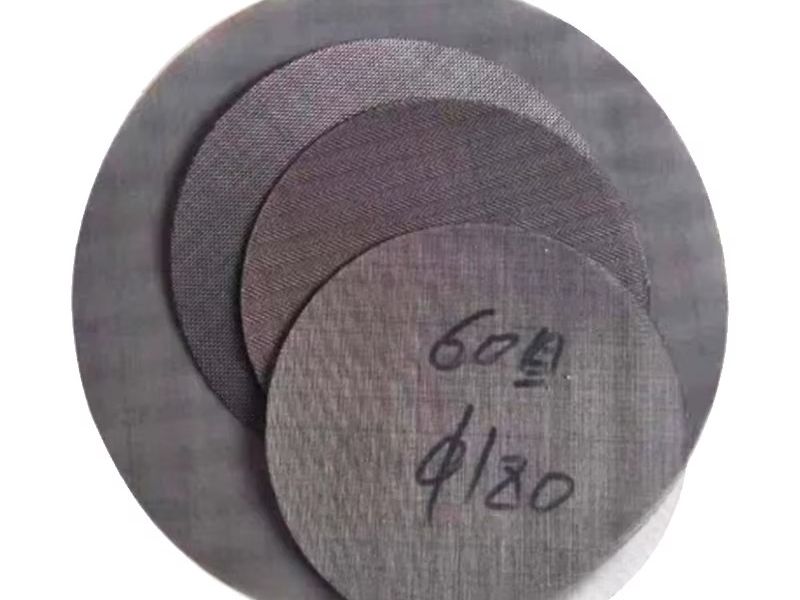
Blow film extruder screens are stainless steel wire mesh filter discs arranged in a screen pack between the extruder screw and the die head, acting as the final barrier that removes gels, black specks, and carbonized polymer from the LDPE, LLDPE, or HDPE melt before it inflates into the film bubble. On a blown film line, the screen pack is the most cost-effective quality-control device on the machine: a correctly specified pack holds contaminants, while a coarse or overloaded pack lets them pass straight into the die lip and out into the film. Filter fineness is expressed in mesh count — 40, 60, 80, 100, 120 and 150 mesh are the standard working range for film lines — corresponding to nominal openings of roughly 400 µm down to 100 µm. Because film gauge runs from about 10 to 200 µm, because PE melt is processed between 170 and 230 °C, and because change pressure is commonly triggered at 80–120 bar, the balance between filtration fineness, pressure build-up, and change frequency decides film optics, pinhole rates, and mechanical properties.
On a blown film line, every contaminant that survives the screen pack is frozen into the finished film within seconds. There is no downstream process to remove it. That is why the extruder screen pack — not the screw design, not the die gap — is usually the difference between a first-quality roll and a complaint.
Three film quality attributes are governed almost entirely by melt filtration:
Optics and clarity. Gels, white specks, and black specks scatter light. In a 25 µm clarity film, a single 50 µm gel creates a visible haze spot that a converter or brand owner rejects on inspection. Filter fineness sets the ceiling on how clean the film can look.
Pinholes and barrier performance. Hard particles such as carbonized polymer, paper fiber from regrind, or catalyst residues can bridge or damage the die gap and leave pinholes. In food and medical film, a pinhole is not a cosmetic defect — it destroys the oxygen and moisture barrier and can fail the finished package.
Mechanical properties. A gel or foreign particle acts as a stress concentrator. Under tensile, tear, or impact loading, the film fails at the weakest point, which is almost always the contamination site. Films with visible gels fail elongation and dart-drop tests disproportionately, even when the average properties look acceptable.
The practical rule on blown film lines is simple: if you can see a defect in the film, the screen pack has already let it through or is so loaded that melt is bypassing it. Plastic extrusion filtration works on the same principle across all film and sheet processes, but blown film is the most demanding because the final product is measured in microns.
To specify a screen correctly, it helps to understand exactly what you are filtering out of an LDPE, LLDPE, or HDPE melt.
Gels are the most common blown film defect. They form when polymer chains crosslink or oxidize in the barrel, die, or screen pack — usually from melt residence at high temperature, dead zones in the adapter, or hot spots from a worn heater. A gel is more viscous than the surrounding melt, so it does not deform as the bubble is drawn; instead it forms a discrete particle, fish-eye, or hard lump in the film. Because melt temperatures above roughly 230 °C accelerate degradation sharply, most film processors hold melt temperature in the 170–230 °C band and let the screen pack carry the contamination load.
Black specks are carbonized polymer or metal flakes. They come from degraded melt that has burned onto the screw, the breaker plate, or the screen support, then intermittently breaks off. They are hard, opaque, and cause both visual rejects and pinholes.
Size thresholds. What is actually visible in film depends on gauge. As a working guide for film extrusion:
This magnification effect is the core of blown film filter selection: the thinner the film, the finer the screen you need, because the film multiplies every particle that reaches the die.
There is no single "right" mesh for blown film — the right choice is the coarsest screen that still keeps the film within spec, because finer screens build pressure faster and shorten change intervals. The starting point is film gauge, modified by polymer type and regrind content.
| Mesh count | Nominal opening | Typical film gauge | Common blown film application |
|---|---|---|---|
| 40 mesh | ~400 µm | 100–200 µm | Heavy-duty sacks; agricultural film; high-regrind blends |
| 60 mesh | ~250 µm | 50–100 µm | General packaging film; carrier bags |
| 80 mesh | ~180 µm | 30–80 µm | Grocery bags; shrink film; lamination base |
| 100 mesh | ~150 µm | 20–50 µm | Medium-clarity packaging; lidding film |
| 120 mesh | ~125 µm | 15–40 µm | High-clarity film; print-grade packaging |
| 150 mesh | ~100 µm | 10–30 µm | Thin-gauge clarity film; food-grade film |
LDPE has the lowest melt viscosity and the least tendency to build gel at normal temperatures, so it can often run on 60–100 mesh at moderate throughput and still produce clean film. LLDPE has higher melt strength and viscosity; it generates more shear heat and pressure across a fine screen, so processors commonly drop one mesh class (for example from 120 to 100) and compensate with a slightly coarser inner layer in the pack. HDPE runs hot and is more prone to degradation at the die, making 80–120 mesh common, with attention to change frequency rather than maximum fineness.
Additive and regrind content shifts the choice. Antiblock, slip, and pigment masterbatches carry agglomerates that break down under shear — but only if they pass the screen. A line running 20–30 % regrind — especially regrind contaminated with paper, ink, or degraded edge trim — will see pressure rise in hours, not days, and may need a screen changer to keep running at all. When contamination is heavy, the correct strategy is a slightly coarser filter to extend life, plus a screen changer, rather than a very fine screen that clogs in one shift.
For a systematic method of matching mesh layers to a job, see the KAIFIL guide on extruder screen pack mesh combinations, which covers layering logic for single and multi-layer packs.
A blown film screen pack is rarely a single disc. Typical packs use several layers so that the filter resists pressure without collapsing and catches a range of particle sizes:
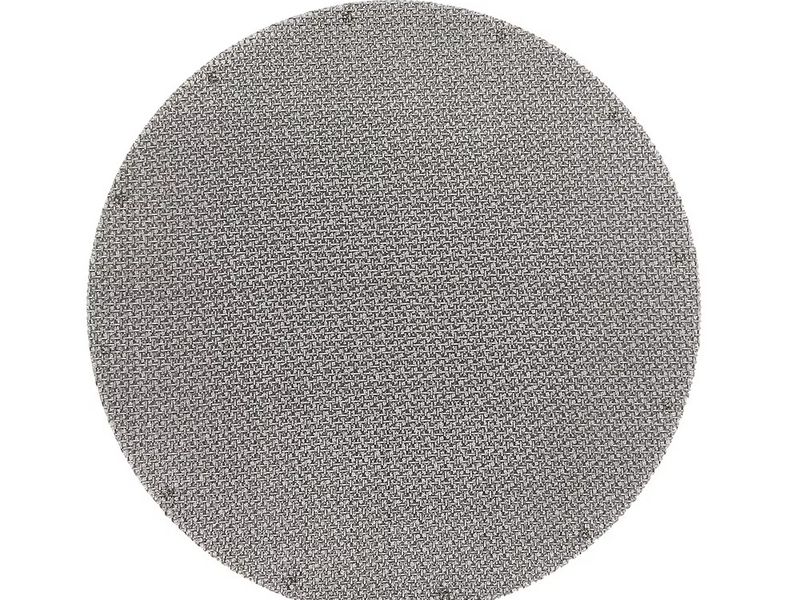
Plain square-weave discs are the workhorse for film lines and give the best throughput-to-fineness ratio for most LDPE and LLDPE jobs; KAIFIL stocks plain wire mesh filter discs in the full 40–150 mesh film range. Rimmed wire mesh filter discs add a welded or folded outer rim that prevents edge bypass — melt leaking between the disc edge and the pack housing — which is the classic cause of sudden gel bursts in an otherwise healthy line. If the pack is being run to very fine filtration for thin clarity film, a Dutch weave wire mesh layer can deliver higher filtration efficiency at a coarser apparent mesh because its wedge-shaped flow channels capture particles inside the weave rather than only on the surface.
Two installation details decide whether the pack actually works. First, every disc must be flat and deburred, because a raised burr holds a melt pocket that carbonizes into black specks. Second, the discs must seat fully against the breaker plate with no annular gap; a rimmed disc or a correctly punched plain disc prevents the edge-bypass short circuit that defeats the entire pack.
The screen pack is a controlled restriction. As it captures contamination, the pressure before the pack rises. The operator's job is to change it before that pressure causes quality loss — or forces the melt to push gels through the blocked layer.
The standard change trigger on film lines is melt pressure in the 80–120 bar range, depending on machine size and polymer:
Screen life is a function of contamination load, not time. A clean virgin LDPE line might run 24–72 hours on a 100 mesh working layer; a line feeding 30 % contaminated regrind can clog the same pack in 2–4 hours. Change frequency should be set by the pressure curve, not by the clock.
| Symptom on the line | Most likely cause |
|---|---|
| Pressure climbs from baseline to 100+ bar faster than expected | Contaminated regrind; over-fine mesh for throughput; or upstream degradation |
| Gels or fisheyes appear while pressure is still normal | Edge bypass around a worn or undersized disc; damaged pack |
| Sudden gel burst right after a pressure spike | Melt forcing through a blocked pack; change interval too long |
| Black specks appear intermittently | Carbonized polymer releasing from screw; die; or pack housing; melt temperature too high |
| Film breaks at the die while pressure is high | Overloaded pack starving the die; change immediately and review mesh |
When pressure is managed correctly, the screen pack also becomes a diagnostic: a consistent, predictable rise to the change setpoint is the sign of a healthy line, while an erratic curve points to a compounding problem elsewhere.
The choice between a manual pack change and a screen changer depends on how fast the line fouls the screen and how much downtime you can absorb.
Manual pack changes are fine for low-regrind, low-contamination jobs where a pack lasts a full shift or more. The line stops, the pack is lifted out, and a fresh one is installed. The cost is downtime, thermal cycling of the adapter, and a window of off-spec start-up film after every change.
Slide-plate screen changers (single or dual bolt) allow a swap in seconds with the extruder running. A dual-bolt unit pre-heats the standby screen so there is no cold-start pressure spike, making it the standard recommendation for film lines that change every few hours.
Continuous rotary screen changers are used on high-throughput or heavy-regrind blown film lines. The filter media advances continuously or in small steps, holding pressure nearly constant, which keeps film quality stable across an entire run. These are the right choice when the pack would otherwise clog faster than a slide-plate operator can cycle it.
Backflush screen changers periodically reverse a small melt flow to clean the screen in place. They suit applications with moderate contamination and low gel stringency; for clarity film they are less common because a partially cleaned screen never fully recovers its filtration rating.
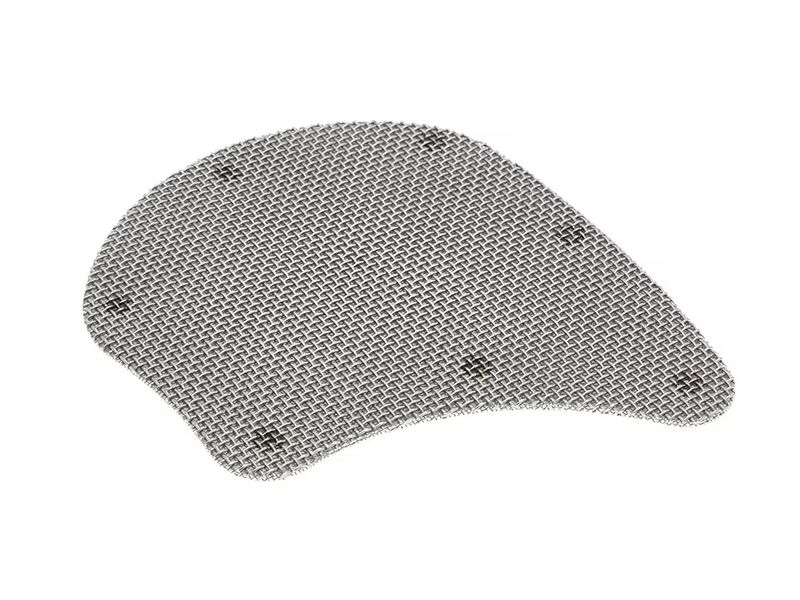
All four options use the same consumables — mesh discs, breaker plates, and pack hardware — and every one of them depends on the same specification discipline described above. KAIFIL supplies the complete range, from a standard extruder screen for manual packs to custom shape wire mesh filter discs machined to your changer's bolt pattern and die geometry.
What mesh size should I use for a blow film extruder screen? Start from film gauge: 40–60 mesh for heavy film above 100 µm, 80–100 mesh for 30–80 µm packaging film, and 120–150 mesh for thin clarity film below 30 µm. Adjust one mesh class coarser when running high regrind or LLDPE.
When should I change the screen pack on a blown film line? Change when melt pressure reaches the setpoint — typically 80–120 bar. If pressure rises to the trigger in a few hours, the feed is contaminated and the contamination source should be fixed rather than just changing screens faster.
Why do gels still appear in film even though the screens are new? Three common causes: melt bypassing the pack edge (an undersized or unrimmed disc), gels forming after the screen in the die itself from high melt temperature, and gels forming in the barrel from degraded resin — no screen can filter gels that form downstream of it.
What melt temperature is safe for PE blown film? Most LDPE, LLDPE, and HDPE film runs at 170–230 °C. Sustained operation above about 230 °C accelerates crosslinking and carbonization, which directly increases gels and black specks regardless of screen fineness.
Does regrind change the screen pack specification? Yes. Regrind — especially printed, contaminated, or degraded edge trim — raises contamination load sharply and shortens screen life. With heavy regrind, use a slightly coarser working mesh, add a screen changer, and watch the pressure curve instead of relying on a fixed schedule.
The correct screen pack for a blown film line is specific to your polymer, gauge, throughput, and regrind level — and getting it wrong shows up in every roll. KAIFIL manufactures stainless steel extruder screens, filter discs, and custom screen pack components from our Shijiazhuang plant and ships worldwide. Send us your die width, mesh or micron requirement, and regrind percentage, and our engineers will confirm the right filter fineness and change strategy for your line. Contact KAIFIL for a quote and get custom screens and engineering support matched to your film application.
Custom screen discs and multilayer packs for plastic extrusion, recycling and polymer melt filtration.
Irregular discs / custom mesh inserts / stamped shapes for non-standard filter seats and oem equipment interfaces, supplied to drawing with material, size and packing details confirmed at RFQ stage.
Plain discs / cut mesh pieces / custom shapes for economical mesh inserts and removable filter screens, supplied to drawing with material, size and packing details confirmed at RFQ stage.
Send drawings, dimensions, material, environment or operating conditions, and we will help confirm the right specification.
Uploaded reference files are included with the inquiry. For larger CAD packages, reply to the confirmation email or send them here:
Our team typically replies within 24 business hours.