The screen is the single most consequential component in a water well. It determines whether the well delivers design flow for 30 years or silts up in five. Yet screen selection often gets less engineering attention than the pump and casing — partly because the distinction between wedge wire and woven mesh screens is not always well understood outside of hydrogeology circles.
This article compares the two dominant continuous-slot screen technologies — V-wire (wedge wire) and wire-wrapped woven mesh — across the parameters that matter most in water well design: slot accuracy, open area, collapse strength, plugging resistance, and development efficiency.
The Fundamental Difference
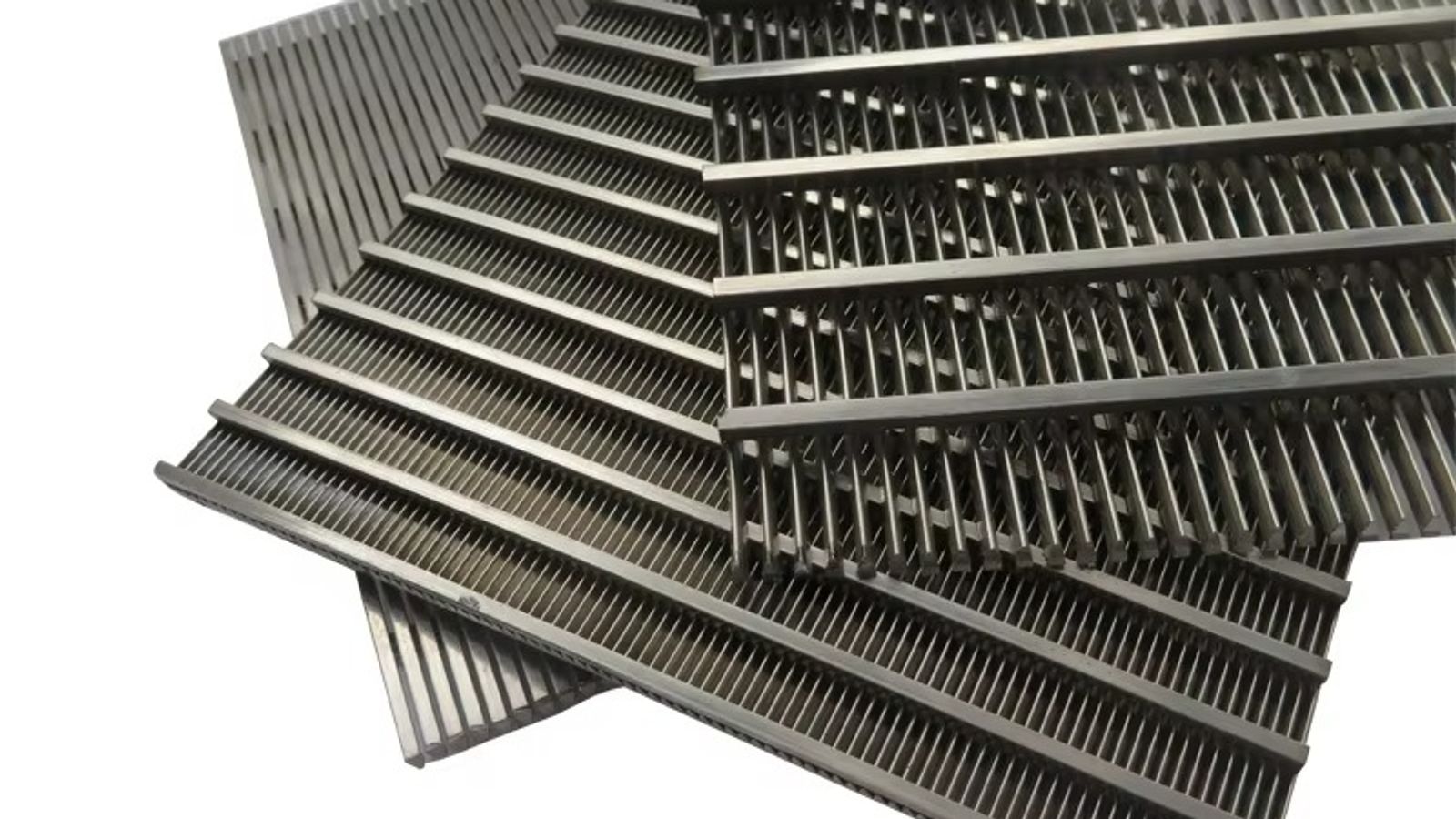
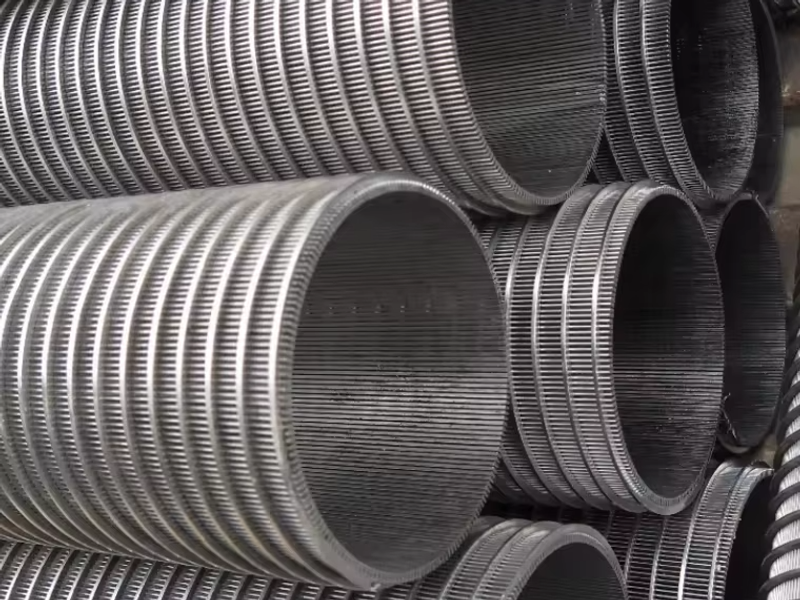
Wedge wire screens are fabricated by welding V-shaped profile wire around a circular array of longitudinal support rods. The V-wire is oriented with the wide face outward, creating a slot that widens inward — a self-cleaning geometry: any particle that passes the narrowest point at the outer face can pass entirely through. Slot openings are manufactured to tolerances of ±0.05 mm (50 µm), giving the design engineer precise control over the formation sand retention envelope.
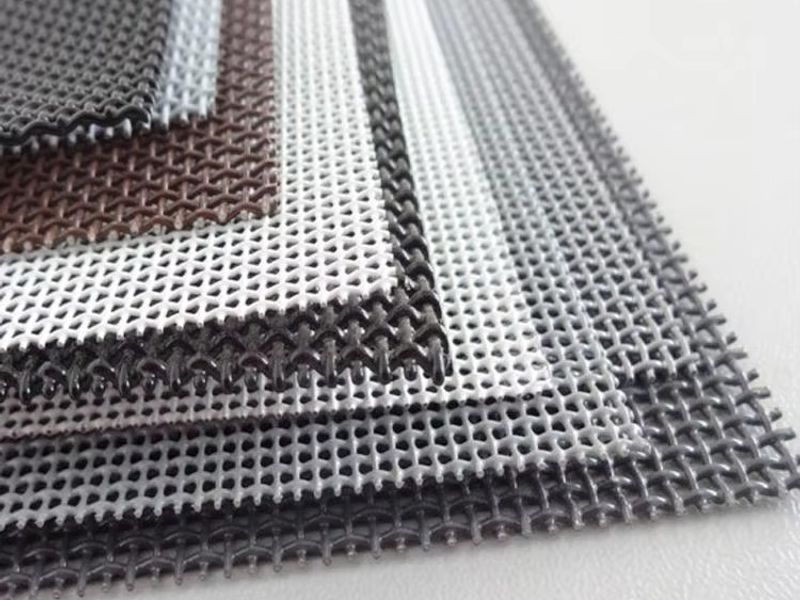
Woven mesh screens, in contrast, are constructed by wrapping layers of woven wire mesh (typically stainless steel 304 or 316) over a perforated base pipe. The mesh layers — often two or three of progressively finer count — are sinter-bonded or mechanically secured. Filtration openings are tortuous and irregular compared to wedge wire slots, and the effective pore size is a statistical distribution rather than a precise mechanical aperture.
Slot Accuracy: Why ±50 µm Matters
In well design, the screen slot size is chosen relative to the formation grain-size distribution — typically the d10 or d30 of the aquifer material. Oversizing the slot by even 100 µm can allow fine formation sand to continuously enter the well, eroding the pump impellers and gradually filling the well bore with sediment. Undersizing increases entrance velocity and plugging risk.
Wedge wire offers slot openings from approximately 0.10 mm (100 µm) to 6.0 mm, manufactured by the wire profile dimensions, with the ±0.05 mm tolerance verified by optical measurement. This makes wedge wire the preferred choice for wells in uniform, unconsolidated sand formations where precise sand exclusion is critical — municipal water supply wells, aquifer storage and recovery wells, and remediation wells.
Woven mesh has a filtration rating range from roughly 40 µm up to 500 µm, but the effective opening size is measured by bubble-point or porometry testing rather than a direct physical slot dimension. This makes woven mesh less predictable for applications where sand-size distribution data dictates a tight slot specification — but it enables finer absolute filtration than can be achieved with wedge wire, making mesh screens the choice for wells in very fine sand or silty formations, or for monitoring wells where turbidity must be minimized for representative sampling.
Open Area and Entrance Velocity
Open area percentage directly governs entrance velocity — the speed at which groundwater enters the well through the screen. The AWWA standard A100 recommends keeping entrance velocity below 1.5 cm/s to minimize encrustation, corrosion, and sand transport. Higher velocities accelerate all three failure mechanisms.
Wedge wire screens typically achieve 7–30% open area, depending on slot size and support rod spacing. The V-shaped wire profile inherently reduces open area compared to a square-edge aperture. For a given well diameter and design flow, the screen length must be sufficient to bring entrance velocity within the 1.5 cm/s limit — and wedge wire's lower open area often means specifying a longer screen interval.
Woven mesh screens can achieve 20–50% open area through their straight-through square apertures, enabling shorter screen intervals at the same flow rate. However, this advantage erodes as mesh wraps are stacked — a 3-layer sintered mesh may have a composite open area closer to 10–20%, comparable to or below wedge wire.
Collapse Strength and Mechanical Integrity
Deep wells exert enormous hydrostatic and formation pressure on the screen, and collapse is a catastrophic failure — the well must be re-drilled. Collapse resistance is a function of screen material, wall thickness, slot geometry, and support structure.
Wedge wire screens are inherently stronger than woven mesh constructions of equivalent diameter because the longitudinal support rods carry the full axial and radial load. Standard wedge wire screen in SS304 or SS316 can typically withstand 30–70 bar collapse pressure depending on diameter, rod count, and wall thickness. For depths beyond 500 meters, custom heavy-wall configurations are available with collapse ratings exceeding 100 bar.
Woven mesh screens rely on the perforated base pipe for structural integrity. The mesh layers themselves contribute negligible axial or radial strength. As a result, collapse rating is essentially the collapse rating of the perforated base pipe, reduced by the perforation pattern. With adequate base-pipe wall thickness, woven mesh screens can be specified for depths up to 300–400 meters. Beyond that, wedge wire is strongly preferred.
Plugging and Development
Every well screen will eventually experience some degree of plugging from chemical encrustation (calcium carbonate, iron bacteria), mechanical bridging of formation fines, or biofouling. The difference is how well the screen geometry resists plugging and how effectively it can be rehabilitated.
Wedge wire's V-shaped slot is the gold standard for plugging resistance. Because the opening widens inward, particles that enter the screen face cannot become wedged — they either pass through or remain outside. This geometry also responds well to mechanical surging and chemical rehabilitation: acid or bleach treatment contacts the entire slot surface, and surging can dislodge external filter pack material that has bridged against the screen face.
Woven mesh's tortuous pore path is inherently more difficult to clean — particles can lodge at multiple constriction points within the mesh thickness, and chemical treatment may not reach the full depth of deposited material. Surgical cleaning (jetting or brushing) risks damaging fine mesh layers. For wells in encrustation-prone aquifers with high iron or manganese concentrations, or in biofouling environments, wedge wire is the lower-lifecycle-cost choice despite higher initial cost.
Side-by-Side Comparison
| Parameter | Wedge Wire (V-Wire) | Woven Mesh | Notes |
|---|
| Slot/pore accuracy | ±0.05 mm (50 µm) | Statistical distribution (bubble-point) | Wedge wire is definitive for sand-control design |
| Filtration range | 100 µm – 6.0 mm | 40–500 µm (single layer) | Mesh reaches finer absolute filtration |
| Open area | 7–30% | 20–50% (single layer) / 10–20% (multi-layer) | Mesh provides higher open area per unit length |
| Collapse strength | 30–70 bar (standard) / 100+ bar (heavy-wall) | Limited by base pipe — typically 20–50 bar | Wedge wire is the definitive deep-well choice |
| Plug resistance | Excellent — V-slot is self-cleaning | Moderate — tortuous path traps particles | Wedge wire wins on life-cycle rehab cost |
| Cost | $$ — higher initial investment | $ — lower initial cost | Woven mesh cheaper upfront but may cost more over 20+ years |
| Typical depth limit | 500–1500+ m | 300–400 m | Depends on base-pipe specification and aquifer lithology |
| Best for | Municipal supply wells / deep aquifers / uniform sand / encrustation-prone water | Monitoring wells / silty formations / shallow domestic wells / gravel-packed completions | Select by aquifer depth and sand-control requirement |
All values are typical for SS304/SS316 construction. Specific products may exceed these ranges — consult the manufacturer's data sheet for the exact specification.
How to Choose
Choose wedge wire when your aquifer has reliable grain-size data, well depth exceeds 200 m, chemical encrustation is a known risk in the region, or the well must meet AWWA or similar municipal water-supply standards. The higher initial cost is recovered through longer service life and lower rehabilitation frequency.
Choose woven mesh when the formation is silty or poorly graded (requiring finer filtration than wedge wire can deliver), the well is relatively shallow, or the application is temporary or monitoring-only — where the capital cost saving is decisive and long-term rehabilitation access is not required.
In many wells, the optimal design uses both technologies: wedge wire for the primary producing intervals where precise sand control is critical, and mesh-wrapped blank casing or shorter screen sections for monitoring zones or intervals where finer silt filtration is needed. A well-designed completion doesn't have to pick one technology exclusively.
Kaifil manufactures wedge wire screen pipe in standard diameters from 50 mm to 600 mm, with slot openings from 0.10 mm to 6.0 mm, in stainless steel 304, 316, and duplex alloys for aggressive water chemistry. Custom lengths, end connections, and centralizer configurations are available. Send us your well design parameters — depth, casing diameter, target flow rate, and formation sieve analysis — for a screen recommendation.