Selection Guide
Juice & Beverage Clarification: Stainless Steel Filter Guide
Learn how to choose stainless steel mesh and cartridges for juice clarification from coarse straining to final polishing. Contact KAIFIL for food-grade filters.
Learn how to choose stainless steel mesh and cartridges for juice clarification from coarse straining to final polishing. Contact KAIFIL for food-grade filters.
Juice clarification filtration is the multi-stage mechanical separation of pulp, pectin, haze-forming colloids, and suspended solids from fruit or vegetable juice using reusable stainless steel media rather than single-use filter sheets, paper, or disposable polymer cartridges. A typical clarified line runs three stages: coarse straining at 20 to 60 mesh, clarification at 100 to 300 mesh (roughly 25 to 75 micron), and final polishing down to 5 to 20 micron before filling. The media are chosen to handle single-strength juice at 10 to 14 °Brix and concentrated juice at 60 to 70 °Brix, operate at pasteurization and hot-fill temperatures of 85 to 95 °C, and survive aggressive clean-in-place (CIP) cycles with 1 to 2% caustic at 75 to 85 °C. Because they are made of welded 304/316L stainless steel, these filters are cleaned and returned to service hundreds of times, which is why high-throughput beverage plants standardize on them instead of disposable depth media.
Mesh count and micron rating are two ways of describing the same filter opening, and confusing them is the most common specification error in juice plants.
Mesh count is the number of openings per linear inch of woven wire. A 20-mesh screen has 20 openings per inch in each direction; a 400-mesh screen has 400. Higher mesh equals smaller openings. Because woven wire is square-mesh, you can convert mesh to a nominal opening: 20 mesh ≈ 840 µm, 40 mesh ≈ 400 µm, 100 mesh ≈ 150 µm, 200 mesh ≈ 74 µm, and 400 mesh ≈ 37 µm.
Micron rating is the nominal particle size the filter retains, stated in micrometers. It is more commonly used for cartridges and sintered media than for woven cloth, because a sintered or pleated element does not have a uniform square opening like a screen. A "10 micron" cartridge retains most particles above 10 µm across its depth.
Two practical rules follow. First, specify coarse stages in mesh (they are screens) and fine stages in microns (they are cartridges). Second, remember that a filter rated to retain particles at a given micron size has an opening larger than that size, so do not order a "50-micron clarification cartridge" and expect it to behave like a 300-mesh screen. KAIFIL's plain weave wire mesh pages publish both mesh and opening micron for every weave, which is the reference you need when drafting a spec.
The first filter after the crusher or press removes gross solids: seeds, skin fragments, stem pieces, and the coarsest pulp. This stage protects every downstream pump, heat exchanger, and fine filter. Use 20 to 60 mesh woven stainless steel screens or stainless steel perforated filter baskets installed in a duplex housing so one basket can be lifted and cleaned while the other stays on line.
Design the coarse stage for a high open area. A 20-mesh screen has roughly 50% open area, so a correctly sized basket handles 50 to 150 m³/h with a clean pressure drop under 0.2 bar. For pulpy juices like mango or peach, many plants use a 30-mesh basket as a first pass and a 60-mesh screen as the second, because a single finer screen blinds quickly when it must also hold back the coarse material. The goal here is not clarity; it is protecting downstream equipment and extending the run time of the clarification filter.
Clarification is where the juice actually becomes bright. After coarse straining, the juice still contains colloidally dispersed pectin, tannins, protein-polyphenol complexes, and suspended cell debris that make it hazy. In a conventional process, pectinase enzymes are dosed to break down pectin before filtration; in either case, the clarification filter must retain the flocculated material, typically at 25 to 75 micron.
For this duty, sintered wire mesh filter cartridges are the standard choice. Sintered mesh fuses multiple woven layers into a rigid, porous matrix, giving a depth-like retention curve with the cleanability of a screen. A typical 20-inch sintered cartridge in a 7-cartridge housing runs 20 to 40 m³/h at a design flux of 1 to 3 m³/m²/h, and the housing is cycled backflush or cleaned in place when differential pressure reaches 1.5 to 2.5 bar. On clear-apple or clarified-grape lines, this stage removes the haze precursors so thoroughly that downstream polishing sees almost no loading.
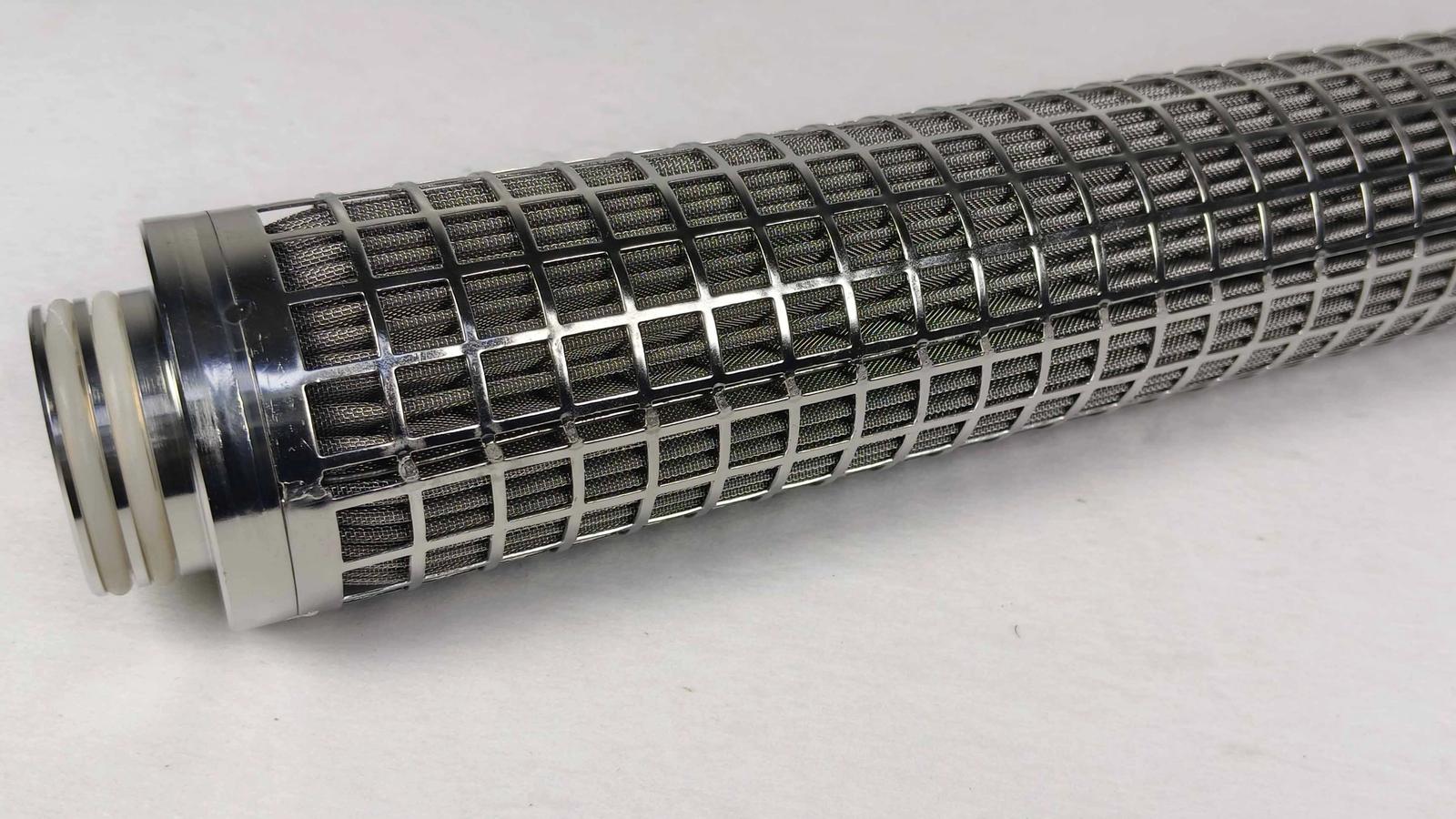
The polishing step catches the last fines so the filled product stays bright on the shelf. Retention should be 5 to 20 micron, and it is sized generously because polishing cartridges are the most expensive to run per cubic meter of juice. Pleated filter cartridges are preferred here: the pleats multiply the effective area severalfold over a plain cylinder, so a 10-inch pleated cartridge handles roughly 1.5 to 3 m³/h of clarified juice while keeping pressure drop low. On aseptic and hot-fill lines, polishing is placed after the final heat exchanger and before the filler, so the element must tolerate continuous service at 85 to 95 °C. A clean 5-micron pleated cartridge typically starts at 0.1 to 0.2 bar and is cleaned when it reaches 1.5 bar.
| Media type | Best stages | Typical micron range | Cleanability | Lifetime cost |
|---|---|---|---|---|
| Woven wire mesh (screen; plain or twill weave) | Coarse straining; pulp removal; light clarification | 37–840 µm (20–400 mesh) | Excellent; lifts out of a basket or backflushes; no pleats to plug | Lowest; wire cloth lasts years; only gaskets are consumable |
| Pleated filter cartridge (stainless steel) | Final polishing; fine clarification | 1–40 µm typical (pleated sintered fiber down to 1 µm) | Good; pleats need forward flush plus soak cycle; hold fines that need longer CIP | Moderate; higher element cost; but large area extends run time between cleans |
| Sintered metal cartridge (sintered mesh / powder) | Clarification; final polishing | 5–75 µm standard; down to 1–5 µm | Excellent; rigid structure survives backflush at 3–5 bar differential and repeated CIP | Low to moderate; higher first cost; longest service life on abrasive juice streams |
Not every juice is meant to be crystal clear. This is the single biggest filter-selection trap for new beverage lines.
Clear juices (clarified apple, grape, pear) are filtered to a target of 0 to 10 NTU turbidity, which in practice means a clarification stage at 25 to 50 micron followed by a 5 to 10 micron polish. The enzyme-treated juice is filtered hot, before concentration, because clarified concentrate is the shelf-stable product.
Cloudy juices (orange, many tropical blends) are intentionally left turbid, with a stable haze of 300 to 600 NTU, because consumers associate cloudiness with fresh pulp. For these, the clarification stage must not remove the colloids. Use only a coarse 40 to 80 mesh screen to remove seeds and rag, and skip the fine clarification entirely; a too-fine filter will strip the cloud and change both the flavor and the appearance of the brand.
Pulp content handling matters too. High-pulp juices (mango, peach, tomato) blind fine media quickly. On these lines, keep the coarse basket stage coarse — 20 to 40 mesh — and protect the fine stage with a swing-batch or rotary-drum pre-filter rather than forcing the cartridge housing to accept the full pulp load.
Any filter that touches juice must satisfy food-contact and hygienic design requirements, and this is where stainless steel has a decisive regulatory advantage over paper and polymer media.
Material of construction should be 304 or, preferably, 316L stainless steel for the wetted parts, with FDA food-contact compliance for any elastomer seals. KAIFIL publishes FDA compliance guidance for food-grade SS316 filter mesh, covering alloy selection, leachables, and documentation for audits. Surface finish is a specification line, not a detail: interior surfaces in contact with juice should be mechanically or electropolished to Ra ≤ 0.8 µm, and ideally Ra ≤ 0.4 µm in the final polishing stage, so that product contact surfaces shed soil instead of trapping it in microscopic roughness.
Woven and sintered stainless media also remove a liability that paper and depth cartridges carry: media migration. A torn filter sheet or a shedding cellulose cartridge puts fibers directly into the juice. A stainless element cannot shed, and if it is damaged it fails as a crack that is visible during inspection, rather than as invisible fiber contamination.
The entire economic case for stainless steel filtration rests on clean-in-place. A typical juice-line CIP sequence for stainless elements runs as follows:
The design details matter as much as the chemistry. Cartridges should be installed in housings with no dead legs, vents at the high point, and a drain at the low point, so CIP solution reaches every wetted surface. Sintered and woven elements tolerate the thermal and chemical load of repeated CIP without the swelling, delamination, or loss of structural strength that destroys polymer depth media. KAIFIL's CIP-cleanable stainless steel filter design walks through housing geometry, flow distribution, and validation steps.
One caution: differential pressure during cleaning should be managed. Never backflush a woven or sintered element past its rated reverse-pressure limit, and confirm with the manufacturer that the element is designed for backflush rather than forward-flow-only cleaning, because forcing flow the wrong way through an element rated for forward flow can permanently collapse the media.
The disposables-versus-stainless decision comes down to cost per cubic meter at production scale.
A paper filter press or a polypropylene depth cartridge is cheaper to buy per unit, but it is used once and thrown away. On a line running 50 m³/h, a 10-micron polishing stage that consumes a bank of 40-inch depth cartridges every shift generates thousands of kilograms of wet, juice-contaminated waste per month, each change-out costs a halt in production, and every housing open exposes the product to contamination risk. A stainless pleated or sintered element of the same retention costs several times more up front but is cleaned in place, in place, hundreds of times over a 5- to 10-year service life. The breakeven is usually reached within months on any line running more than a few hours per day.
There are three reasons this holds specifically for beverage lines. First, juice is a high-throughput, low-value-per-liter product, so unscheduled stops for media change kill margin. Second, juice runs hot — 85 to 95 °C at pasteurization and hot fill — which is exactly the regime that degrades polymer media and where stainless is strongest. Third, the same hygienic design that protects product also protects the filter: the CIP program that keeps a stainless element clean would soften, swell, or prematurely load a paper or polymer element.
For a plant that already runs hot juice, the total cost of ownership favors reusable stainless media at every stage: perforated baskets for coarse work, sintered cartridges for clarification, and pleated cartridges for the final polish. The disposable filter is not eliminated entirely — many plants keep a safety cartridge at the filler — but it moves from a consumable to an emergency spare, and media cost drops by an order of magnitude.
What mesh count should I use for coarse straining juice? Start with 20 to 40 mesh for gross solids (seeds, skin, stem pieces) and 60 mesh for a second-pass pulp screen on pulpy fruits. Below 20 mesh the openings are large enough to pass undesirable solids; above 60 mesh the screen blinds quickly on unclarified juice.
What is the difference between mesh count and micron rating? Mesh count is the number of openings per linear inch of woven screen; micron rating is the particle size a filter retains. As an example, 100 mesh ≈ 150 µm opening, and 400 mesh ≈ 37 µm. Screens are specified in mesh, cartridges in microns, and the two systems should not be treated as interchangeable.
Can stainless steel filters clarify juice without fining agents? Yes, for physical clarification of suspended solids and haze. Pectinase enzyme dosing is still normally required to break down soluble pectin so the colloidal haze collapses into particles the filter can retain. Stainless media removes the need for filter aids like diatomaceous earth on most lines, because it filters in depth rather than by building a cake.
How do you clean a stainless steel filter after filtering juice? Use a CIP sequence of a hot water pre-rinse, 1 to 2% NaOH at 75 to 85 °C for 30 to 60 minutes, a rinse, 0.5 to 1% nitric acid at 60 to 70 °C for 15 to 30 minutes, and a final rinse. Sintered and pleated elements can also be backflushed at 3 to 5 bar if the element is rated for reverse flow.
Are stainless steel filters FDA food-contact compliant? Yes, when made from 304 or 316L stainless steel with FDA-compliant elastomer seals and an interior surface finish of Ra ≤ 0.8 µm (ideally Ra ≤ 0.4 µm) in product-contact areas. Request alloy certs and FDA documentation from the manufacturer to satisfy an audit.
Choosing the wrong mesh or micron at any stage shows up as turbid product, short runs, or wasted media. KAIFIL manufactures food-grade stainless steel filters for every stage of juice and beverage clarification — woven mesh screens, perforated baskets, sintered wire mesh cartridges, and pleated cartridges — with custom micron ratings from 1 to 400 µm, hygienic surface finishes, and CIP-cleanable designs built for hot, high-throughput lines. Send your juice type, Brix, flow rate, and target turbidity, and the engineering team will recommend a stage-by-stage filtration package, provide drawings, and ship samples for your trial. Contact KAIFIL to spec your food and beverage processing filtration today.
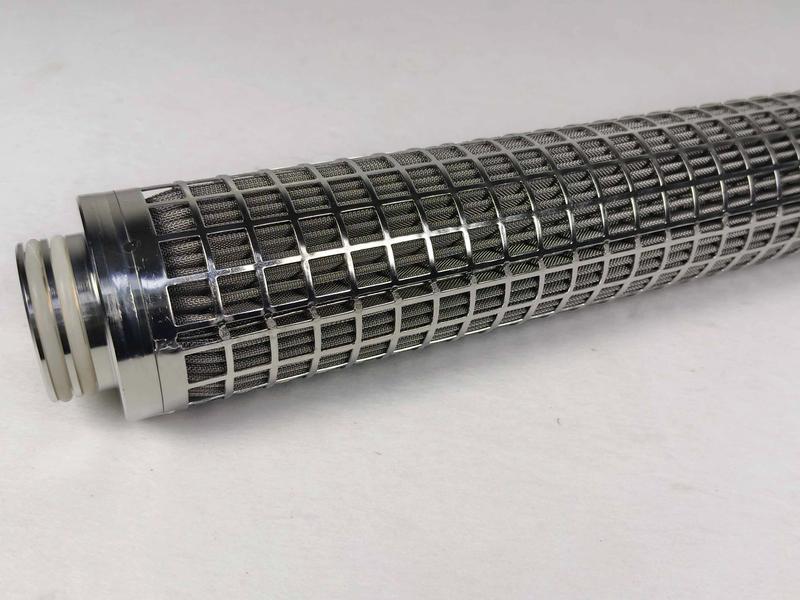
High-area pleated metal filter cartridges with custom media, end caps and seals.
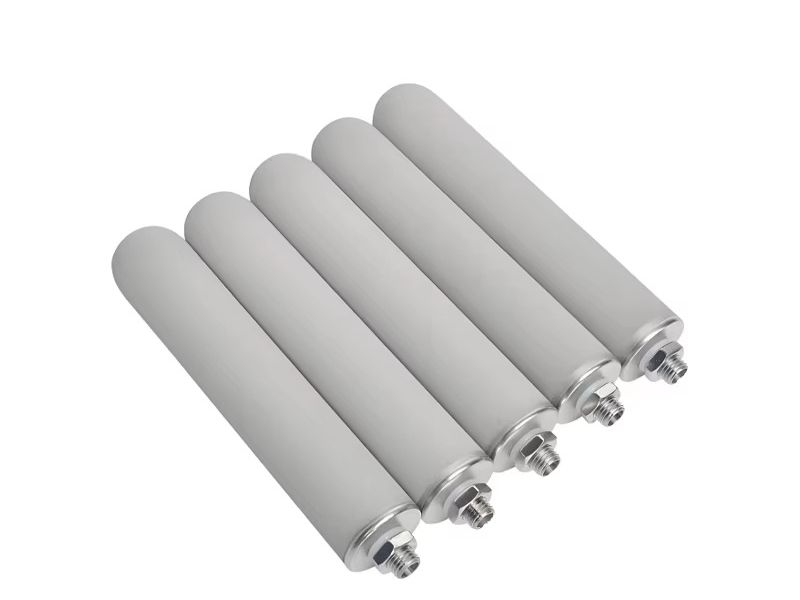
Cartridges / tubes / cylinders for reusable cartridge filtration with rigid sintered mesh media, supplied to drawing with material, size and packing details confirmed at RFQ stage.
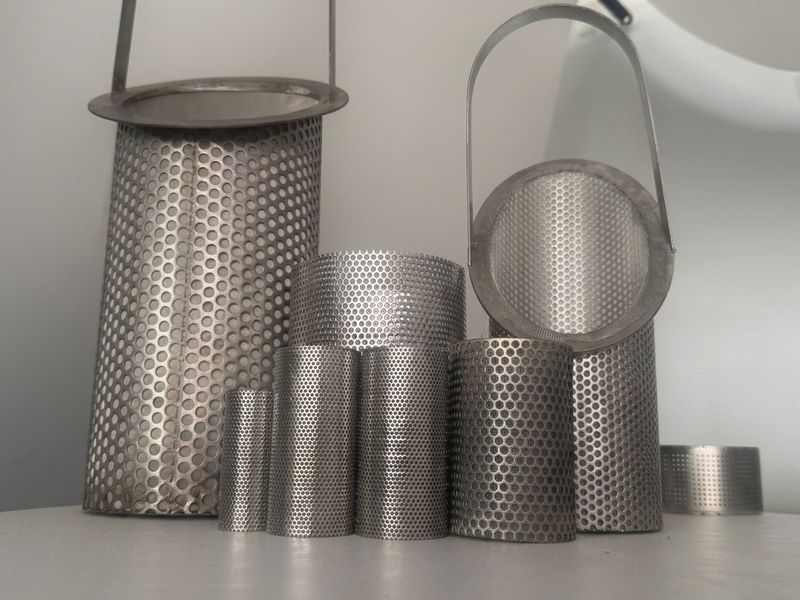
Made-to-drawing SS304, SS316 and SS316L perforated baskets for liquid straining, equipment protection and removable process screens.
Send drawings, dimensions, material, environment or operating conditions, and we will help confirm the right specification.
Uploaded reference files are included with the inquiry. For larger CAD packages, reply to the confirmation email or send them here:
Our team typically replies within 24 business hours.