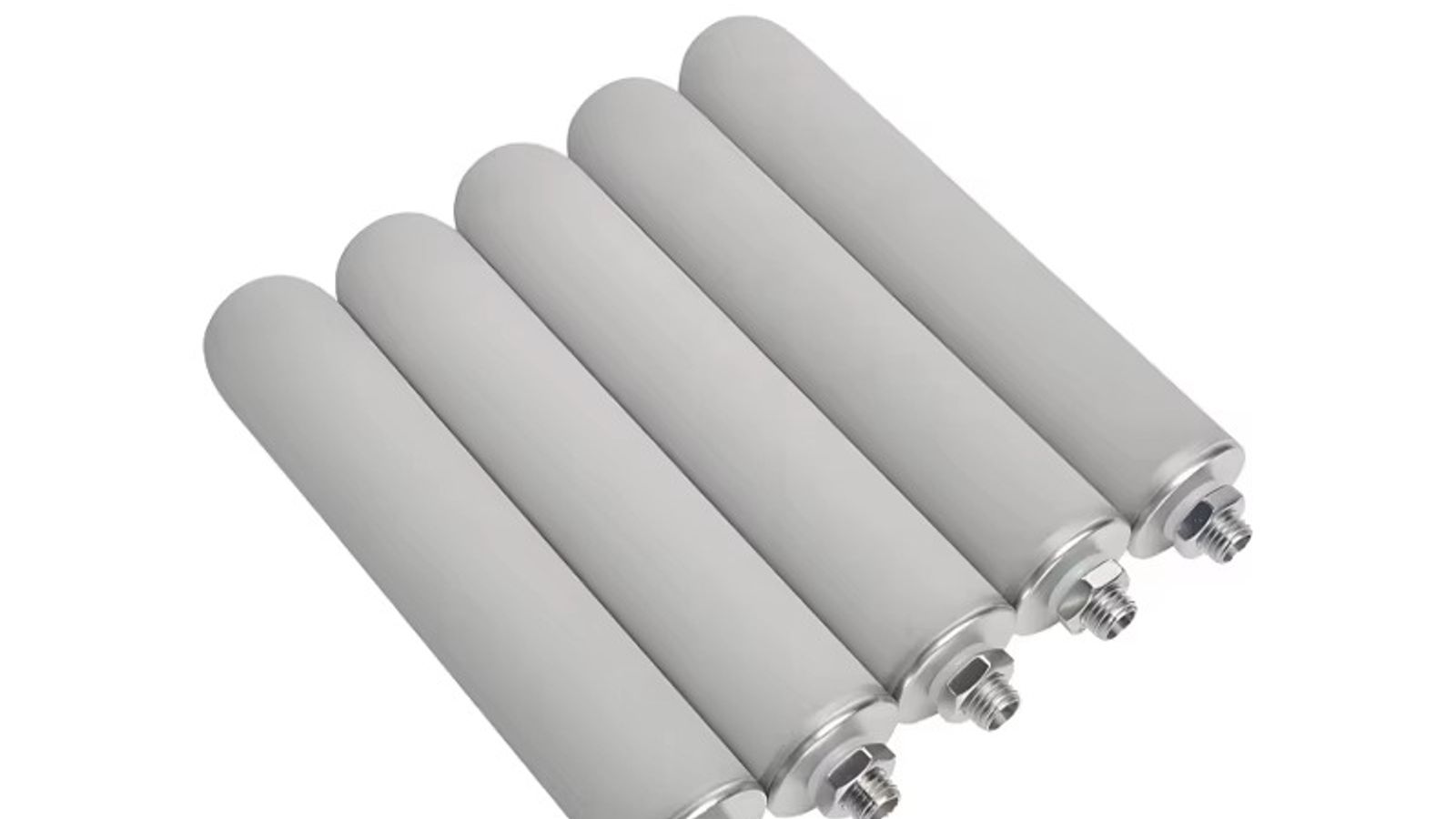
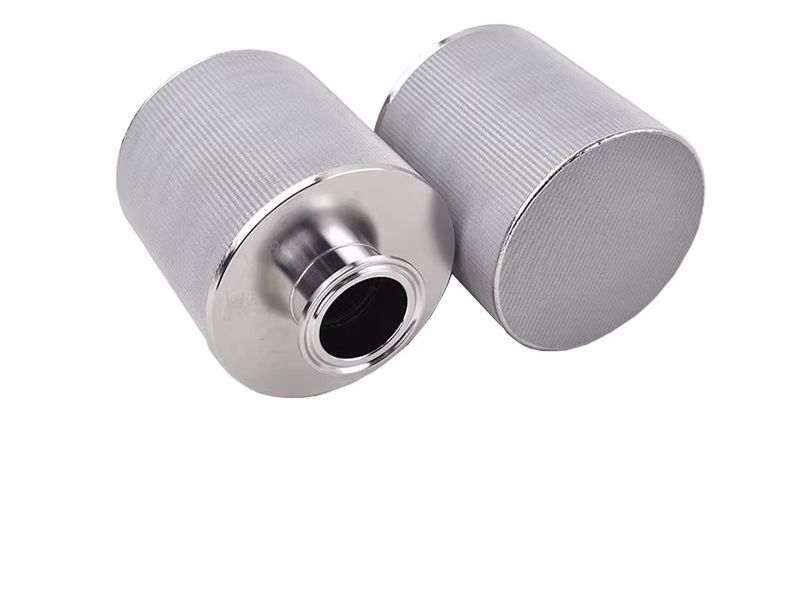
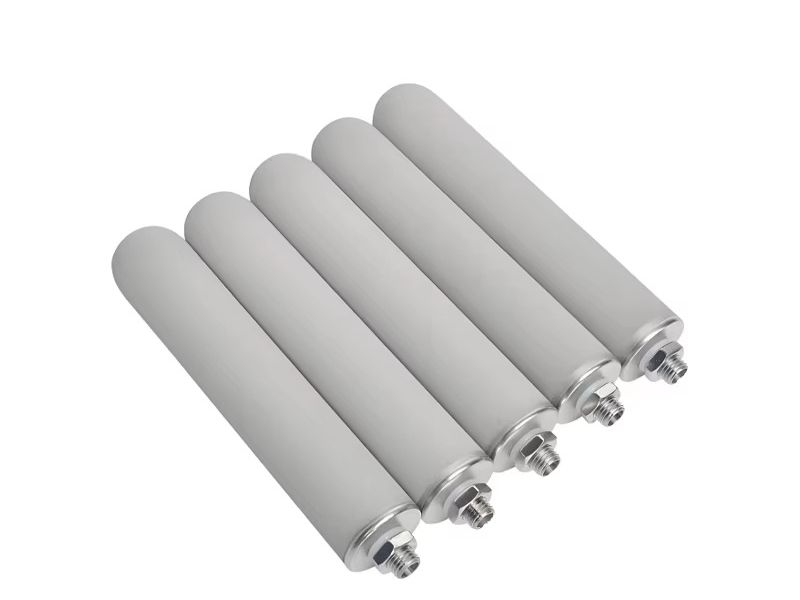
Pharmaceutical filter validation is the documented process by which a filter element is proven, through material traceability, integrity testing, and qualification records, to perform its intended separation function consistently under defined process conditions. For a reusable stainless steel filter this means far more than a disposable-membrane lot release. It means an element whose 316L metallurgy is certified (carbon ≤ 0.03%, molybdenum 2.00–3.00%), whose pore structure is confirmed by a wet bubble point test inside a defined pressure window — typically 0.3–2.5 bar (30–250 kPa; 4–36 psi) for 2–20 μm sintered ratings — and whose wetted surfaces carry an electropolished finish of Ra 0.4–0.8 μm. This article walks pharmaceutical QA, validation, and process engineers through the five pillars of metal-filter validation: regulatory context, material certificates, integrity testing, filtration rating data, and the DQ/IQ/OQ/PQ documentation package.
Regulators treat filtration as a critical process step. FDA 21 CFR Part 210 and 211 require drug products to be manufactured under conditions that ensure identity, strength, quality, and purity, and they place filtration squarely inside good manufacturing practice (GMP). EU GMP Annex 1, in its 2022 revision, sharpened the contamination-control lens: every filter in the process must be justified, demonstrated fit for purpose, and backed by documented evidence. USP adds the product-quality view through chapters such as <788> (Particulate Matter in Injections) and <665> (construction materials): the filter must not become a source of particles, extractables, or contamination itself.
For a single-use membrane, "validated filter" is largely synonymous with the manufacturer's lot release — a documented retention rating, a correlated non-destructive integrity test, and one use. For a reusable metal element the situation is different and, in some ways, more demanding. The filter is expected to survive years of service, dozens or hundreds of cleaning cycles, repeated steam sterilization, and aggressive chemicals — and to keep performing at a defensible level. Validation therefore must cover the entire lifecycle: the material it is made from, the integrity evidence after each cleaning and sterilization, the cleaning process itself, and the point at which the element is retired. This is why a pharmaceutical buyer should evaluate a metal filter vendor on documentation as much as on hardware.
Material Certificates: The Traceability Backbone
The first and most fundamental validation document for any stainless steel filter is the mill certificate that ties the material back to its melt.
EN 10204 3.1 and 3.2 Certificates
EN 10204 defines the types of inspection documents that accompany metallic products. The two grades that matter in pharmaceutical filtration are 3.1 and 3.2. An EN 10204 3.1 certificate is issued by the manufacturer and declares that the products supplied comply with the order requirements, with the results of the tests performed attached. A 3.2 certificate goes one step further: it is validated by a party independent of the manufacturer, typically a notified body or an inspector appointed by the buyer. For critical pharmaceutical applications, many QA departments require 3.2 on the wetted alloy and 3.1 on the finished filter element.
316L Chemistry That Holds Up
The "L" in 316L means low carbon — 0.03% maximum — which prevents sensitization and carbide precipitation during welding and high-temperature processing, a prerequisite for corrosion resistance in CIP/SIP environments. The molybdenum content (2.00–3.00%) is what gives 316L its resistance to chloride pitting and crevice corrosion. By contrast, 304 stainless has no molybdenum specification and a higher allowable carbon, making it acceptable for less aggressive duty but a poor choice for repeated exposure to hot chloride and acid cleaning regimes. The certificate should show the full ladle analysis: carbon, manganese, phosphorus, sulfur, silicon, chromium, nickel, and molybdenum. We compare the two alloys in more detail in our guide to 304 vs 316 wire mesh corrosion resistance.
Surface Finish
A certificate says what the metal is; the surface finish says how it behaves in contact with product. Electropolishing removes the work-hardened layer, micro-burrs, and embedded contamination left by drawing and weaving, leaving a smooth, chromium-enriched surface that resists sticking and is far easier to clean. For pharmaceutical service, specify an electropolished finish in the range Ra 0.4–0.8 μm on wetted surfaces — and ask the vendor to state the measured finish on the certificate rather than accepting a generic "electropolished" claim.
Melt Number Traceability
Melt number traceability ties every wire spool, weave batch, and finished element back to a specific heat of steel. If a QA investigation ever needs to determine whether a batch of elements is affected by a raw-material anomaly, the melt number is the link that makes the question answerable. A vendor that can walk an element from its melt, through the certificate, to the finished filter has the traceability chain that validation protocols and regulators expect.
Integrity testing is the set of non-destructive tests that confirm a filter is physically sound — no cracks, tears, out-of-spec pores, or leaks in seals and welds. For membranes, integrity tests are correlated to bacterial retention during qualification. For sintered metal and woven mesh the same physics applies, with one caveat: correlation to sterilizing-grade retention is not the usual objective. The test is run to confirm the element is structurally intact and consistent with its specification.
Bubble Point Test
The bubble point is the pressure at which the first continuous stream of gas bubbles is expelled from the largest wetted pore. The element is wetted with a liquid of known surface tension, gas pressure is applied slowly, and the operator records the first steady stream of bubbles. Because bubble point pressure is inversely proportional to pore diameter, a measured bubble point above a minimum threshold demonstrates that no pore exceeds the specified size.
For wet sintered 316L elements, first-bubble values typically fall between 0.3 and 2.5 bar (30–250 kPa; 4–36 psi), depending on the rated pore size — a 2 μm-rated element bubbles at a higher pressure than a 20 μm element. The exact window depends on the wetting fluid; many metal-filter users wet with a surfactant or a water/isopropanol mixture to obtain repeatable readings. KAIFIL publishes recommended test fluids and minimum bubble point values for each sintered metal filter element rating so that QC departments can set their own acceptance limits.
Forward Flow / Diffusion Test
At a pressure below the bubble point, gas can still cross a wetted filter by diffusion: it dissolves into the wetting liquid on one side and comes out of solution on the other. The diffusion (forward flow) rate is proportional to the total open wetted area and the pore structure. A damaged element, with its enlarged pores, shows a measurably higher forward flow at the same test pressure. The test is more sensitive than the bubble point for detecting gradual damage, which is why it is the method usually favored for larger-area cartridges.
Pressure Hold Test
The pressure hold test is a variant: the system is pressurized to a set point below the bubble point, isolated, and the pressure decay over a fixed time window is measured. A rapid decay indicates a leak path. The method is simple, fast, and ideal for routine post-CIP and post-SIP checks, especially on vent filters and housings.
When Is Integrity Testing Required?
For sterilizing-grade membrane filtration, integrity testing before and after each use is mandatory in practice under Annex 1. For metal filters used as prefilters, vent filters, or point-of-use particulate filters, integrity testing is required when the filter supports a claimed critical function — a sterile vent on a fermenter or hold tank, for example — and recommended on a scheduled basis otherwise, typically after each cleaning and at defined intervals during service. An element that fails its bubble point test is evidence that cleaning or handling has damaged it; it must be re-cleaned, repaired, or replaced. Because metal filters are cleaned rather than discarded, integrity testing after cleaning is what makes reuse defensible.
Filtration Rating and Validation Data
Rating a filter is more subtle than quoting a micron number. An absolute rating means the filter retains essentially all particles larger than the rated size under defined test conditions, usually verified by a challenge with a known contaminant. A nominal rating is statistical, typically retaining a stated percentage — often 90–98% — of particles at that size. In pharmaceutical documentation, absolute ratings carry the weight because they are defensible in a protocol.
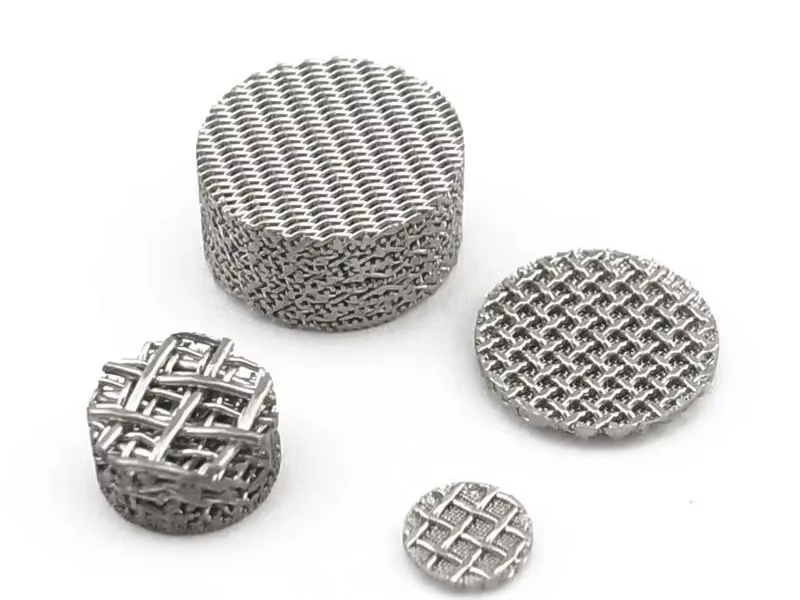
Five-layer sintered mesh — two protective layers of coarse mesh, a central precision-woven layer, and two support layers fused into a single structure — gives the alloy the mechanical strength to be fabricated into cartridges, discs, and elements while holding a tight, reproducible pore structure. Standard ratings for pharmaceutical-style five-layer sintered mesh media run from approximately 2 μm to 20 μm. That places sintered metal squarely in the prefilter and particle-removal space, ahead of a final sterilizing-grade membrane.
On bacterial retention: a sintered metal element is not normally specified for sterilizing-grade liquid filtration in the way a 0.2 μm-rated membrane is, because the bacterial challenge standard — retention of Brevundimonas diminuta at ≥ 10^7 cfu/cm² — is a membrane-filtration paradigm. Metal filters nonetheless carry real weight in biopharma: sterile vent gas, compressed air, solvents and aggressive chemicals, and prefiltration that protects the final membrane. When bacterial retention is claimed on a metal element, the vendor must provide the challenge data and a correlated integrity test, and the buyer should treat the claim with the same rigor as a membrane claim.
Two USP chapters frame the product-quality side. USP <788> sets limits on particulate matter in injections; a filter that sheds particles — through corrosion, media migration, or poor welds — works against compliance. USP <665> addresses construction materials and the cleanability expectations for components used in drug manufacturing; although written for polymeric components, its logic — qualified materials, controlled surfaces, and demonstrated cleanability — is exactly the standard a documented 316L element with electropolished surfaces is built to meet. Unlike a polymer, a well-passivated 316L filter has no meaningful extractables profile, which is one reason metal filters remain attractive for solvent, hot, and otherwise aggressive streams.
Documentation Package and Qualification: DQ/IQ/OQ/PQ
Validation of a filter installation follows the classic four-stage framework. Design Qualification (DQ) confirms the chosen filter matches the process need: the right rating, the right material and surface finish, the right housing, and the right flow and pressure capability. Installation Qualification (IQ) documents that the filter and housing were installed correctly and that equipment records are complete. Operational Qualification (OQ) runs the filter under defined conditions to demonstrate it performs as designed, including the integrity test procedure and its acceptance limits. Performance Qualification (PQ) demonstrates consistent performance under actual process conditions over time.
The metal-filter difference is in the re-validation loop. Cleaning validation proves that the CIP procedure reproducibly removes product residue without degrading the element, and it must include evidence that integrity survives the cleaning. CIP for 316L sintered elements typically uses caustic washes (for example 0.5–1% NaOH), followed by acid rinses (nitric or citric acid) and high-purity water rinses; SIP with steam at 121–134°C is routine. Because the element is reusable, the qualification file must specify the number of cleaning and sterilization cycles the element is designed to withstand, or a monitoring plan — periodic bubble point and pressure-drop checks — that catches degradation before it matters. KAIFIL's sintered wire mesh filter cartridges and related elements are designed to hold up through hundreds of CIP/SIP cycles when operated within their rated temperature and differential-pressure limits.
Service life is determined not by calendar alone but by evidence: rising clean pressure drop, falling bubble point, visible media damage, or corrosion. A well-run program re-qualifies the element after a defined number of cycles or a defined interval, and always after a significant process change. The vendor's role is to supply the baseline data — material certificates, dimensional drawings, flow curves, and recommended integrity test limits — that make re-validation possible. For a closer look at how sintered mesh elements are constructed and why the layer structure matters, see our post on five-layer sintered mesh structure and uses.
| Criteria | Sintered metal element | Pleated stainless cartridge | Disposable membrane cartridge |
|---|
| Typical rating | 2–20 μm (down to ~0.5 μm in specialty media) | 5–100 μm; coarse particulate duty | 0.2 μm and finer; sterilizing grade |
| Integrity test method | Bubble point; forward flow; pressure hold | Bubble point / pressure hold | Correlated bubble point or forward flow (required pre/post-use) |
| Cleanability | Excellent — CIP/SIP; autoclave; back-flush; designed for hundreds of cycles | Good — CIP/SIP capable; robust pleat pack | None — single use |
| Sterilization | Autoclave and SIP at 121–134°C; repeated | SIP capable | Gamma/EO or pre-sterilized; single use |
| Lifecycle cost | Highest first cost; lowest per-use cost over years of reuse | Moderate; reusable; suited to high particulate loads | Lowest first cost; recurring consumable cost |
The pleated stainless option — a pleated filter cartridge built from sintered or woven stainless media — is a middle path for high-flow particulate removal where a disposable membrane would be consumed too quickly. The membrane remains the default for final sterilizing filtration; the sintered element is the workhorse that protects it.
FAQ
Do metal filters need integrity testing? Yes, whenever the filter serves a critical function — a sterile vent, a product-protective prefilter, or a filter whose failure would compromise product quality. In critical service, test before and after use; in routine particulate service, test after cleaning and on a defined schedule. The test physics are the same as for membranes: bubble point, forward flow/diffusion, and pressure hold.
What is an EN 10204 3.1 certificate? It is an inspection document issued by the manufacturer declaring that the supplied material complies with the order requirements, with the results of the required tests attached. The 3.2 variant adds independent third-party validation. For pharmaceutical service, ask for 3.1 on the finished element and consider 3.2 on the wetted alloy.
Can sintered stainless filters be autoclaved and CIP'd? Yes — that is their principal advantage over single-use membranes. 316L sintered elements tolerate repeated autoclaving and SIP at 121–134°C, plus caustic and acid CIP regimes, provided the cleaning parameters stay within the vendor's recommended limits. Integrity testing after each cleaning is what makes the reuse defensible.
How often must a metal filter be re-qualified? There is no fixed legal interval; the answer is risk- and evidence-based. Typical programs re-qualify after a defined number of CIP/SIP cycles, at a defined calendar interval, and after any significant process change — and always when integrity or pressure-drop monitoring shows drift. The vendor's baseline data is what makes this possible.
Are stainless filters absolute-rated? Some are. Absolute rating is a test result, not a property, and it depends on the challenge method. Five-layer sintered mesh elements are available with validated absolute ratings in the 2–20 μm range; below that, treat claims as nominal unless the vendor provides challenge data and a correlated integrity test.
Get the Documentation You Need for Your Filter Validation
Choosing a filter element is only half of the purchasing decision; the other half is the evidence that lets your validation team sign off. When you request a quote from KAIFIL, ask for the EN 10204 3.1 certificates, the surface finish measurements, the flow curves, and the recommended integrity test limits for the sintered metal filter elements you specify — we will supply them with the hardware. For pharmaceutical and chemical applications, our filtration engineers can help you match the rating, finish, and documentation package to your process and your regulators' expectations. Contact KAIFIL today with your application details and receive a documented validation package with your quotation.