Every woven wire mesh starts with the same basic operation: warp wires running lengthwise, weft (shute) wires running crosswise, interlaced at right angles. But the pattern of that interlacing — the weave type — changes everything: opening geometry, flow capacity, mechanical strength, particle retention, and cleanability. Choosing the wrong weave means either premature clogging, insufficient filtration, or structural failure under differential pressure.
This guide breaks down the three fundamental weave families — plain weave, twill weave, and Dutch weave (plain Dutch and twill Dutch) — so you can specify the right mesh with confidence, whether you are sizing a general-purpose strainer or a precision hydraulic filter.
Plain Weave — The Industry Standard
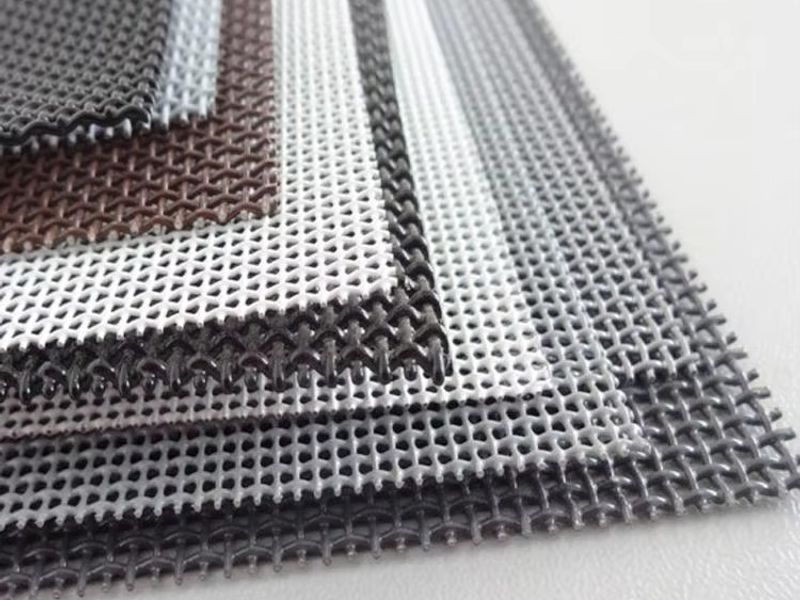
Plain weave is the simplest and most widely used wire mesh construction. Each weft wire passes alternately over one warp wire and under the next, producing a symmetrical 1×1 crisscross grid. Warp and weft wires typically share the same diameter, creating uniform square openings that are directly visible when you look at the mesh face-on.
This symmetrical structure gives plain weave its defining strengths. The uniform aperture geometry means predictable, repeatable particle retention — critical for sizing and grading applications where missing a single oversized particle is unacceptable. The straight-through openings maximize open area for a given wire diameter, delivering the highest flow rates and lowest pressure drop among all weaves. Every wire intersection is a friction point that resists wire migration, giving plain weave excellent dimensional stability even under moderate load. And maintenance is straightforward: the simple geometry responds well to backflushing, ultrasonic cleaning, and mechanical brushing.
Plain weave is the default choice for general industrial screening, test sieve cloth, architectural and security mesh, protective equipment guards, basket strainers, and ventilation grilles. It is manufactured in a vast range of mesh counts — roughly 2 to 400 mesh — and can be woven from virtually any ductile metal: stainless steel 304 and 316, plain carbon steel, brass, copper, aluminum, and high-nickel alloys.
Its limitation is mechanical. The 1×1 pattern forces each wire to bend sharply at every intersection. As mesh count increases, wire diameters must decrease, and the achievable wire tension reaches a ceiling. For filtration targets below roughly 60 µm, or for environments with heavy solids loading and vibration, plain weave runs out of headroom.
Twill Weave — Built for Heavy Loads
Twill weave modifies the interlacing pattern: each weft wire passes over two warp wires, then under two, creating a distinctive diagonal pattern across the surface. This seemingly minor change — a 2×2 pattern instead of 1×1 — has major structural consequences.
Because each wire crosses fewer intersections per unit length, twill weave accommodates heavier wire diameters at the same nominal mesh count compared to plain weave. The result is higher tensile strength, greater load-bearing capacity, and better resistance to deformation under mechanical stress. Twill mesh also bends and forms more readily without fracturing individual wires, making it easier to fabricate into shaped filter elements.
Twill weave is the preferred choice for mining and aggregate screens, chemical filtration under pressure, vibrating screen decks, and any application where the mesh must survive sustained impact, abrasion, or heavy solids throughput. The trade-off is slightly lower open area than plain weave at an equivalent specification — but the durability gain typically outweighs the modest flow reduction in demanding service conditions.
Important: Twill weave still produces square openings — it is not inherently finer than plain weave. Its advantage is strength and wear resistance, not filtration precision. For finer particle retention, you need a Dutch weave.
Dutch Weave — Precision Filtration Architecture
Dutch weaves depart from the square-opening paradigm entirely. Instead of uniform wire diameters in both directions, Dutch weaves use coarse warp wires (lengthwise) combined with fine, tightly packed weft wires (crosswise). The weft wires are driven so close together that no straight-through opening exists — fluid must follow a diagonal, tortuous path through the mesh thickness. This architecture delivers micron-level filtration precision while preserving mechanical strength through the heavier warp strands.
A critical detail for specification: Dutch weaves are identified by two mesh counts — warp count × weft count. For example, a 30 × 150 plain Dutch weave has 30 warp wires per inch and 150 weft wires per inch. This dual-count convention is the first thing a supplier needs to see on an RFQ. There are two variants within the Dutch weave family, and the distinction matters.
Plain Dutch Weave
Plain Dutch weave applies the 1×1 over-under pattern but with the asymmetric wire diameters described above. Weft wires are packed to the physical limit, producing triangular pore openings that slant diagonally through the mesh. The resulting filtration range spans roughly 35–250 µm nominal, with common specifications including 12×64 (coarse), 30×150 (medium), and 80×400 (fine).
Plain Dutch is the standard choice for hydraulic and fuel filtration, liquid/slurry separation in chemical and petrochemical processing, centrifuge filter media, and water treatment screening. Flow rates are moderate — lower than square-mesh weaves at the same nominal opening, but substantially higher than twill Dutch. The key benefit is guaranteed particle retention in a robust, cleanable media that withstands moderate differential pressure.
Twill Dutch Weave
Twill Dutch weave (TDW) combines the 2×2 twill pattern with the Dutch principle, enabling roughly double the weft wire density of plain Dutch in the same space. Each shute wire passes over two and under two warp wires, creating a more tortuous flow path with three internal constrictions rather than one. At its finest specifications — 325×2300 for example — twill Dutch is effectively light-proof and achieves absolute filtration ratings as fine as 5–8 µm.
This is the weave for critical applications where filtration failure is not an option: aerospace hydraulic systems, pharmaceutical sterile filtration, polymer melt filtration in extruder screen packs, high-pressure gas filtration, and food and beverage processing. Twill Dutch offers the highest mechanical strength, the finest particle retention, and the greatest resistance to differential pressure of any woven wire mesh — approaching the performance of porous sintered metal at a meaningfully lower cost. The trade-offs are real: lowest flow rate, highest pressure drop, and most challenging cleanability. Select TDW only when your filtration target genuinely demands sub-10 µm absolute retention.
Side-by-Side Comparison
| Weave Type | Pattern | Opening Shape | Typical Filtration | Flow Rate | Strength | Best For |
|---|
| Plain Weave | 1×1 over-under | Square (visible) | ≥ 60 µm | ★★★★★ Highest | ★★★ Moderate | General screening / sieving / architectural |
| Twill Weave | 2×2 over-under | Square (visible) | ≥ 60 µm | ★★★★ High | ★★★★ High | Heavy-duty screening / mining / abrasives |
| Plain Dutch | 1×1 — warp > weft dia. | Diagonal (not visible) | 35–250 µm nominal | ★★★ Moderate | ★★★★ High | Liquid filtration / hydraulics / centrifuges |
| Twill Dutch | 2×2 — warp > weft dia. | Diagonal (not visible) | 2–100 µm absolute | ★★ Lowest | ★★★★★ Highest | Precision filtration / pharma / aerospace / polymer melt |
Flow rate and strength ratings are relative to woven wire mesh weaves only. Actual performance depends on specific mesh count, wire diameter, and material grade.
How to Choose the Right Weave
The weave decision reduces to three questions. Answer them in order, and the right choice usually becomes clear.
1. What is your target particle size?
Coarser than 100 µm — plain or twill weave is almost always sufficient. Between 30 and 100 µm — plain Dutch weave offers the best balance of precision, flow capacity, and cleanability. Finer than 30 µm — you need twill Dutch weave. Always specify whether you require absolute (98–100% retention at the stated size) or nominal (60–90% retention) ratings — the same mesh count can carry very different guarantees depending on which standard you apply.
2. What mechanical loads will the mesh face?
Static or low-pressure filtration with minimal solids loading — plain weave provides adequate strength at the lowest cost. Vibration, impact, heavy solids throughput, or high differential pressure — twill weave or Dutch weaves for their structural integrity. If peak differential pressure exceeds 10 bar (150 psi), twill Dutch is strongly recommended regardless of the particle size target.
3. How will the mesh be cleaned?
Regular backflushing or mechanical brushing favors square-mesh weaves (plain and twill), which clean most effectively through their straight-through openings. Single-use or batch-process elements can accept Dutch weaves despite their more challenging cleanability. If your process has zero tolerance for unplanned downtime, favor plain or twill weave — unless filtration precision absolutely demands a Dutch specification.
A practical rule for RFQ preparation: always communicate both your target particle retention size AND your required flow rate or maximum allowable pressure drop. These two numbers together determine whether a given weave is viable. Micron rating alone is never sufficient to size a filter element — a 10 µm twill Dutch mesh at 325×2300 has dramatically different throughput than a 10 µm sintered fiber felt, and your supplier needs both numbers to recommend correctly.
Beyond Weave Type — What Comes Next
Selecting the weave type is the first decision. The next considerations depend on your specific operating environment:
- Material grade — SS304 for general corrosion resistance, SS316/316L for chloride exposure and marine environments, and specialty alloys (Duplex 2205, Hastelloy, Monel) for extreme chemical or temperature conditions.
- Mesh count and wire diameter — the exact combination that delivers your target micron rating at the required open area percentage.
- Fabrication requirements — whether you need cut-to-size sheets, edge treatment (welded, folded, or bonded), pleating for increased surface area, or fully framed filter elements.
Kaifil supplies all four weave types in stainless steel 304, 316, and 316L, with in-house fabrication for cut-to-size orders, edge treatment, and framed elements. If you have a target particle size and flow rate in mind, send us your specs — our engineering team will recommend the optimal mesh specification for your application.