Selection Guide
Wedge Wire Screens for Sand & Aggregate Dewatering: Slot Sizes
Learn how wedge wire screens dewater sand and aggregate in washing plants — slot sizes, moisture targets, and capacity rules. Get a quote from KAIFIL.
Learn how wedge wire screens dewater sand and aggregate in washing plants — slot sizes, moisture targets, and capacity rules. Get a quote from KAIFIL.
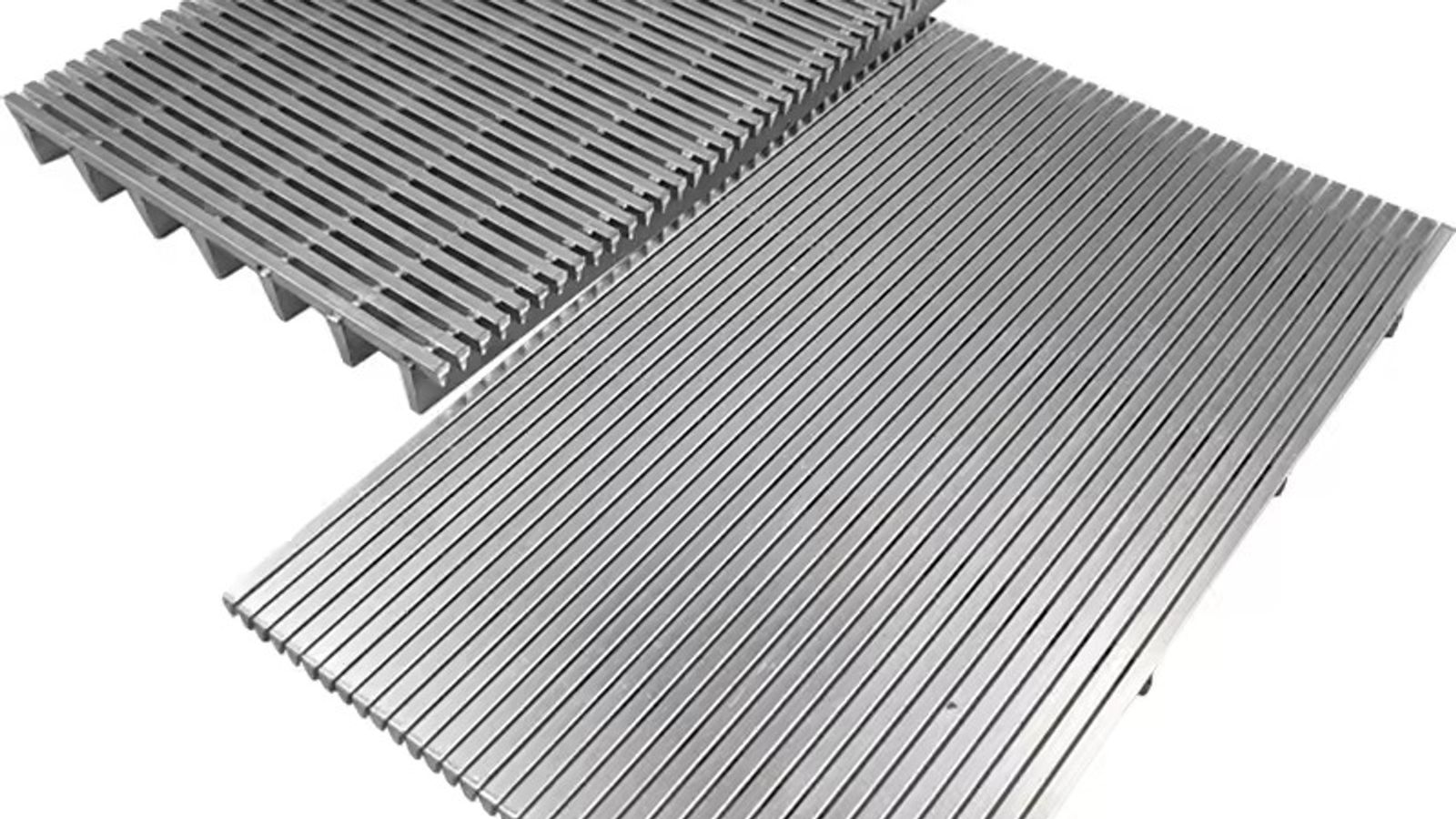
Sand and aggregate dewatering is a process in which excess moisture is mechanically removed from washed sand, crushed fines and gravel so the product meets the moisture and cleanliness specifications demanded by concrete, asphalt, mortar and filter-bed buyers. In a typical sand washing plant, material leaves a sand screw, dewatering wheel or hydrocyclone underflow carrying 20–25% moisture; a wedge wire dewatering screen then pulls that down to below 15%, and many installations hold 10–12%, before the product is stockpiled or loaded. Wedge wire (Johnson or V-profile) screen panels, baskets and cylinders are the workhorse media in this duty because their tapered slots pass water while retaining sand, resist the blinding that stops a woven mesh within hours, and wear far longer in abrasive slurry service.
The dewatering screen is the primary moisture-removal step in most wet plants. It is usually a high-frequency vibrating screen — often a horizontal or slightly uphill-sloping deck — fitted with wedge wire screen panels running 0.25–1.0 mm slots. Slurry from a sand screw, dewatering bucket wheel, or cyclone underflow is distributed across the feed end; vibration drives the sand bed forward while the slot profile literally "pumps" water downward through the panel. Because the wedge wire slot is narrow at the deck surface and widens downward, water drains freely while sand grains that are close to slot size cannot wedge and pack inside the opening.
A dewatering screen sized for 20–30 t/h of washed concrete sand commonly uses a 0.5 mm slot with around 15–20% open area. The result is a product dry enough to convey and stockpile without running sand — moisture typically 11–14% straight off the screen.
The most valuable fine-sand tool in the circuit is the hydrocyclone, which classifies slurry at a cut point usually near 75 µm (200 mesh). The underflow — a dense, fast-moving stream at roughly 20–35% solids — still carries a large proportion of usable fine sand, but it is too wet to stockpile. Here, wedge wire screen cylinders and curved sieve-bend panels are mounted under or beside the cyclone bank. Feed enters tangentially or along the curved surface; the V-slots at 0.15–0.3 mm recover up to 90–95% of the +0.15 mm fraction while allowing water and silt to fall through.
This is the core of what operators call fine sand recovery. Plants that add a wedge wire underflow sieve to an existing cyclone bank routinely lift recovered fines from 5–10 t/h to 15–25 t/h without enlarging the classification step, and the recovered material is often cleaner and better-graded than the sand screw discharge.
Sand screws (dewatering screws) and bucket wheels are efficient classifiers but weak dewaterers: discharge moisture is typically 18–25%. A common low-cost upgrade is to replace the standard perforated plate or woven mesh on the upper drain section of the screw trough — and on conveyor transfer drain decks — with wedge wire panels. The V-profile drains the carried water immediately, cutting the load on the downstream dewatering screen and reducing moisture before the material ever reaches the screen feed box. On conveyor drain decks, a short run of 0.5–1.0 mm wedge wire can remove most of the free surface water and produce a noticeable reduction in the "fines carry" that stains stockpile toes.
Slot size is the single most important decision in a dewatering application, and it must be matched to the sand particle size distribution (PSD), not guessed from plant tradition. The governing rule: choose the slot around 10–20% larger than the smallest sand particle you need to keep, so near-size grains pass freely without wedging, and set it smaller than the top size you want to retain as a filter or drainage layer.
For a standard concrete sand (ASTM C33-type, 0.075–4.75 mm), a 0.5–1.0 mm slot is the usual starting point — it retains essentially all recoverable sand, passes the finest silt, and still drains quickly. When the product must be finer — a masonry sand, a manufactured sand, or a tight-grade asphalt sand — drop to 0.25–0.4 mm. For fine sand recovery from hydrocyclone underflow, go to 0.15–0.3 mm; this is the range that captures the 0.1–0.6 mm fraction that would otherwise be lost to the cyclone overflow. The same logic applies to well screens, and the water well screen slot sizing and sand analysis guide walks through reading a grain-size curve to fix a slot — the identical method used for a dewatering deck.
| Sand fraction | Typical particle range | Recommended wedge wire slot | Typical application |
|---|---|---|---|
| Coarse washed sand | 0.5–4.75 mm | 0.75–1.0 mm | Concrete aggregate; filter sand |
| Concrete sand (C33) | 0.075–4.75 mm | 0.5 mm | Standard washed concrete sand |
| Medium/fine sand | 0.075–1.18 mm | 0.25–0.4 mm | Masonry sand; manufactured sand |
| Fine sand from cyclone underflow | 0.05–0.6 mm | 0.15–0.3 mm | Fine sand recovery; MSand |
| Gravel and chips | 2–10 mm | 1.5–3.0 mm | Drain deck; gravel dewatering |
Useful conversions: a 0.25 mm slot is roughly equivalent to 60-mesh (US) woven cloth, 0.15 mm to about 100-mesh, and 0.3 mm to about 50-mesh. That equivalence is handy when you are retrofitting a woven-mesh dewatering screen and want to preserve the same cut point. As a sizing rule of thumb, the d50 cut point of a slotted deck sits close to the nominal slot width — a 0.5 mm slot passes roughly half of the material sitting near 0.5 mm — so check your PSD curve at the 50% passing point and at the d10 (the fine tail you must retain) before fixing the slot. If the d10 of the sand you must recover is 0.18 mm, a 0.2–0.25 mm slot is defensible; if you only need to retain 0.4 mm and above, you can open the slot to 0.5 mm and gain both capacity and drainage.
Dewatering efficiency is controlled by open area, slot profile and screen motion. A typical wedge wire dewatering panel with a 0.5 mm slot on a 2.5–3.0 mm wire top width delivers roughly 15–20% open area; finer 0.15–0.25 mm slots sit lower, typically 8–15%, while coarse 1.0 mm+ drainage panels can exceed 25%. The V-profile compensates for that seemingly modest open area because every opening stays fully effective: the slot narrows at the surface, so water passes and sand does not pack, and the slot cannot blind the way a woven aperture does.
Moisture targets follow the downstream use. As a practical benchmark:
For concrete producers, the difference between 15% and 11% moisture in a washed sand matters commercially: a plant shipping 100 t/h that cuts moisture from 15% to 11% moves roughly 4–5 fewer tonnes of water per hour, which directly improves as-delivered tonnage and reduces cement-paste sensitivity in the mix. That is why most operators treat the dewatering screen slot not as a classification decision but as a moisture-content decision.
The self-cleaning mechanism also matters for efficiency. In the V-profile (Johnson) design, the slot is wider at the back than at the face, so a grain that enters the opening is squeezed forward by the next water pulse and ejected rather than jammed. The Johnson screen working principle and applications article explains this geometry in detail — the same mechanism that keeps water well screens and intake screens clear is what keeps dewatering decks open in sand slurry.
Many plants inherit dewatering screens decked with woven mesh. It works for a shift or two, then progressively blinds as wet fines pack into the square apertures, surface tension holds a film of water, and the deck starts "surging" — throwing water instead of draining it. Wedge wire is engineered to avoid exactly this failure mode. The table below summarizes the practical differences in wet screening service.
| Factor | Wedge wire (V-profile) | Woven wire mesh |
|---|---|---|
| Slot shape | Tapered; self-cleaning; narrow at face; wider at back | Square apertures; uniform through-thickness |
| Wet screening | Excellent — water drains; fines do not pack | Poor in wet service — blinding; water film |
| Open area | 8–25% typical; but fully effective | 40–60% nominal; lost once blinded |
| Wear in abrasive slurry | Thick V-wire profile; long life | Thin wires; rapid wear at intersections |
| Panel rigidity | Self-supporting welded structure | Flexible; requires support bars |
| Cleaning / downtime | Minimal; self-clearing | Frequent manual cleanout |
| Typical use | Dewatering; fines recovery; sieve bends | Dry screening; scalping; coarse separation |
Note that the higher nominal open area of woven mesh rarely translates into better dewatering — a blinded square aperture passes nothing. In dry screening (crushed stone scalping, aggregate sizing) woven mesh remains the economical standard, and KAIFIL's crimped woven wire mesh is widely used in those dry duties. But once the feed is wet slurry, the decision is clear: wedge wire pays for itself in uptime alone.
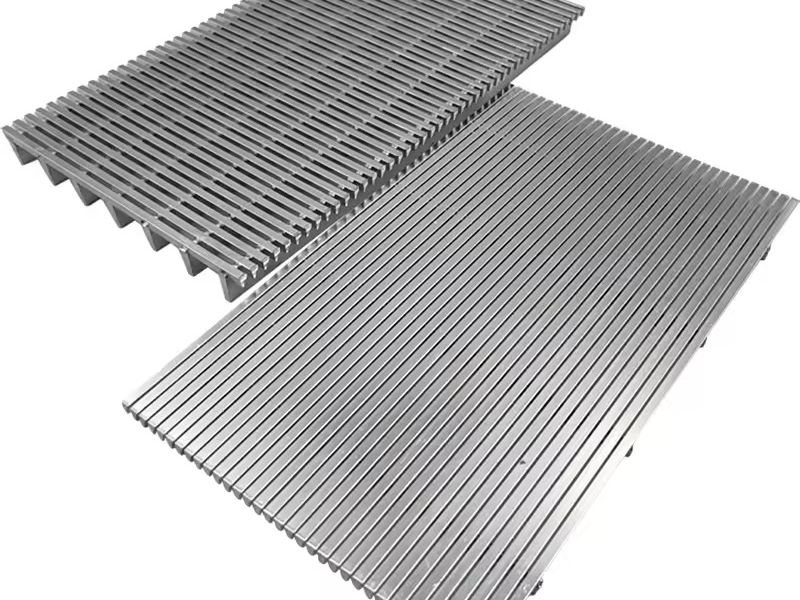
Construction. Wedge wire panels for dewatering are built by resistance-welding V-profile wire to support rods at every crossing. Panels are finished with hook strips on two edges (typically 25–40 mm hooks) for tensioned mounting on vibrating screens, or with machined bolt flanges and edge welding for bolt-down frames and sieve bends. Because the profile is welded rather than woven, a panel holds its slot dimension over its whole life — there is no wire slip or aperture growth.
Material choice: 304 vs 316. For normal fresh-water washing, 304 stainless steel is the standard — it is cost-effective, corrosion-resistant, and hard enough for sand abrasion. Choose 316 (or 316L) where chloride is present: seawater wash, marine aggregate, de-icing salt exposure, or any plant fed by brackish water, where 304 will pit at the weld and support-rod contacts. For extremely abrasive feeds, some operators specify hardened or thicker V-wire (2.5–3.5 mm) on the leading half of the deck. KAIFIL manufactures panels, cylinders, baskets and bespoke shapes as custom wedge wire screen parts with hook, bolt, or clamp mounting to match any OEM screen frame.
Capacity rules of thumb.
Wear and maintenance. The highest wear point is the feed-end leading edges and the first 300–400 mm of deck. Rotate panels front-to-back on the deck to equalize wear, and replace when the slot top width opens beyond roughly 1.5× the design value (measure with a feeler gauge — at 0.5 mm design, replace at ~0.75 mm). Keep the panel crown high enough for a 20–30 mm material bed; a thin bed lets water channel around the sand instead of through it, which quietly cuts dewatering efficiency.
What is a sand dewatering screen? A high-frequency vibrating screen fitted with wedge wire panels (typically 0.25–1.0 mm slots) that removes water from washed sand by draining it through the slotted surface while the vibrating bed conveys the sand off the deck. It typically reduces moisture from 20–25% to below 15%.
How do I choose the right dewatering screen slot size? Match the slot to the particle size distribution of your sand. Use 0.5–1.0 mm for concrete sand, 0.25–0.4 mm for finer/masonry sand, and 0.15–0.3 mm for fine sand recovery from hydrocyclone underflow. A good rule is slot ≈ 1.1–1.2× the smallest sand particle you need to retain.
Why is wedge wire better than woven mesh for wet screening? The V-shaped slot is self-cleaning: it narrows at the face and widens at the back, so water drains while sand cannot wedge and pack. Woven mesh blinds rapidly in wet slurry, which halts drainage and requires frequent cleaning.
How much moisture can a wedge wire dewatering screen remove? Washed sand typically leaves a sand screw at 18–25% moisture; a wedge wire dewatering screen lowers this to 10–15%, depending on slot size, screen area, and feed rate. Fine sand recovered from cyclone underflow usually reaches 12–16% after screening.
What capacity can I expect from a dewatering screen? A practical planning figure is 10–25 t/h per m² of screen area for washed sand at 0.5 mm slots — less for fine slots, more for coarse sand. Capacity falls by roughly 30–50% when the slot is halved to 0.25 mm.
Wedge wire is the difference between a washed sand that sells and one that drains away in the stockpile. Whether you are re-slotting an existing dewatering screen, adding a fine sand recovery cylinder to a hydrocyclone bank, or building a complete wet processing deck, KAIFIL can engineer the panels, cylinders and custom parts to your sand PSD and screen frame. We supply 304 and 316 stainless steel wedge wire products in slot sizes from 0.15 mm upward, with hook strips, bolt flanges or edge welding to suit your installation — and our engineers will help you confirm the slot size, open area and capacity before you order. Contact KAIFIL for a quote and a sizing recommendation for your sand washing plant.
Flat panels / sieve bends / framed panels for dewatering, sizing and solid-liquid separation, supplied to drawing with material, size and packing details confirmed at RFQ stage.
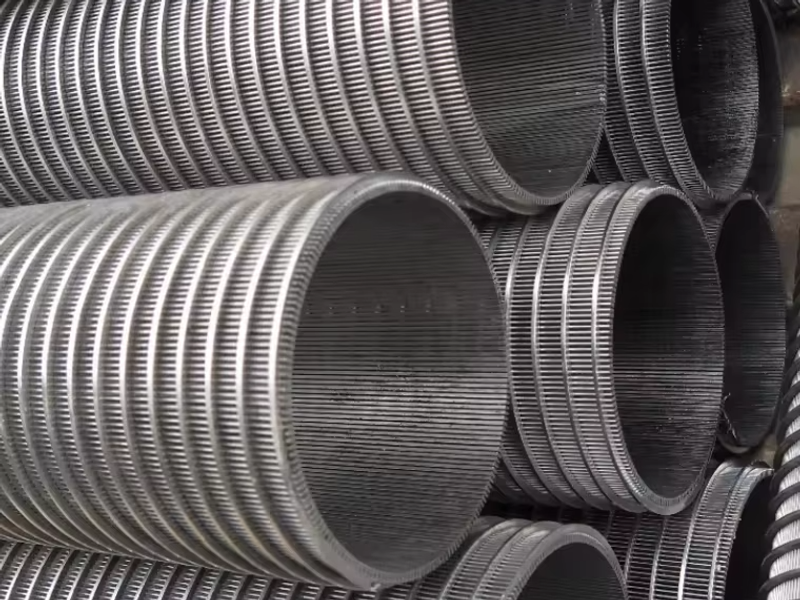
Continuous-slot screen pipe for wells, vessel internals, resin traps and dewatering systems.
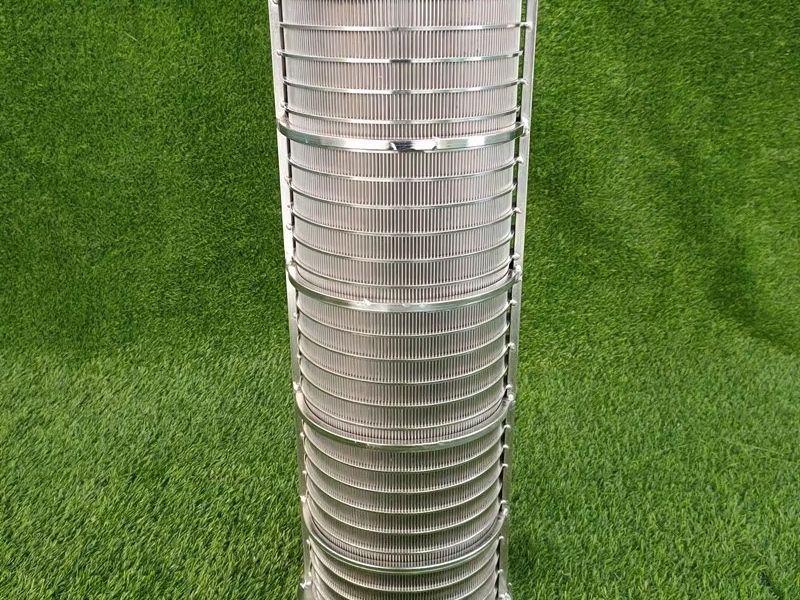
Screen cylinders / pipes / baskets for intake, resin traps, strainers and distributor internals, supplied to drawing with material, size and packing details confirmed at RFQ stage.
Send drawings, dimensions, material, environment or operating conditions, and we will help confirm the right specification.
Uploaded reference files are included with the inquiry. For larger CAD packages, reply to the confirmation email or send them here:
Our team typically replies within 24 business hours.