Selection Guide
Stainless Steel vs Manganese Steel Screen Mesh: Mining Guide
Compare manganese vs stainless steel screen mesh for mining: abrasion, corrosion, service life, cost. Choose the right alloy — contact KAIFIL for a quote.
Compare manganese vs stainless steel screen mesh for mining: abrasion, corrosion, service life, cost. Choose the right alloy — contact KAIFIL for a quote.
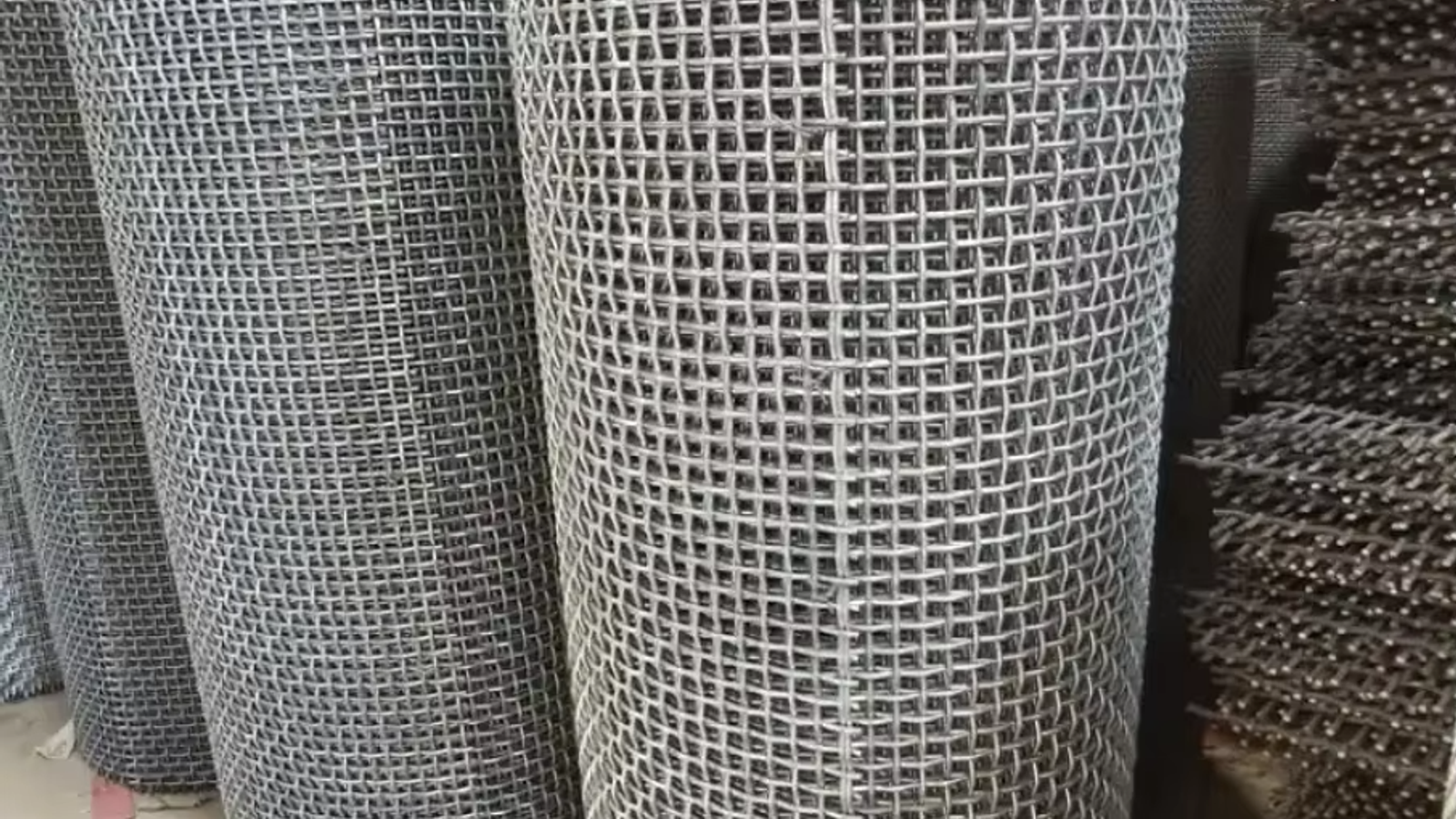
Manganese steel screen mesh is a screening surface woven or crimped from high-manganese austenitic steel wire containing roughly 11–14% manganese and 1.0–1.4% carbon — the alloy known as Hadfield steel. What makes it unique is a work-hardening property: an as-quenched panel ships at only 180–220 HB, but under repeated impact the surface hardens to 450–550 HB within the first hours of screening rock, giving it a self-sharpening wear resistance that has made it the default for dry scalping and primary sizing decks for over a century. Stainless steel screen mesh (304 and 316) starts softer, at roughly 150–210 HV, but brings something manganese steel simply does not have: corrosion resistance. In wet screening, acidic process water, or chloride-laden environments, stainless steel screen mesh mining applications routinely outlast manganese by 2–4×. This guide lays out the real trade-off — abrasion versus corrosion — the practical wire and aperture ranges used on vibrating screens, and a decision framework plant engineers and procurement managers can apply directly to their mining and aggregate screening duty.
Manganese (Hadfield) steel is the classic heavy-duty screening alloy. Its 11–14% manganese content holds the steel in an austenitic (non-magnetic, face-centered cubic) structure that stays tough and ductile at room temperature. The mechanism that makes it valuable is work hardening: every impact from a lump of granite or iron ore deforms the surface lattice, and the dislocations pile up to create an intensely hard, dense surface layer. This is why manganese screen mesh gets harder as it works, rather than wearing down at a steady rate. A fresh panel at ~180–220 HB will rapidly build a surface hardness of 450–550 HB, then hold it for the rest of its life.
The practical consequence: manganese steel screen mesh is the strongest performer on dry, high-impact, coarse-duty screening — scalping decks at the primary crusher, 50–100 mm apertures taking run-of-mine feed, and any deck where rocks strike the surface at speed. When water is absent and corrosion is not a factor, manganese typically outlasts stainless by 2–3× because stainless cannot work-harden to the same degree and simply wears through faster on impact-abrasion.
Stainless steel screen mesh for mining is almost always 304 or 316. Grade 304 is 18% chromium and 8% nickel; grade 316 adds 2–3% molybdenum (with 16–18% Cr and 10–14% Ni) for much better pitting and chloride resistance. The chromium forms a passive oxide film that self-repairs, so the wire does not corrode in water, dilute acids, or saline environments the way carbon and manganese steels do.
Stainless wire is softer than work-hardened manganese at around 150–210 HV in the annealed condition, so on pure dry impact-abrasion it is the weaker alloy. But in wet screening the rules change. Water acts as a lubricant between rock and wire, dramatically reducing the abrasive component of wear, and the dominant failure mode switches from mechanical wear to corrosion — pitting, rusting, and section loss that rapidly destroys non-stainless wire. In wet washing decks, rinsing screens, and dewatering applications with acidic or saline water, stainless routinely delivers 2–4× the service life of manganese. A 316 panel is the correct choice where chlorides, acid mine drainage, or seawater proximity are in play.
The single most common mistake in vibrating screen mesh alloy selection is assuming one "tougher" material is universally better. Manganese is not tougher in every sense — it is harder under impact but not resistant to corrosion. Stainless is corrosion-resistant but softer under impact. The deciding question is always: which failure mode kills your screens first?
| Property | Manganese (Hadfield) Steel Screen Mesh | Stainless Steel Screen Mesh (304/316) |
|---|---|---|
| Typical composition | 11–14% Mn; 1.0–1.4% C; austenitic | 304: 18% Cr; 8% Ni · 316: 16–18% Cr; 10–14% Ni; 2–3% Mo |
| Hardness as supplied | 180–220 HB | 150–210 HV (~140–200 HB) |
| Hardness under impact | 450–550 HB surface (work-hardened) | Minor cold-work hardening only |
| Abrasion resistance (dry; impact) | ★★★★★ | ★★☆ |
| Corrosion resistance (wet; acidic; saline) | ★☆ (rusts) | ★★★★★ (304) / ★★★★★+ (316) |
| Typical aperture range | 10–100 mm (coarse to medium) | 0.5–75 mm (fine to coarse) |
| Typical wire diameter | 4–12 mm | 2–12 mm (finer wire also available) |
| Relative material cost per panel | Baseline (×1.0) | ~×1.5–2.5 |
| Best duty | Dry scalping; primary sizing; high impact | Wet screening; washing; rinsing; corrosive water |
This table is the short answer to the title question. If you are scalping dry rock at 100 t/h with 300 mm feed, manganese is almost certainly the economic winner. If you are washing sand with recycled water at pH 5 and a chloride count from the local bore supply, stainless is not a premium — it is the difference between a 3-month deck and a 9-month deck.
For mining screens, aperture and wire diameter drive the construction, and the construction partly determines which alloy can be used economically. Most heavy mining screens fall in the 2–100 mm aperture range with 2–12 mm wire, and within that envelope you meet two main constructions.
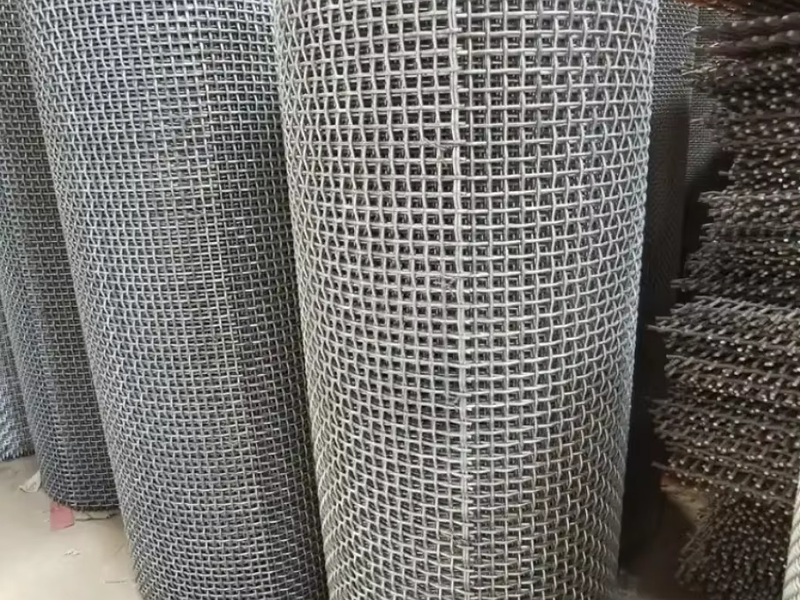
Crimped wire mesh is the standard for coarse heavy-duty decks. The wires are pre-crimped at each intersection so they lock together, forming a rigid, self-supporting surface that resists both opening up and closing down under vibration and impact. Crimped woven wire mesh with 4–12 mm wire is the workhorse for manganese screen mesh at 10–100 mm apertures, and the same crimped geometry carries stainless decks for wet washing. For a detailed look at how crimping, wire diameter, and mesh count interact on heavy screening, our guide to heavy-duty crimped screening covers the construction trade-offs in depth.
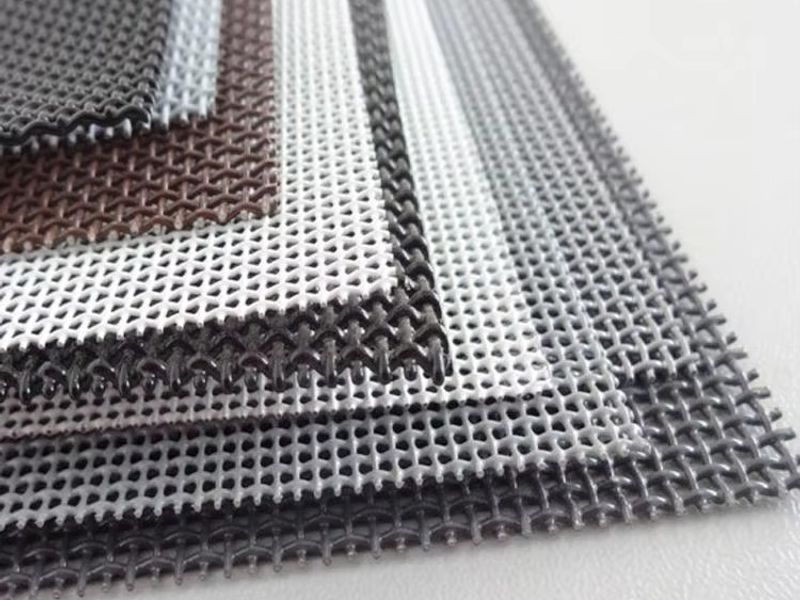
Plain (square) weave is used where the aperture is small relative to wire — typically finer than about 10 mm aperture with proportionally lighter wire. Because plain weave relies on the wire intersecting and bending at every point, it suits lighter-duty and wet applications, which is exactly where stainless comes into its own. Plain weave wire mesh in 304 stainless is a common choice for fine aggregate rinsing and sand sizing screens, where corrosion resistance matters more than brute impact strength. As a general rule: the finer the aperture, the more the balance shifts toward stainless, because finer wire has less section to lose to corrosion and wet duty dominates fine screening.
When you specify a deck, match wire diameter to feed size and impact energy, not just to aperture. A 4 mm manganese wire will not survive a scalping deck fed with 300 mm boulders; a 12 mm stainless wire will not survive 300 t/h of wet abrasive slurry as well as a properly sized manganese wire will. Wire selection guidance for specific mesh counts and products can be found in our companion article on coal preparation vibrating screen mesh selection, which applies equally to aggregate plants.
The cleanest way to pick a mining screen mesh material is to separate your plant into dry and wet streams and apply a different rule to each. Dry streams are the manganese territory; wet streams are the stainless territory.
Dry scalping and primary sizing. Crusher scalping decks, grizzly replacements, and the first sizing screens see dry rock, high impact, and minimal moisture. Manganese steel screen mesh, crimped with heavy wire, is the correct choice here. The work-hardening effect converts every rock strike into a harder surface, and there is no corrosion mechanism to attack the wire. Expect manganese to outlast stainless 2–3× on this duty.
Wet washing and rinsing. Aggregate washing screens, log washer discharge, and sand rinsing decks run saturated with water. Here the wear mode is sliding abrasion plus corrosion, and stainless steel screen mesh wins. A 304 crimped deck will typically deliver 2–4× the life of manganese on the same wet deck, and 316 should be specified when the water is acidic or saline. Many plants run a hybrid line: manganese on the dry scalping decks, stainless on the wet washing decks, and it is the right answer at both ends.
Dewatering. Note that fine dewatering is often better served by a slotted, non-woven surface than by woven mesh at all. Where dewatering efficiency and slot accuracy are the priority, wedge wire screen panels frequently outperform woven decks — our article on mining dewatering wedge wire screen panels explains when to switch from woven to wedge-wire construction.
| Application | Feed / Environment | Recommended Alloy | Construction |
|---|---|---|---|
| Dry scalping deck | Run-of-mine rock; high impact; dry | Manganese (Hadfield) | Crimped; 4–12 mm wire; 25–100 mm apertures |
| Primary sizing screen | Crushed rock; dry or damp | Manganese | Crimped; 4–10 mm wire; 10–50 mm apertures |
| Wet washing / rinsing deck | Sand and aggregate in water | Stainless 304 | Crimped or plain weave; 2–8 mm wire |
| Acidic or saline water screen | Process water pH < 6; chlorides | Stainless 316 | Crimped or plain weave; 2–6 mm wire |
| Fine sand sizing | Fine aggregates; wet | Stainless 304/316 | Plain weave; fine mesh |
| Fine dewatering | Slurry; high fines content | Consider wedge wire | Slotted panels (non-woven) |
Procurement managers comparing invoice prices will see manganese screen mesh as the cheaper panel, typically at about ×1.0 baseline cost versus roughly ×1.5–2.5 for stainless 304 and up to ×3 for 316 at equivalent wire gauge. But the invoice price is the wrong metric for a wear part. The correct metric is cost per tonne screened, which factors in service life, changeout labour, and the cost of downtime — and on a modern plant, downtime is often the largest number in the equation.
Run the arithmetic on your actual duty:
The crossover point is consistent: whenever the wet or corrosive environment shortens manganese life below roughly half of stainless life, stainless becomes the lower-cost option even at double the panel price. Add the value of avoided downtime and unplanned maintenance, and the case for 316 in acidic or saline water strengthens further. This is also where a reputable supplier earns its keep — a properly tensioned, correctly crimped panel from a manufacturer who understands your vibrating screen mesh alloy needs will outlast a mis-specified "bargain" panel regardless of alloy.
Procurement checklist:
If you want a single mental model, run this sequence:
Most plants end up with a hybrid fleet: manganese crimped panels on dry scalping and primary sizing, stainless 304/316 panels on wet washing and rinsing decks, and a wedge-wire product reserved for fine dewatering. That combination is not a compromise — it is the lowest cost-per-tonne solution for a plant that has both dry and wet streams.
Which is better for mining screen mesh, manganese steel or stainless steel? Neither is universally better. Manganese (Hadfield) steel wins on dry, high-impact screening where it work-hardens to 450–550 HB; stainless steel wins in wet or corrosive duty where manganese would corrode. Choose based on moisture and water chemistry, not on "toughest" claims.
Why does manganese steel screen mesh get harder in service? Manganese steel is austenitic with 11–14% Mn and work-hardens under impact. Each rock strike creates surface dislocations that raise hardness from ~180–220 HB as supplied to 450–550 HB in service, giving it excellent resistance to impact-abrasion.
When should I use 316 instead of 304 stainless screen mesh? Use 316 (which adds 2–3% molybdenum) when the process water is acidic or has meaningful chloride content, such as acid mine drainage or saline bore water. 316 resists pitting and chloride attack much better than 304.
What wire diameters and apertures are typical for mining screens? Mining vibrating screens generally run 2–100 mm apertures with 2–12 mm wire. Manganese crimped screens are common at 10–100 mm apertures with 4–12 mm wire; stainless covers finer wet-screening work down to fine mesh.
Is stainless steel screen mesh worth the higher price? On wet washing and corrosive decks, yes — 304/316 often lasts 2–4× longer than manganese, so the cost per tonne screened and per hour of operation is lower despite a higher panel price. On dry scalping decks, manganese is usually the lower-cost choice.
Every plant screens a different rock, water, and duty cycle, and the alloy that suits your neighbour's quarry may be the wrong one for yours. At KAIFIL we manufacture both manganese steel screen mesh and stainless steel screen mesh in 304 and 316, in crimped and plain-weave constructions, with the wire diameters and apertures your vibrating screens actually need. Send us your screen dimensions, your mesh count or aperture, your feed type, and your water conditions — our engineers will recommend the right alloy and construction, and we can produce custom panels to your drawings in either material. Get a quote for your custom wire mesh screen panels by contacting KAIFIL today, and put the cost-per-tonne question to bed for good.
Panels / sheets / custom screens for heavy-duty screening and protective mesh, supplied to drawing with material, size and packing details confirmed at RFQ stage.
Square-opening woven wire mesh for screening, support layers and custom fabricated filter parts.
Dense woven wire mesh for fine filtration and custom screen packs in demanding process lines.
Send drawings, dimensions, material, environment or operating conditions, and we will help confirm the right specification.
Uploaded reference files are included with the inquiry. For larger CAD packages, reply to the confirmation email or send them here:
Our team typically replies within 24 business hours.