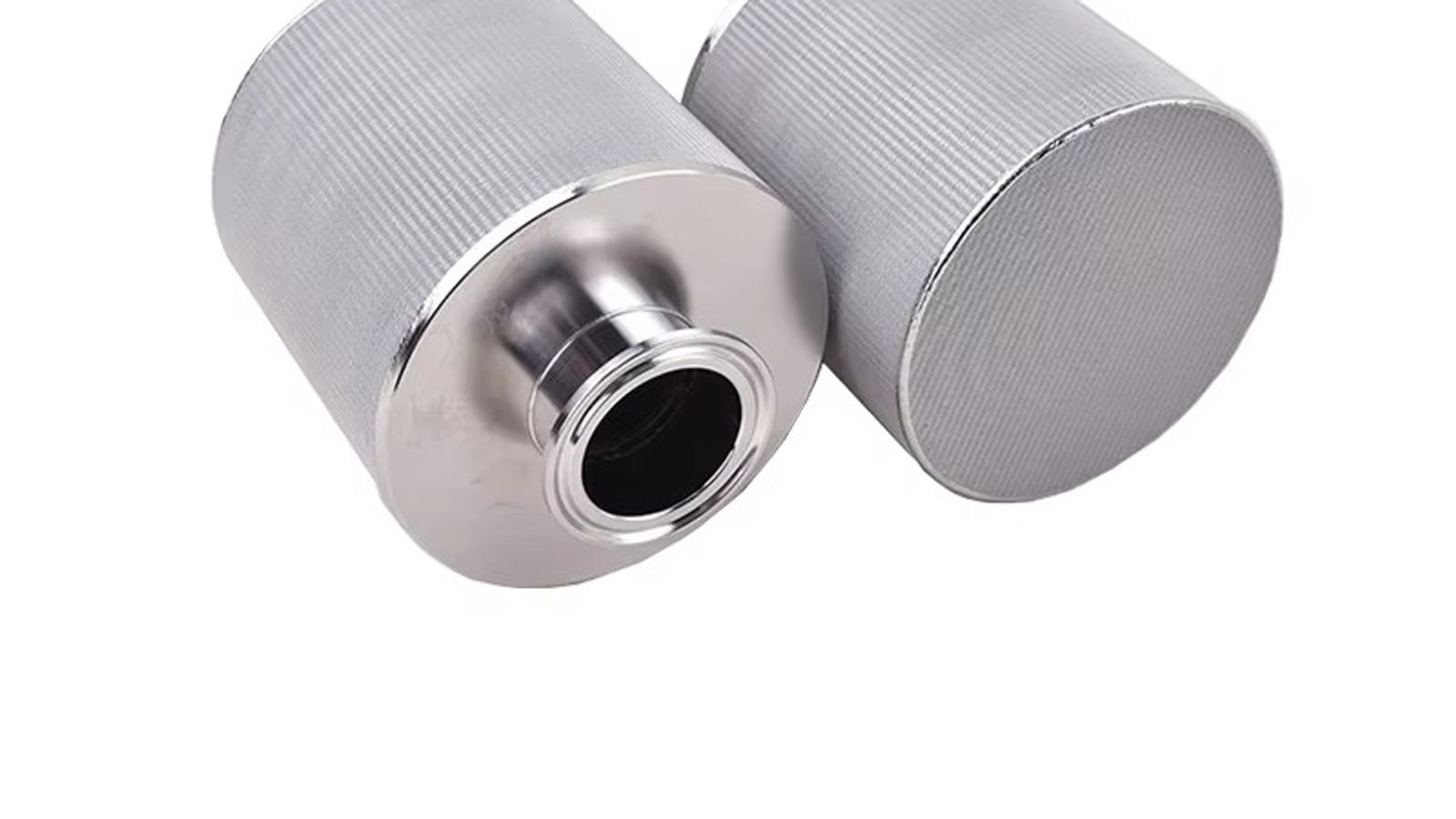
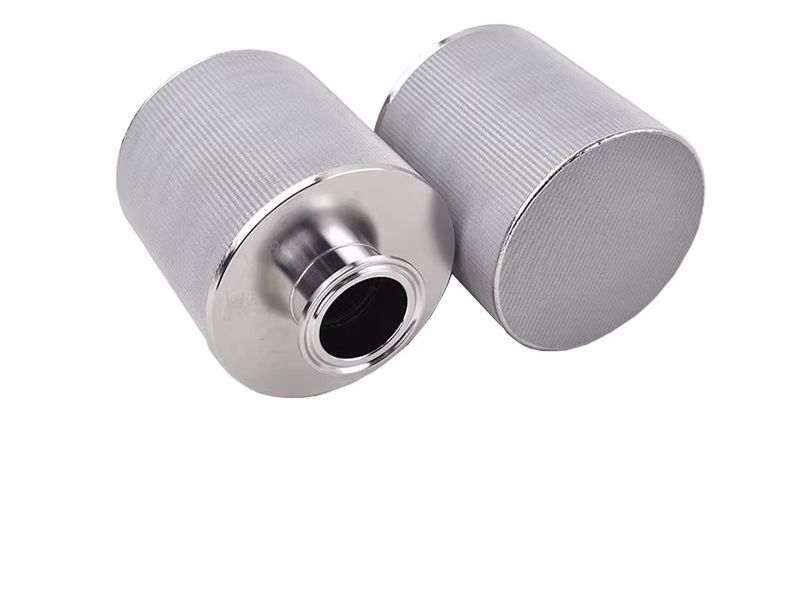
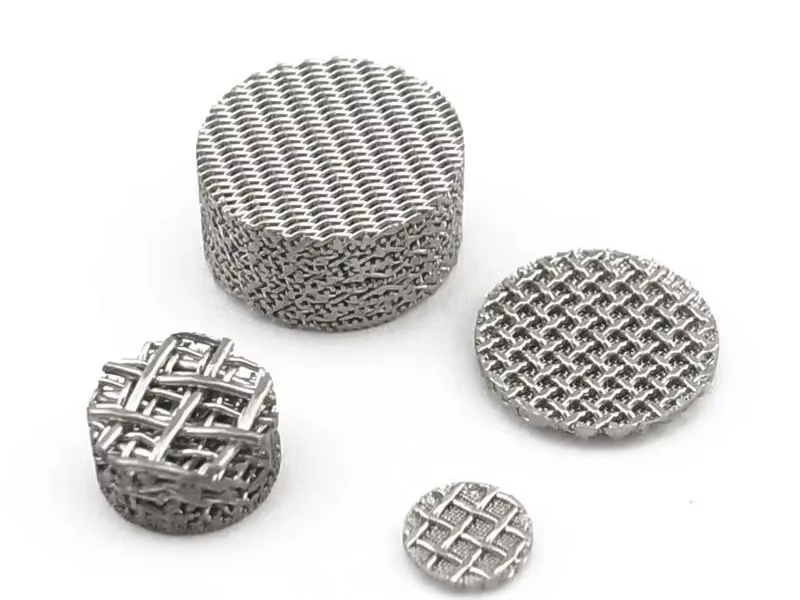
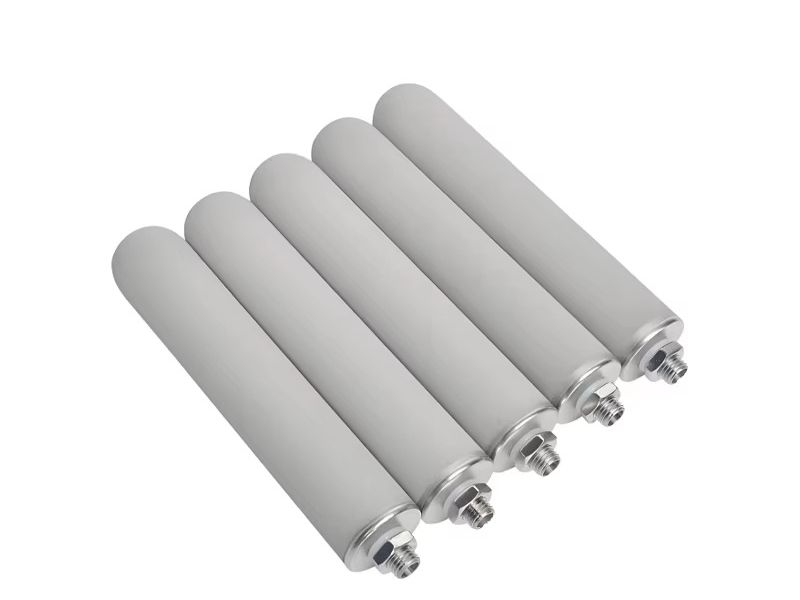
Sintered metal filters are porous metal elements made by fusing stainless steel or specialty alloy into a single rigid structure — either by diffusion-bonding multiple layers of woven wire mesh at every wire crossover, or by compacting and sintering metal powder into a controlled pore network. The result is a monolithic, all-metal body with uniform filtration ratings of roughly 1–200 µm and open porosity of 25–40%, which keeps initial pressure drop low while capturing fines that would slip through a plain weave. Chemical plants adopt them because they keep filtering when other media fail: they survive process temperatures that melt polymer seals, they shrug off pressure surges that crush pleats, they resist aggressive media that corrode screens, and they can be cleaned and returned to service dozens of times. In short, a sintered metal filter element is not a consumable — it is process equipment, engineered to outlast the campaigns it serves.
That durability is what separates sintered metal from the woven wire mesh, pleated cartridge, and bag filters still common across the industry. The paragraphs below walk through five demanding operating scenarios where sintered metal is not just the preferred option but often the only option that keeps the process running.
Scenario 1: High-Temperature Filtration (Up to 480°C and Beyond)
Most filter media are built around polymers. Melt-blown polypropylene softens well below 100°C; polyester pleated media degrade around 150°C; even PTFE-based cartridges are typically limited to roughly 260°C, and their polymer support cages, seals, and gaskets fail far earlier. In high-temperature chemical service — hot polymer melt filtration, catalyst flue-gas cleanup, high-temperature solvent recovery, or reactor off-gas scrubbing — those temperature ceilings are disqualifying.
Sintered metal has no such limitation. A standard 316L stainless steel sintered filter is rated for continuous service up to 480°C, and higher-performance alloys push that ceiling further still. Because the element is all metal, there are no O-rings, adhesives, or polymer end caps to degrade, soften, or outgas volatiles into the product stream. Thermal cycling — the repeated heating and cooling that accompanies batch operations and plant shutdowns — is also manageable, provided the element is designed with the correct metal-wall thickness and support structure.
This is where construction matters. Five-layer sintered mesh (typically two protective outer layers, two fine filtration layers, and a structural drainage layer) is diffusion-bonded into one unit, so it resists delamination and retains its pore geometry at temperature, cycle after cycle. Sintered powder elements, meanwhile, are favored where high dirt-holding capacity is needed alongside temperature resistance. If you are specifying for hot-gas or high-temperature liquid duty, the selection of alloy and construction affects both service life and cost — a topic covered in depth in our guide to high-temperature stainless steel filter tube materials.
Hard data anchor: 316L sintered metal filters are commonly rated for continuous service up to 480°C (and intermittent peaks higher), versus roughly 120°C for standard pleated polyester cartridges and 260°C for the most advanced PTFE-based cartridges. Construction options range from five-layer sintered mesh elements for fine, high-integrity filtration to sintered wire mesh filter cartridges for higher flow, lower ΔP service.
Scenario 2: High Pressure, High Differential Pressure, and Pressure Cycling
Chemical processes are not steady-state. Pumps start and stop, valves slam, pressure surges roll through lines, and a filter in continuous service accumulates solids until the differential pressure across it climbs steadily toward the collapse point of the media. Standard woven wire mesh is structurally weak in compression: a typical plain-weave or even twilled-weave screen bursts or blows out below roughly 500 kPa of differential pressure. Pleated cartridges fail differently — the pleats can collapse and pinch together under differential pressure, effectively blinding the filter and spiking pressure drop long before the media tears.
Sintered metal filters are engineered for exactly these conditions. A diffusion-bonded sintered mesh element has burst strength on the order of 2,275 kPa — several times that of the equivalent woven mesh — because every wire crossover is metallurgically fused rather than merely interlaced. Sintered powder elements are stronger still, and because the structure is rigid, there are no pleats to collapse and no media to dislodge under reverse flow. This makes sintered metal the natural choice for reactor discharge filtration, where the filter must handle the full process pressure at start-up and then withstand a rapidly rising ΔP as catalyst or solids are retained.
Pressure cycling deserves its own mention. In batch chemical plants, filters are pressurized and depressurized on every cycle. Woven screens fatigue at the weave intersections; pleated media work loose at the fold lines. Sintered metal, with its fused nodes and monolithic structure, is far more resistant to this fatigue mechanism. The result is a filter that survives thousands of cycles instead of dozens. For guidance on sizing and selecting elements for high-ΔP, start-up-heavy service, see our reactor discharge filtration and metal filter selection guide.
Hard data anchor: Diffusion-bonded sintered mesh elements are typically rated for burst strengths up to ~2,275 kPa, versus <500 kPa for standard woven wire mesh of similar wire diameter. This differential-pressure headroom is what lets a sintered element keep filtering — and keep its shape — while a pleated cartridge blinds or blows out.
Chemical plants handle acids, caustics, chlorides, solvents, and reactive intermediates that quietly destroy ordinary filter media. Polymer cartridges can swell, dissolve, or leach plasticizers into the process. Woven screens suffer from crevice corrosion and pitting at the wire intersections, where micro-gaps trap aggressive ions. Bag filters shed fibers and binder material into the product — a contamination risk that is unacceptable in many reactive and high-purity processes.
Sintered metal filters are made from corrosion-resistant alloys selected to match the process fluid. The most common is 316L stainless steel, with its low carbon content and added molybdenum giving good resistance to pitting and general corrosion in chloride-bearing and mildly acidic streams. Where conditions are more aggressive, 904L, duplex stainless grades, and Hastelloy C-276 provide substantially higher resistance to chlorides, hot acids, and oxidizing media. Because the element is a single fused metal structure, there is no media to migrate and no fiber to shed — the filter introduces nothing into the stream, which is often a regulatory and product-quality requirement in its own right.
Alloy selection is not a one-size-fits-all decision: the same process stream at a different temperature or chloride concentration can move from "316L is fine" to "Hastelloy required." Working through that selection — including how chlorides, pH, temperature, and oxidizing agents interact — is exactly what our chemical process filter material compatibility guide covers, and it is one of the first questions we ask when sizing a new element. Specifying the right alloy up front is cheaper than replacing a corroded element mid-campaign.
Hard data anchor: Material options range from 316L stainless steel (the default for most organic and mildly acidic service) to duplex stainless steel and Hastelloy C-276 for hot chloride, sulfuric, and oxidizing environments. Correct alloy selection prevents both structural failure and trace-metal contamination of the process stream — a failure mode no polymer or woven media can fully address.
Scenario 4: Backwash and Regeneration Cycles
In continuous chemical service, a filter that cannot be cleaned is a cost line, not an asset. Bag filters and pleated cartridges are single-use or limited-life media: when the ΔP limit is reached, they are lifted out and replaced, generating disposal cost, labor hours, and process downtime. Sintered metal filters are engineered to be cleaned and reused.
The most common method is backwashing — reversing flow through the element to flush collected solids off the surface. Backwashable filter elements are typically triggered by a differential pressure set point (for example, initiating a backwash cycle when ΔP reaches 100–150 kPa and continuing until it returns to a baseline of 20–40 kPa), though time-based and flow-based triggers are also used. When backwashing alone is insufficient — for example, with sticky or gelatinous foulants — sintered metal elements can be cleaned by ultrasonic baths, caustic or acid chemical cleaning, and steam sterilization, all of which would destroy a polymer cartridge.
This cleanability is the single largest driver of total cost of ownership. A well-designed sintered element in a properly backwashed system routinely delivers a service life of 5–10 years, through hundreds of cleaning cycles, with stable filtration performance throughout. The practical mechanics of setting up an effective backwash loop — including cleaning frequency, flow reversal rates, and how to judge when an element is truly clean — are detailed in our guide to sintered mesh backwash and regeneration.
Hard data anchor: Sintered metal filters tolerate repeated reverse-flow and chemical cleaning cycles that destroy pleated and polymer media, delivering typical service lives of 5–10 years versus weeks or months for disposable cartridges. Typical ΔP-based backwash triggers fall in the 100–150 kPa range, with cleaning restored baseline ΔP of 20–40 kPa.
Scenario 5: Catalyst Recovery, High-Purity, and Safety-Critical Service
Some filtration duties have no margin for error. Catalyst recovery filtration returns expensive noble-metal or heterogeneous catalysts to the reactor — every gram lost is a direct cost, and every particle that slips through contaminates downstream product. High-purity pharmaceutical and fine-chemical service demands zero media migration: a single shed fiber from a bag filter can invalidate a batch. Safety-critical duties — emergency vent filters, relief-line filters, and filters protecting downstream equipment from debris — require an element that will not fail under fault conditions.
Sintered metal filters answer all of these demands with the same property: integrity. Because the element is a rigid, fused metal structure with a controlled pore size, it does not shed media, does not unweave under stress, and holds its rated filtration efficiency for its entire service life. For catalyst recovery, this means the catalyst is retained at the filter surface and returned to the process, and the recovered cake is fully accessible for washing, drying, and redispersion. For pharmaceutical service, the all-metal, fully drainable construction is validation-friendly, compatible with cleaning-in-place and steam-in-place, and free of extractables. And for safety-critical duty, the burst and temperature margins described in the scenarios above translate directly into fail-safe performance.
The recovery value alone often justifies the switch. In precious-metal catalyst service, the cost of the metal captured by an efficient sintered element can pay for the filter many times over, while eliminating the contamination risk inherent in fiber-shedding media. To dig deeper into duty-specific sizing and the economics of catalyst recovery, see our article on catalyst recovery with sintered metal filters.
Hard data anchor: Sintered metal elements retain their rated filtration efficiency (1–200 µm, depending on construction) for the life of the element, with zero media migration — a requirement for catalyst recovery, pharmaceutical validation, and safety-critical relief service where a media failure is a process-safety event, not just a maintenance issue.
| Criteria | Sintered Metal Filter | Woven Wire Mesh | Pleated Filter Cartridge |
|---|
| Filtration rating | 1–200 µm (precise; uniform pores) | 5–500+ µm (limited by weave) | 0.1–100 µm (but depth-loading can blind) |
| Strength / burst | Up to ~2;275 kPa (diffusion-bonded) | <500 kPa typical | Low; pleats collapse under ΔP |
| Temperature limit | Up to 480°C (316L); higher with alloys | High (all-metal); but weave shifts under stress | 80–260°C (polymer-dependent) |
| Cleanability | Backwash; ultrasonic; chemical; steam — reusable | Limited; solids wedge into weave | Disposable; single-use |
| Lifetime cost | Highest upfront; lowest per-year (5–10+ yr life) | Low upfront; frequent replacement | Low upfront; continuous replacement |
| Best scenarios | High-temp; high-ΔP; corrosive; catalyst; safety-critical | Simple straining; low-ΔP; ambient duty | Clean feed; low-temperature; moderate ΔP |
The pattern is clear. Sintered metal costs more on day one, but it is the only option that survives the five demanding scenarios above — and when you divide the purchase price across five or ten years of cleanable service, it is often the cheapest filter in the plant.
Frequently Asked Questions
How fine can sintered metal filters filter? Sintered metal filter elements are typically rated from about 1 µm up to 200 µm. Sintered powder elements can reach sub-micron ratings for the finest service, while five-layer sintered mesh covers the 2–100 µm range with high dirt-holding capacity. The practical limit depends on the alloy, the construction, and the ΔP your system can tolerate.
Can sintered metal filters be cleaned and reused? Yes — this is their defining advantage. They can be backwashed in place, cleaned with ultrasonic baths, soaked in caustic or acid solutions, and steam-sterilized. A properly maintained element survives hundreds of cleaning cycles, which is why it is considered process equipment rather than a consumable.
How long do sintered metal filters last? With correct alloy selection, proper sizing, and routine cleaning, sintered metal filters typically last 5–10 years in continuous chemical service. Disposable pleated cartridges and bags, by comparison, are usually replaced every few weeks or months. Filter longevity is documented in our sintered mesh backwash and regeneration guide. The elements themselves — from single tubes to multi-layer sintered metal filter elements — are engineered for decades of service when the alloy and rating match the process.
Which is cheaper long-term: sintered metal or woven wire mesh? Woven wire mesh is cheaper to buy but is weaker (<500 kPa burst), more prone to weave shift, and harder to clean thoroughly. Over a multi-year operating horizon, sintered metal is usually cheaper: it lasts far longer, survives cleaning, and avoids the downtime and disposal costs of repeated replacement.
Are sintered metal filters relevant for FDA, pharmaceutical, and ATEX service? Yes. All-metal construction with no extractables and no media migration makes sintered metal filters compatible with pharmaceutical validation, cleaning-in-place, and steam-in-place requirements. For safety-critical and potentially explosive atmospheres, their high burst strength and fail-safe integrity help ensure the filter does not become a source of process-safety failure.
Get a Free Element Sizing Recommendation
Every chemical plant has its own combination of temperature, pressure, media chemistry, and cleaning strategy — and the right sintered metal filter element depends on all of them. Choosing the correct construction (five-layer sintered mesh vs. sintered powder), the right alloy (316L vs. Hastelloy C-276 vs. duplex), and the right pore rating is an engineering decision, not a catalog lookup. Send us your process conditions — operating temperature, pressure, flow rate, fluid composition, solids loading, and your target filtration rating — and our engineers will return a free element sizing recommendation and a competitive quote, usually within one business day.