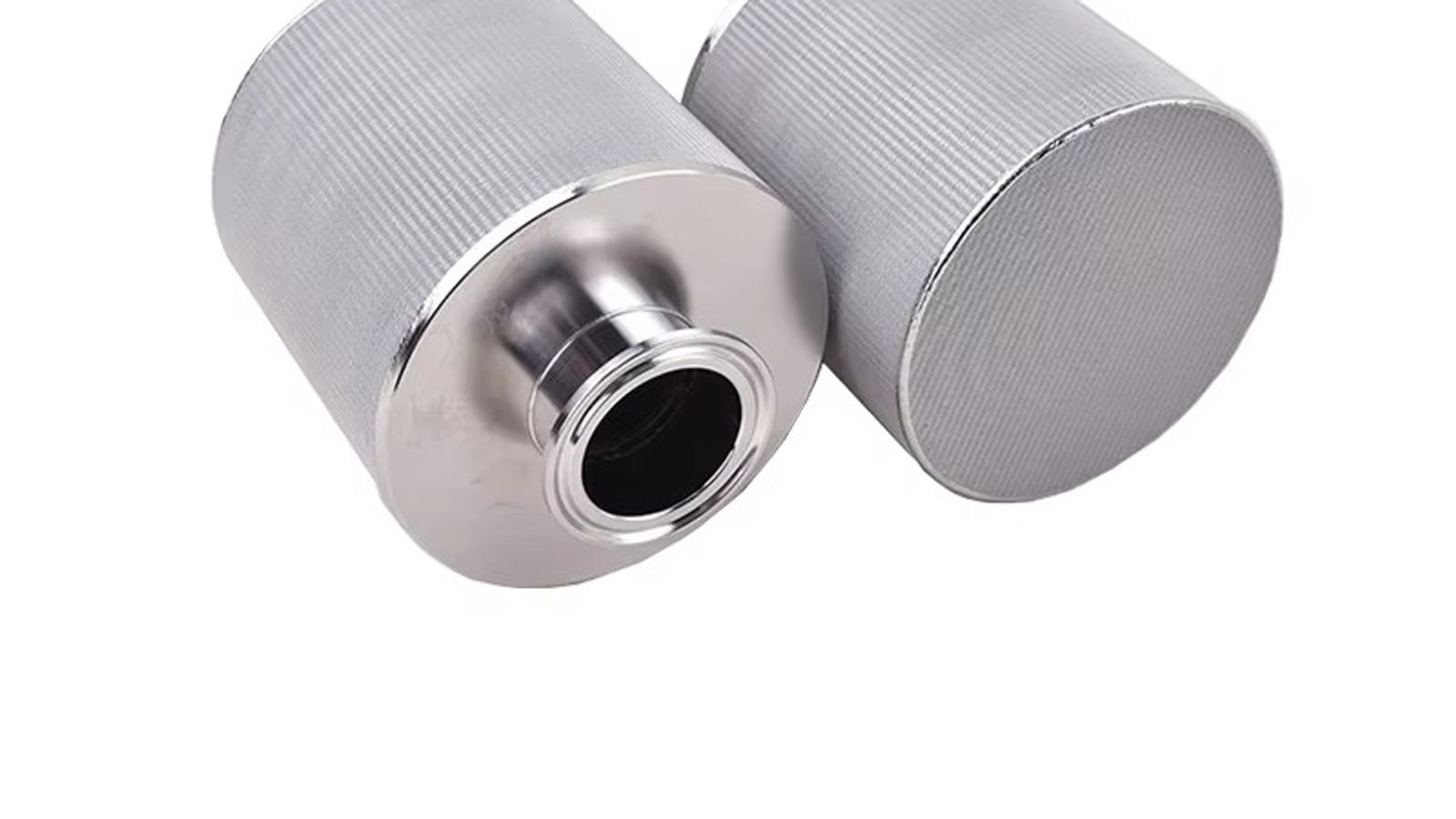
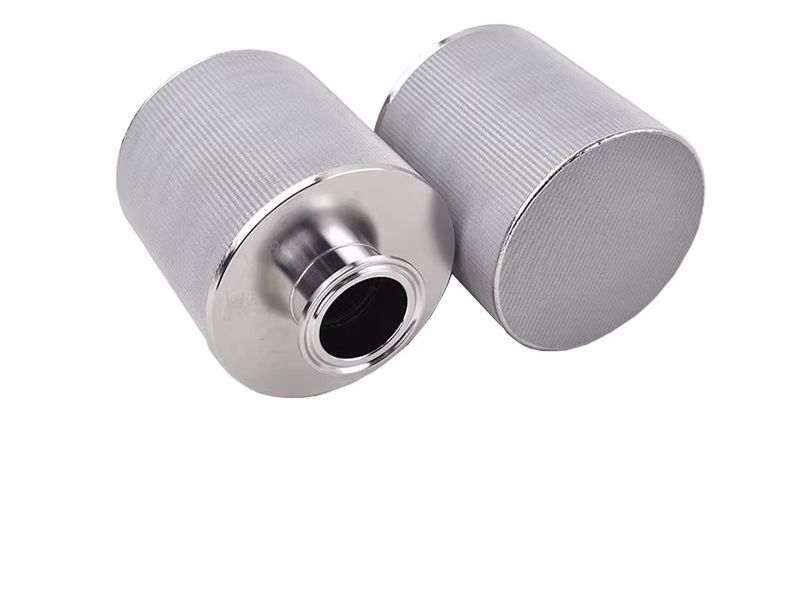
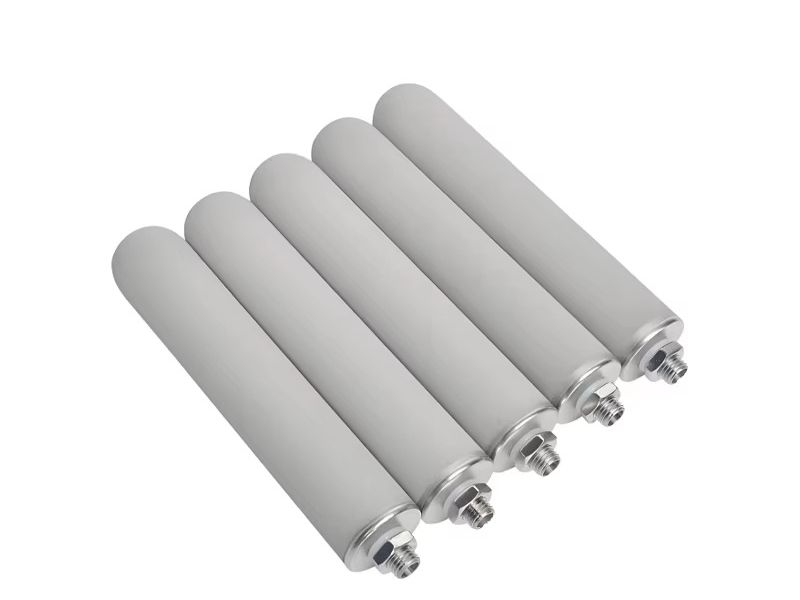
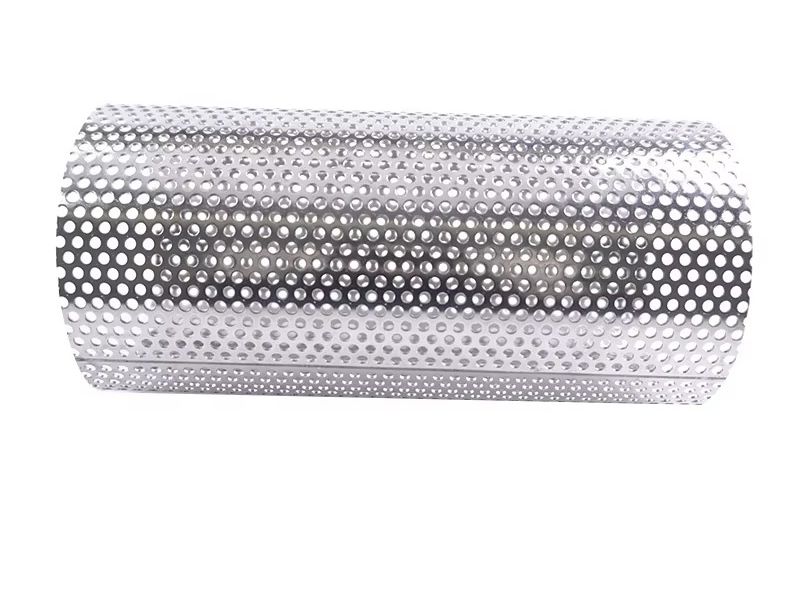
A reactor discharge filter is a rigid metal filter element — typically a sintered metal filter element, a sintered wire mesh filter cartridge, or a stainless steel perforated filter tube — installed at the reactor bottom outlet or in the discharge line to remove catalyst fines, process solids, scale, and by-product particulates before the stream moves downstream. Reactor bottom filtration is a severe-service application that polymer media cannot survive: operating temperatures typically run from 150 °C to 450 °C, system pressures range from 10 bar to 100 bar and above, and the process fluid frequently contains aggressive solvents, monomers, acids, or hydrogen. Practical metal filter ratings for this duty span roughly 1 µm to 100 µm, and most elements are manufactured in 316L stainless steel, with alloys such as 321, 310, Hastelloy®, Inconel®, or Monel® specified when chloride stress cracking, hot hydrogen, or temperatures above 400 °C rule out standard austenitic grades.
This guide is for process engineers and procurement managers who need a reactor bottom filter that runs reliably across a full batch cycle. It covers why metal media is the only realistic choice, how the three main element families compare, the design and sizing parameters that drive performance, the three common installation patterns, and the failure modes that most often cost plants downtime.
The first decision is media family, and for reactor discharge service it is rarely a close call. Polymer media — polypropylene, nylon, polyester, and most fluoropolymer membranes — is optimized for ambient-to-moderate temperatures and low differential pressure. Reactor duty exceeds its limits on three independent axes:
- Temperature. Polymer cartridges soften, creep, and lose structural integrity above roughly 80–130 °C, and they degrade well below the 150–450 °C range seen at reactor outlets. Sintered metal and wire mesh elements operate continuously at these temperatures with no loss of rated strength.
- Pressure and differential pressure. Discharge pressure of 10–100+ bar means the filter must tolerate high operating pressure plus the ΔP spikes that accompany cake build-up or a blocked downstream valve. Rigid metal media has burst pressures of tens to hundreds of bar; polymer cartridges collapse at a few bar of differential.
- Chemical attack. Ketones, aromatic and chlorinated solvents, monomers, acids, and caustic streams swell, dissolve, or embrittle polymer binders. Stainless steel and higher alloys are chemically inert across virtually all reactor chemistries.
There is also a reliability angle. A failed reactor bottom filter is not simply a cartridge swap — in many designs it protects a downstream pump, a catalyst recovery step, or a finished-product spec, and failure can force an emergency shutdown of the reactor itself. Choosing metal media moves the weak point out of the element and into components that are designed to be maintained.
Filter Element Types Compared: Sintered, Wire Mesh, and Perforated
Three all-metal element families dominate reactor discharge service. All are cleanable, all can be built in 316L or higher alloys, and all differ in filtration mechanism, strength, dirt capacity, and cost:
| Filter element type | Typical micron rating | Permeability / open area | Strength & burst pressure | Backflush capability | Best suited for |
|---|
| Sintered metal (powder) element | 0.5–100 µm | Moderate; deep porous matrix | Highest — uniform rigid matrix | Excellent — cleans to near-new ΔP | Fine catalyst fines; high ΔP; filter cartridge high temperature duty |
| Multilayer sintered mesh | 1–100 µm | High open area; high dirt capacity | High — diffusion-bonded cross-points | Excellent | High solids loading with fine ratings; backflush metal filter duty |
| Sintered wire mesh filter cartridge | 1–200 µm | High | High | Good to excellent | General discharge filtration with frequent backflush |
| Woven wire mesh cartridge | 10–500 µm | Very high | Moderate — needs support mesh | Good | Coarser solids; pre-filtration; low ΔP budgets |
| Perforated filter tube | 100–3000 µm | Highest open area | Moderate to high (structural) | Good (coarse) | Coarse solids; protective screens; support layer for finer media |
Sintered metal powder elements are pressed and vacuum-sintered into a porous matrix. Because the pore structure is three-dimensional, they trap particles inside the media rather than only on the surface, giving consistent effluent quality down to sub-micron levels. They are the strongest all-metal filter form available and the standard choice where a sintered metal filter element must survive repeated backflush cycles, thermal cycling, and high differential pressure. See the sintered metal filter elements range for 316L and alloy options down to 0.5 µm.
Sintered multi-layer wire mesh
Five-layer and multilayer sintered mesh elements are made by diffusion-bonding precision wire meshes at every cross-point, producing a monolithic media that combines the high open area of wire mesh with the rigidity of a sintered structure. This delivers high dirt capacity and long cycle times while staying fully backflushable — the classic case being catalyst fines in reactor discharge. Five-layer sintered mesh elements are often the most cost-effective solution per operating cycle.
Wire mesh filter cartridges
Wire mesh cartridges offer very high permeability and low clean pressure drop. They are the first choice when the reactor discharge stream is relatively clean and the goal is to protect a downstream pump or valve. Ratings typically fall in the 1–200 µm band, and pleated versions multiply surface area in a compact envelope. See the sintered wire mesh filter cartridges range for reactor-rated designs.
Perforated filter tubes
Perforated stainless steel tubes are laser- or press-perforated cylinders with coarse openings, typically 100 µm and above. They serve two reactor roles: as coarse protection screens that stop large debris before a fine filter, and as structural support or drainage layers beneath finer media. Their open area is the highest of any element type, so clean ΔP is negligible. Reactor-rated options are available in the stainless steel perforated filter tubes line.
Key Design Considerations for a Reactor Bottom Filter
Micron rating
The required rating is set by the downstream specification — pump clearance, catalyst recovery efficiency, or product particle spec — not by what the element can technically achieve. Characterize the particle size distribution of the discharge and select a rating that holds the fines that matter. Catalyst recovery commonly needs 1–10 µm; simple pump protection needs only 50–100 µm. If you are recovering catalyst, the catalyst recovery sintered metal filters guide explains the retention-versus-flow trade-off.
Pressure drop and ΔP limits
Three numbers define the pressure-drop envelope:
- Clean ΔP should typically be 0.1–0.5 bar at design flow, leaving the rest of the available head for cake growth.
- Maximum operating ΔP is the ceiling the media, core, and end caps must survive without collapse; a well-designed metal element handles 3–10 bar or more, but the system should set a conservative operating limit.
- Terminal ΔP for a backflush metal filter is usually 0.5–2 bar — low enough to keep the cake loose and reversible, high enough to avoid excessive backflush frequency.
Open area
Higher open area means lower clean pressure drop and longer cycles for a given filter area. Typical figures are 30–40% for sintered wire mesh and up to 40–50% for perforated tubes. Open area and filter area trade against each other inside a fixed ΔP budget; do not sacrifice the retention rating you actually need to gain open area.
Mechanical strength and burst pressure
Reactor discharge elements see the full pressure of the vessel plus any ΔP transient from a blocked outlet or a cold, high-viscosity start. Specify burst pressure with margin: sintered powder elements and diffusion-bonded multilayer mesh typically burst at several times rated operating ΔP, whereas single-layer woven mesh relies entirely on its support structure. Confirm the rated burst pressure of a high-pressure metal filter element against the worst-case combination of system pressure and possible differential.
Backflush capability
A reactor bottom filter is costly to service and often impossible to reach without opening the reactor, so it should be cleanable in place. A backflush metal filter is backpulsed with gas or liquid in the reverse direction, automatically on ΔP or manually on a schedule. Multilayer sintered mesh and sintered powder elements clean back to near-original ΔP; single-layer woven mesh is more vulnerable to backflush damage. The sintered mesh backwash regeneration guide details cycle-life data and recommended backflush parameters.
Material selection: 316L vs alloys
316L covers the large majority of reactor discharge services up to roughly 400 °C. Beyond that, or where the process contains chlorides, hot hydrogen, or reducing acids, choose 321, 310, Hastelloy, Inconel, or Monel. The pore structure is essentially unchanged by the material switch, so the same element design can be supplied in any grade. The high-temperature stainless steel filter tube materials review gives the temperature–corrosion envelope of each grade.
Key Sizing Parameters for Reactor Discharge Service
Sizing a reactor discharge filter comes down to four process parameters plus duty-cycle reality:
- Flow rate. Use maximum design flow, not normal operating flow. Reactor discharges are often batch operations with level-drain flows 1.5–2× the average rate.
- Viscosity. Most reactor products are viscous at discharge temperature, and viscosity rises sharply as the reactor cools. Because pressure drop scales directly with viscosity, a filter sized for operating temperature can fail on a cold start. Always re-check ΔP at the highest-viscosity condition.
- Particle size distribution and solids loading. Know the mass of solids per unit volume and the d50/d95/d99 of the distribution. This drives both micron rating and filter area, and it determines whether the element blinds quickly or runs a full batch.
- Allowable pressure drop. The difference between reactor pressure available at the outlet and the minimum pressure required downstream is the usable ΔP budget. Everything — clean element, cake build-up, piping — must fit inside it.
- Cycle time / batch time. The element must carry the full solids load of a batch (or reach backflush) before the ΔP budget is exhausted, so required area is driven by solids load and cake resistance, not just flux.
As a rule of thumb, design flux for a clean, backflushable metal element is often 0.5–5 m³/m²/h depending on viscosity and solids — but every service should be calculated individually, and a manufacturer sizing recommendation based on actual fluid data beats a generic flux number.
Installation Patterns: Bottom Valve, External Loop, or Self-Cleaning
There are three standard arrangements, and each changes both the element design and the maintenance procedure.
Inside the reactor bottom valve / outlet nozzle
The element is mounted directly in the bottom outlet nozzle or within the bottom valve body, above or below the seat. This is the most compact arrangement and protects every downstream component from the moment the reactor drains. The trade-off is accessibility: the element is usually cleaned only by backflushing in place, and mechanical removal requires an empty, opened reactor. Elements for this duty are typically short, large-diameter sintered or multilayer-mesh cylinders with a robust center core.
External discharge loop
The reactor bottom line is routed to a filter vessel in an external loop with isolation valves on either side. This pattern allows cartridge exchange without entering the reactor and makes ΔP monitoring, sampling, and backflush straightforward. The vessel and piping must be rated for full reactor pressure and temperature, and the loop should drain and purge before maintenance. External loops are the most common choice when the filter is cleaned several times per batch.
Self-cleaning / automatic backflush filters
Where solids loading is high and batches are long, a self-cleaning filter with an automatic backflush sequence is the standard answer. The element is backpulsed — typically with gas or filtered liquid at 2–6 bar reverse ΔP — on a pressure-drop setpoint or timer, and solids are purged to a recovery vessel. Because the element returns to near-clean ΔP in seconds, this pattern maximizes reactor throughput. Sintered metal and multilayer-mesh elements tolerate frequent backflushing best, which is why they dominate this pattern.
Common Failure Modes to Avoid
Most reactor discharge filter problems are specification errors, not material defects. The most common:
- Sizing for average flow instead of drain flow — the filter blinds before the batch drains, forcing an unplanned shutdown.
- Ignoring cold-start viscosity — a filter sized for 350 °C product fails on a 40 °C startup because ΔP scales with viscosity.
- Polymer media in a 150–450 °C line — softens, collapses, and contaminates the product. Metal is not optional here.
- Under-specified burst pressure — a blocked downstream valve or sudden valve opening can expose the element to full vessel ΔP; a collapsed element dumps its cake downstream.
- Wrong alloy for the chemistry — chlorides cause pitting and stress corrosion cracking in 316L; hot hydrogen and reducing acids need stabilized or high-alloy grades.
- Thermal shock — rapid temperature swings can crack brittle sintered structures; specify elements and start-up procedures that limit thermal shock.
- Overly aggressive backflush — reverse pressure or flow beyond the element's rating permanently damages the media.
- No protection against total blinding — if the process can block the filter completely, provide a bypass or relief path so the reactor is never trapped without a drain.
Frequently Asked Questions
What temperature can stainless steel metal filter elements withstand?
316L stainless steel elements operate reliably at continuous temperatures up to about 400 °C, and alloys such as 310, 321, Hastelloy, or Inconel extend service to 450 °C and beyond. The practical envelope for reactor discharge filters is 150–450 °C, covering virtually all chemical, pharmaceutical, and petrochemical reactor duties.
What is the maximum pressure and burst pressure for a metal filter element?
Metal filter elements are rated for system pressures of 10–100 bar and above. Burst pressure depends on media type and support design: sintered powder elements and multilayer sintered mesh typically withstand several times their rated operating ΔP, often 10–50 bar or more, while single-layer woven mesh relies on its support core. Always confirm rated burst pressure against your worst-case differential pressure.
Sintered metal vs wire mesh — which is better for reactor discharge?
For fine retention (1–10 µm) with high pressure drop and frequent backflush, sintered metal powder elements are the stronger choice. For high solids loading with good permeability and long cycles, multilayer sintered wire mesh offers the best balance. Woven single-layer mesh and perforated tubes work best as coarse protection or pre-filters. The decision is driven by particle size, solids load, and available pressure drop.
How do you backflush a reactor bottom filter?
A backflush metal filter is backpulsed in the reverse direction with filtered gas or liquid at a reverse ΔP of roughly 2–6 bar, triggered by a pressure-drop setpoint or timer. The flush medium dislodges the cake and carries it to a purge or recovery line. Multilayer sintered mesh and sintered powder elements clean back to near-original ΔP and can be cycled hundreds of times.
Can a reactor discharge filter be cleaned and reused?
Yes. All-metal elements are cleanable in place by backflush, and most can be removed, ultrasonically cleaned or chemically soaked, and reinstalled. Over a typical life cycle a well-maintained sintered metal element is regenerated many times before replacement — the primary reason metal elements are preferred over disposable polymer cartridges in reactor service.
Get a Custom Reactor Discharge Filter Quote from KAIFIL
Every reactor is different, and a correctly specified reactor bottom filter is the difference between a campaign that runs to schedule and one that stops for a filter change. KAIFIL manufactures sintered metal filter elements, multilayer sintered mesh, wire mesh filter cartridges, and perforated filter tubes in 316L and high alloys, with custom dimensions, end fittings, and backflush-ready designs for reactor bottom and discharge service. Send your flow rate, viscosity, particle size distribution, operating temperature and pressure, and allowable pressure drop, and our engineers will recommend the element type, micron rating, and filter area — and provide a quote for custom reactor discharge filter elements sized for your reactor. Request your quote today.