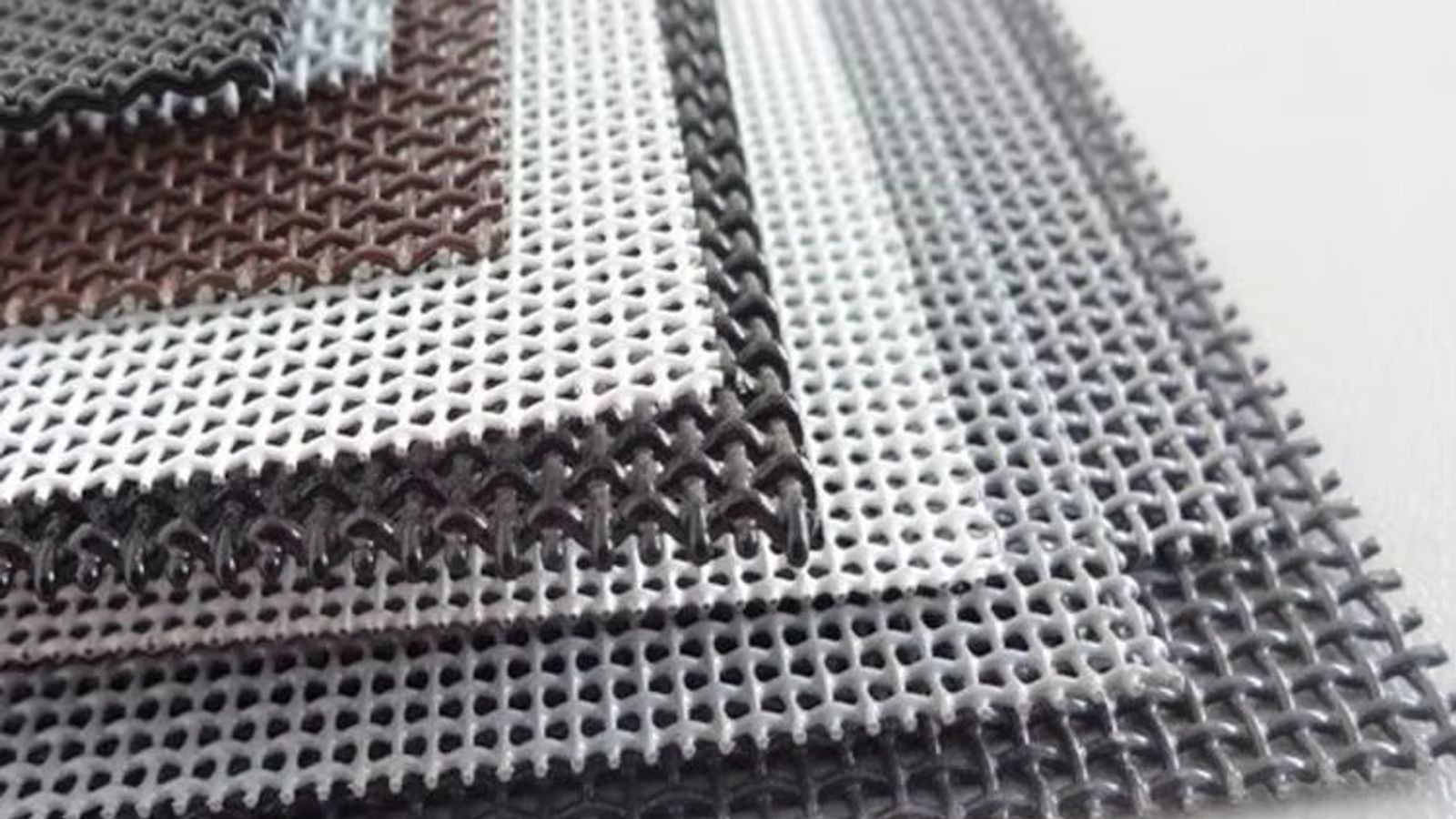
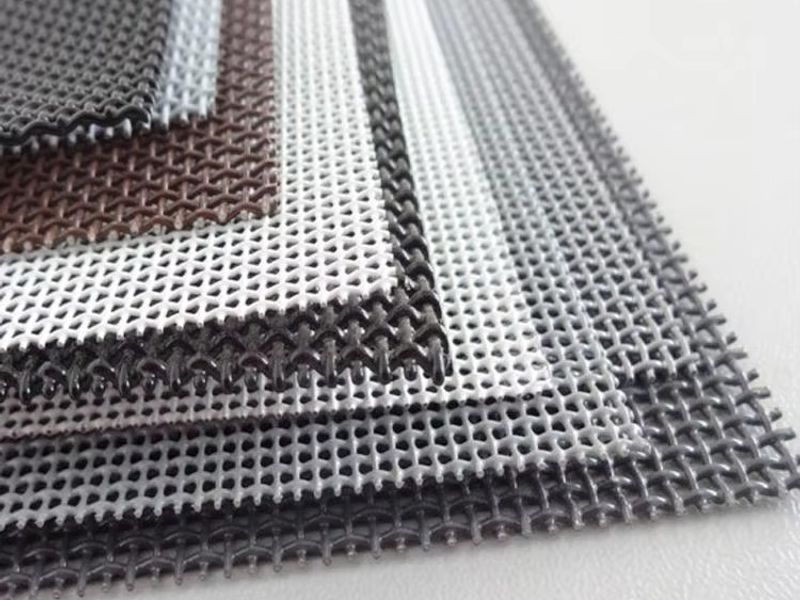
Ultra-fine woven stainless steel wire mesh is precision-woven wire cloth with mesh counts from 400 up to 635 openings per linear inch, corresponding to apertures of roughly 37–38 µm at 400 mesh, 25–30 µm at 500 mesh, and 19–20 µm at 635 mesh. At these counts the wire itself is drawn down to 0.020–0.025 mm (0.0008–0.001 in), open area falls to roughly 25–35%, and the fabric becomes a true micron-level screen rather than a coarse separator. In practice, 635 mesh (≈20 µm) sits at the practical floor of standard square-weave stainless steel filtration media: below this level, process engineers and procurement teams must step up to Dutch weave (≈1–10 µm) or diffusion-bonded sintered wire mesh (≈2–5 µm) to get a finer, more reliable cut. This article explains how high-mesh-count woven stainless mesh is made, what micron ratings the common grades actually deliver, where 400–635 mesh is used in real filtration duty, and exactly where the woven approach stops making sense.
What Counts as Ultra-Fine Woven Stainless Steel Wire Mesh
In woven wire cloth, "mesh" is the number of openings per linear inch. A 635 mesh stainless steel wire mesh therefore has 635 apertures per inch — a nominal 40 µm pitch between wire centers. Subtracting the wire diameter leaves the aperture (opening) size, which for 635 mesh is approximately 19–20 µm. One micron (1 µm) is one-thousandth of a millimetre, so these apertures are roughly one-fifth the thickness of a human hair.
Three properties matter when specifying ultra-fine mesh:
- Aperture size (µm) — the square opening between adjacent wires, which drives the nominal filtration rating.
- Wire diameter (mm) — the drawn wire thickness, which determines strength, open area, and how fine the fabric can physically be woven.
- Open area (%) — the percentage of the fabric surface that is open holes, calculated as the square of the aperture divided by the pitch. It governs flow capacity and cleanability.
At 400–635 mesh these three values converge on a narrow engineering envelope: apertures of 20–40 µm, wires of 0.020–0.025 mm, and open areas of roughly 25–35%. That combination — sub-40 µm openings held in a corrosion-resistant stainless steel lattice — is what makes this material a high mesh count wire mesh rather than a commodity screen. For a broader mesh-to-micron reference across coarser grades, see our mesh count vs micron rating conversion chart.
How High Mesh Counts Are Woven
The weave mechanics behind fine mesh
Almost all ultra-fine stainless mesh is plain weave: each warp wire passes alternately over and under each weft wire, producing uniform square openings. Twill weave (wires pass over two, under two) appears at some very fine grades to reduce wire movement, but square plain weave is the standard construction for 400–635 mesh. The product is woven on high-precision looms where every wire is individually tensioned; at 0.020–0.025 mm, wire that has gone slack even briefly will buckle and create an oversize opening that ruins the filtration rating. See our plain weave wire mesh page for the full range of constructions available.
A mesh count written as 500 × 500 simply specifies the warp count and shute (weft) count separately — in this case 500 of each. On fine fabric the two are usually equal to keep the openings square, but the notation exists because some Dutch and specialty weaves deliberately use different counts in each direction. When you see a single number such as "500 mesh," it implies equal warp and weft counts in a square weave.
Why the wire itself is the limiting factor
The geometry is unforgiving at high counts. Pitch at 635 mesh is 25.4 mm ÷ 635 ≈ 40 µm. To leave a 20 µm opening you need wire of roughly 20 µm — and to leave a 10 µm opening you would need 30 µm wire, which breaks the pitch budget entirely. This is why aperture cannot shrink without limit:
- Wire drawing limits. Stainless steel wire can be drawn to 0.020 mm and below, but at these diameters tensile strength and elongation must be tightly controlled. Wire diameter tolerance per ISO 4783-2 is a percentage of nominal, and at 0.020 mm a small absolute variation is a large relative one.
- Weaving fragility. Sub-0.020 mm wire has little stiffness, so warp tension, reed spacing, and shuttle handling must all be far tighter than on coarse fabric. Damage in weaving shows up as torn wires or displaced apertures that are invisible to the naked eye but fatal to a 20 µm rating.
- Open area collapse. Open area falls as the wire-to-aperture ratio rises. Below 635 mesh, open area drops toward 20% and lower, which starves flow and makes the media far more prone to blinding.
The practical result is well established across the industry: ≈20 µm is the realistic floor for standard square-weave stainless steel wire mesh, delivered by 635 mesh. The weave family you choose — and whether a Dutch or sintered construction is the better engineering call — is covered by our guide to plain weave vs twill vs Dutch weave.
Mesh Count vs Micron Rating: 400 to 635 Mesh
The table below gives engineering values for the ultra-fine end of the range. Apertures are nominal; actual values depend on the wire diameter and tolerance class specified.
| Mesh count | Aperture (µm) | Wire diameter (mm) | Open area (%) | Typical use |
|---|
| 400 mesh | 37–38 | 0.025 | ≈35 | Fine chemical filtration; laboratory screening; powder classification |
| 500 mesh | 25–30 | 0.020–0.025 | ≈26–30 | Polishing filtration; micro mesh screening; gas–solid separation |
| 500 × 500 | 25–30 | 0.020–0.025 | ≈26–30 | Precision screening where equal warp/shute counts are specified |
| 635 mesh | 19–20 | 0.020 | ≈25 | Fine particle retention; pharmaceutical polishing; micro mesh filtration |
Two points are worth internalising. First, mesh count and micron rating are not linearly convertible by any single formula — aperture depends on the wire diameter chosen, which is why two suppliers' "500 mesh" can differ by several microns. Second, at these counts the mesh number is only half the specification: the wire diameter, alloy, and weave tolerance define the real performance. When writing a spec, always state mesh count and target aperture in microns together.
Real Applications of 400–635 Mesh
Despite sitting at the fine end of woven mesh, 400–635 mesh is a workhorse material in four broad duty classes.
Fine chemical and pharmaceutical polishing filtration
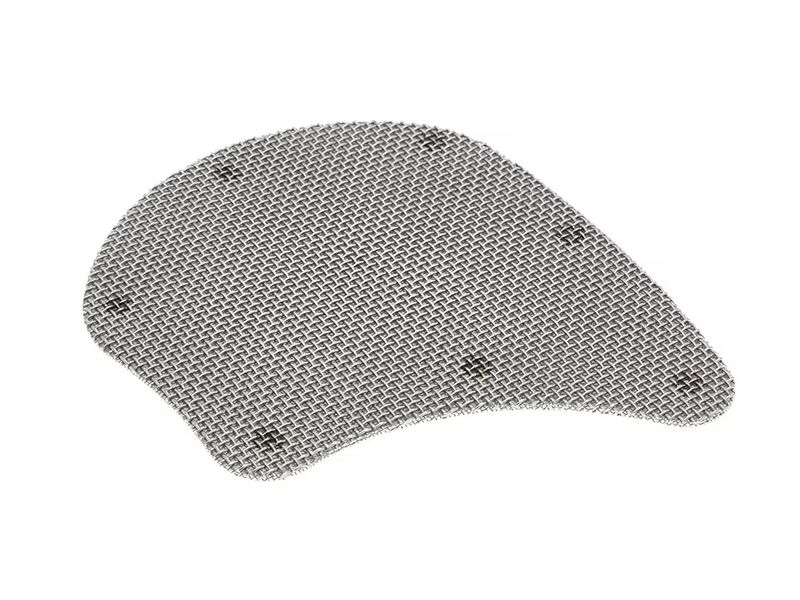
The most common use is polishing filtration — removing small particulate, catalyst fines, activated carbon dust, or precipitates from an already-clarified stream rather than handling heavy solids loads. In fine chemical and pharmaceutical service, 500–635 mesh is often used as a final screen or as a protective layer ahead of finer media, where the wire mesh's high open area keeps pressure drop low while trapping 20–30 µm particles that could blind downstream membranes. The material is fully compatible with 316L stainless steel vessels and cleanable by backwashing or ultrasonic cleaning, which suits batch processes. KAIFIL supplies this media in custom-shape wire mesh filter discs die-cut to filter housings, and it appears throughout pharmaceutical and chemical processing applications.
Gas–solid and liquid–solid separation
Ultra-fine woven mesh is frequently used where a gas stream carries solid particulate that must be captured or protected against. Applications include:
- Fluid-bed and pneumatic conveying systems using 400 mesh as a process filter or vent filter.
- Gas dispersion and air-swept screening where uniform 37 µm openings give a consistent cut.
- Dried powder classification at 500 mesh for consistent particle size distribution.
- Inlet protection on compressors and analyzers where 635 mesh blocks airborne fines.
In liquid–solid duty, 500–635 mesh suits slurry polishing and recirculation loops in which the solids fraction is low but the particle size limit is tight.
Laboratory screening and particle sizing
Test-sieve and analytical screening is one of the oldest applications of high mesh count wire cloth. A 400 mesh sieve (38 µm) and 500 mesh sieve (25 µm) are standard steps in particle size analysis for powders, abrasive grits, metal powders, and food ingredients. In this role the tightness of the weave tolerance — not just the nominal aperture — is what makes the result defensible, which is why laboratory-grade cloth is woven to tighter wire and aperture tolerances than industrial-grade.
Spray, fuel, and hydraulic fine filtration
Fine wire mesh discs and screens protect nozzles, injectors, and hydraulic valves from abrasive and plugging particles. A 635 mesh screen is often the last line of defence before a spray nozzle, catching particles that would otherwise erode the orifice, while 400 mesh is common in fuel and lubricating-oil strainers. Because woven mesh retains particles on its surface, it can be removed, cleaned, and reused — a real cost advantage over disposable depth media in high-turnover equipment.
Food and beverage polishing
Where a bright, particulate-free product is required, 500–635 mesh stainless steel screen provides a cleanable, corrosion-resistant finish filter. Typical points include post-centrifuge polishing of juices, fine screening of dairy and beverage streams, and sieving of milled ingredients. Food-grade mesh is supplied degreased and clean, with surface quality suitable for food and beverage processing environments, and 304/316L alloys meet typical contact-material requirements.
The Practical Limits of Woven Mesh — and When to Step Up
Woven square mesh has three inherent limitations at ultra-fine levels:
- Nominal, not absolute, retention. A woven screen removes particles at and above its nominal aperture with good efficiency, but the rating is not absolute: particle bridging, irregular particle shape, and the small distribution of aperture sizes across the fabric mean a few finer particles will pass. Where a certified absolute rating is required, woven mesh is the wrong tool.
- Pressure drop and blinding. Below 25% open area, flow resistance climbs quickly and fine particles wedge into the weave. Square-weave mesh is a surface filter — once blinded, it must be cleaned or replaced.
- Strength at the woven limit. At 0.020 mm wire the fabric has limited burst and flex strength. High differential pressure or vibration will fatigue ultra-fine mesh faster than a sintered or Dutch construction.
When your process genuinely needs finer than ~20 µm, or needs an absolute rating, move to one of two constructions:
Dutch weave uses heavy warp wires and finer shute wires packed tightly together, creating small triangular pores that are smaller than the aperture of a square weave using the same wire. Plain Dutch weave and twilled Dutch weave reach roughly 1–10 µm, with high density and strength — a common choice for high-pressure liquid filtration. Reverse Dutch weave extends the approach for fine cake filtration. KAIFIL's Dutch weave wire mesh covers these grades, and our data on reverse Dutch weave 80 × 700 filtration performance quantifies what they achieve in practice.
Sintered multi-layer mesh stacks several layers of woven mesh and diffusion-bonds them at high temperature and pressure, producing a rigid, self-supporting element with controlled pore size. Sintered wire mesh reaches 2–5 µm — and thinner with powder layers — with a tortuous pore structure that gives a closer-to-absolute cut and far higher mechanical strength. It is the standard choice for high-temperature, high-pressure, or high-integrity filtration. KAIFIL's five-layer sintered mesh and sintered wire mesh filter cartridges are the usual escalation path from woven media.
| Property | Square-weave mesh (400–635) | Dutch weave | Sintered multi-layer mesh |
|---|
| Typical filtration range | ≈20–40 µm | ≈1–10 µm | ≈2–5 µm (down to ~0.5 µm with powder layers) |
| Pore geometry | Uniform square apertures | Small triangular pores | Rigid; tortuous pore channels |
| Open area / flow | Highest (25–35%) | Low (≈5–20%) | Moderate to low |
| Strength & rigidity | Moderate | Good | Excellent — self-supporting |
| Rating character | Nominal | Nominal to near-absolute | Near-absolute / tested |
| Cleanability | Easy (surface cake; reusable) | Moderate | Moderate; often single-use elements |
| Best-suited duty | Polishing; screening; low ΔP | Fine liquids; high ΔP | High pressure; high temperature; high integrity |
Selecting Ultra-Fine Wire Mesh: Alloy, Certification, Tolerances
Three specification points separate a mesh that performs from one that fails a quality audit:
Alloy. For most filtration service, AISI 304/304L covers cost-sensitive applications with mild media; 316L is the default where chlorides, acids, or cleanability requirements demand better pitting and corrosion resistance. For aggressive chemical or high-temperature duty, consider 317L, 904L, Monel, Inconel, or Hastelloy grades. Confirm the alloy certificate matches the drawn wire, not just the coil of origin.
Certification and traceability. For regulated industries (pharma, food, aerospace), require:
- Mill test certificates for the wire alloy and heat number.
- Aperture and wire-diameter verification against the specified tolerance class, in line with ISO 4783-2 for woven metal wire cloth.
- For sintered media, pore-size verification per ASTM E2016-06 (controlled pore size of porous metals) or a bubble-point test, rather than a nominal figure.
- Cleanliness statements for food and pharmaceutical contact — degreased, contaminant-free, and packed to prevent re-contamination.
Tolerances. On ultra-fine cloth, tolerance is everything. Specify the aperture tolerance (e.g., ISO standard tolerance or a tight custom band), the open-area range, and the inspection method (projected-image measurement rather than visual inspection). A 635 mesh cloth woven to industrial tolerance can differ from a laboratory-grade cloth by more than the entire pore-size window you are trying to control.
FAQ
What micron rating is 635 mesh stainless steel wire mesh? Approximately 19–20 µm. At 635 openings per inch the pitch is about 40 µm; with a typical 0.020 mm wire, the aperture is 19–20 µm.
What is the finest stainless steel mesh available? In standard square weave, 635 mesh (≈20 µm) is effectively the practical floor for commercial stainless steel wire cloth. Twill-weave and specialty grades can reach roughly 10–15 µm, and Dutch weave or sintered multi-layer mesh extend down to 1–5 µm when a genuine fine cut is required.
Is higher mesh count always better filtration? No. Higher mesh count means smaller apertures, but also lower open area, higher pressure drop, and faster blinding. The right mesh is the coarsest one that reliably holds the particles you must remove — not the finest fabric that can be woven.
What is the difference between 500 mesh and 500 × 500 mesh? A single "500 mesh" figure implies 500 wires per inch in both directions. "500 × 500" states the warp and weft counts explicitly. On fine square-weave cloth they are normally equal; the two-part notation matters for Dutch and specialty weaves where the counts differ.
Can 635 mesh be used for liquid filtration? Yes, for low-solids polishing duty. The 19–20 µm aperture retains fine particulate, and the high open area keeps pressure drop manageable. For high solids loads or high differential pressure, a Dutch weave or sintered element is usually the more robust choice.
Get the Right Mesh for Your Process
The difference between a 400 mesh screen and a 635 mesh screen is rarely a matter of "finer is better" — it is a question of your particle size distribution, flow rate, pressure budget, and cleanability requirements. If you are specifying ultra-fine woven stainless steel wire mesh, or deciding whether a woven, Dutch-weave, or sintered construction is the right call, send KAIFIL your mesh count, target micron rating, media, temperature, and flow conditions. Our engineers will confirm the weave, alloy, and tolerance class that fits your process, and can supply the mesh as roll stock, die-cut discs, or finished filter elements. Request a quote or discuss your mesh specification with a KAIFIL engineer today.