Technical
Beer Brewing Filtration with Stainless Steel Mesh: From Wort Lautering to Polish Filtration
From lauter tun false bottoms to 1-5 micron beer polishing: how stainless steel mesh filters every brewing stage, and how to get your custom quote.
From lauter tun false bottoms to 1-5 micron beer polishing: how stainless steel mesh filters every brewing stage, and how to get your custom quote.
Stainless steel mesh filtration in brewing is the use of food-grade 304/316L woven wire mesh, sintered wire mesh, and perforated screen to separate solids from wort and beer at every production stage — from the lauter tun false bottom that supports a 30–40 cm grain bed and collects first wort through 0.7–1.2 mm slots or 20–60 mesh woven cloth, to sintered stainless steel cartridges that polish finished beer to 1–5 microns before packaging. Because the media is metal, it is cleaned in place with hot caustic and steam and reused through hundreds of CIP (clean-in-place) cycles, instead of being discarded after every run like filter pads or polymer cartridges.
That reusability changes the economics of a brewery as it scales. From a 20-hectolitre craft system to a multi-brew commercial plant, the filtration train runs hot-side and cold-side, and stainless steel mesh has a role at every step. It is the same material family KAIFIL engineers for the wider food and beverage processing application, and in brewing it delivers the same three benefits: cleanable media, reproducible micron ratings, and no consumable filter aid to buy, store, or dispose of.
Every batch of beer passes through the same sequence of solids-separation challenges, and it helps to map them before choosing media. Even before the mash, most breweries filter incoming process water and brewing liquor to 5 µm or finer — protecting heat exchangers, pumps, and control valves, and removing particulates that can cause inconsistent extract and off-flavours. Then the brewhouse itself presents three classic duties: lautering (separating sweet wort from the grain bed), trub removal (separating coagulated protein and hop debris from boiling wort), and wort cooling.
Fermentation shifts the challenge. The finished beer — now called green beer — is a fragile product carrying yeast and haze-forming colloids, and the cellar presents two more duties: rough filtration to strip yeast, and polish filtration to make the beer bright and stable for packaging.
The hot side and cold side demand different engineering. Above 80 °C, microbiological risk is essentially nil, so filtration is purely a solids-separation problem and coarse, high-open-area media dominate. On the cold side, the beer sits between 0 and 10 °C, every piece of hardware must be hygienic, and oxygen becomes the enemy: dissolved oxygen (DO) picked up in the filter accelerates staling, so closed, pressure-driven systems are preferred. Mesh works on both sides — the difference is in the rating and the cleaning protocol.
Lautering is the first serious filtration duty in the brewhouse, and the principle is often misunderstood: the filter medium is not the steel — it is the grain bed itself. The false bottom simply holds the packed bed of barley husks in place and gives the clear wort a drainage path. A bed 30–40 cm deep acts as a natural depth filter: fine starch particles and husk fragments are trapped between the grains while wort drains through. That is why lautering works even though the openings in the false bottom are far larger than the particles being removed.
Two false-bottom geometries dominate. Wedge-wire (V-profile) screens with slot openings of 0.7–1.2 mm offer high open area and resist blinding, because the slot profile widens downward and lets solids fall through rather than wedge in. Alternatively, a flat woven stainless cloth of 20–60 mesh — an aperture range of roughly 0.85 mm down to 0.25 mm — is laid over a perforated support plate, giving a smooth, easily cleaned surface. KAIFIL also supplies stainless steel perforated filter tubes for lauter tuns and mash mixers where a tubular collector is preferred over a flat plate.
Run-off is a balancing act. The first wort is cloudy, so it is recirculated — the vorlauf — for 10–20 minutes until it runs bright; this "setting" of the bed is what makes subsequent wort clear. A raking mechanism periodically cuts the bed to keep flow uniform and prevent channeling. Typical run-off rates are 5–10 hl/m²·h: too fast and the bed compacts, extract drops, and the wort hazes; too slow and lautering drags to three hours or more. A correctly specified false bottom also distributes flow evenly across the whole vessel, which is more about slot geometry and open area than about the steel itself.
For very large plants, mash filters — plate-and-frame presses using a membrane and filter cloth — can run a full mash-off in one to two hours and recover up to two percent more extract than a lauter tun. They are a genuine alternative, but they consume disposable cloth, and the false-bottom lauter tun remains the standard across craft and mid-scale brewing, with stainless mesh as its core component.
After the boil, wort enters the whirlpool tangentially at several metres per second, spinning the whole vessel and producing the familiar "tea-cup" effect. Coagulated hot trub — denatured protein–polyphenol complexes mostly in the 20–100 µm range — plus whole hops and hop debris, collect in a cone at the centre. After a 20–30 minute rest, clear wort is drawn off from the side outlet, leaving the trub cone behind.
The whirlpool removes the bulk of the solids, but it is not a polish. Wort leaving the whirlpool typically still carries on the order of 50–200 mg/L of suspended solids, and fine cold-break particles — spanning from under a micron up to roughly 10 µm — only form later, as the wort is chilled. So most breweries fit a screen or strainer between the whirlpool and the wort cooler. A woven mesh basket at 40–100 mesh holds back hop matter and coarse trub that would otherwise foul the plate heat exchanger, aerate the wort, or settle in the fermenter — and a high-open-area screen keeps the pressure drop below 0.1 bar so it does not throttle the drain. This is exactly the duty covered in our guide to wire mesh strainer baskets in food and beverage.
There is a trade-off worth noting: aggressive trub removal improves fermentation and beer clarity, but it also removes some fatty acids and nutrients that yeast need, so many breweries deliberately leave a controlled amount of fine trub in the wort. The screen should therefore be sized for solids retention, not for maximum cleanliness — a point that matters when the same mesh is specified across a whole plant.
Once fermentation is complete, the green beer carries yeast cells (roughly 5–10 µm) and the haze-forming proteins and polyphenols that will otherwise throw chill haze in the package. This is where cartridge filtration earns its keep.
Rough filtration is the first pass, and it strips the bulk of the yeast and coarse haze. A pleated stainless cartridge rated at 5–10 µm is a strong fit: the pleated construction packs a large filter area into a short housing, so a small skid handles high flow, and because the media is metal it can be backflushed and cleaned rather than thrown away. For breweries still running diatomaceous earth (kieselguhr) pre-coat filters, the switch to reusable mesh removes crystalline-silica dust handling, spent-filter-aid disposal, and the labour of pre-coating and scraping out. KAIFIL's pleated filter cartridges are built for exactly this duty.
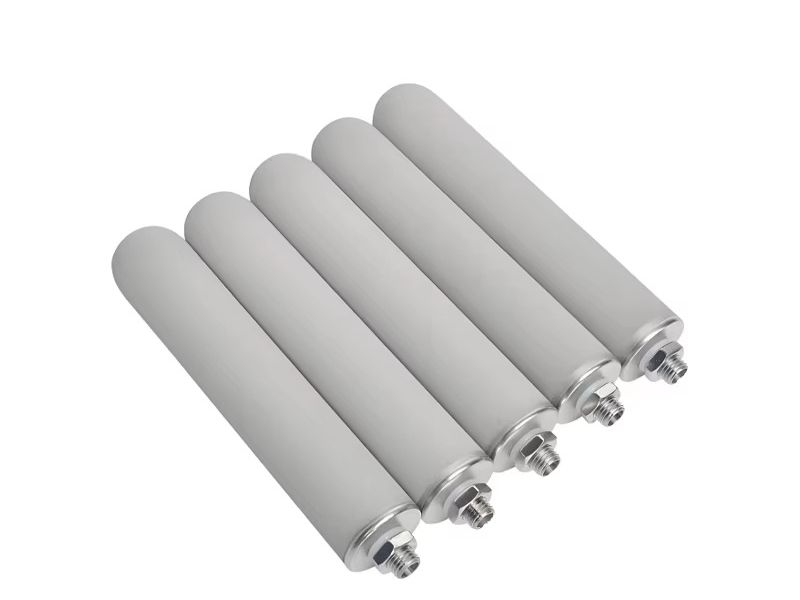
Polish filtration is the final pass, and it takes the beer to 1–5 µm for a bright, stable product. Sintered stainless steel cartridges are the workhorse here: five-layer sintered mesh forms a rigid, depth-filtration structure with a defined pore size that does not flex or unseat under pressure, and the same cartridge can be steam-sterilised at 121 °C, backflushed, and run for years. Many of KAIFIL's sintered wire mesh filter cartridges are produced as drop-in replacements for imported elements — same length, same gasket faces, same housing — so a brewery is never locked into a single OEM. Polished beer typically leaves the filter below 1 EBC turbidity, and some producers add a 0.45–0.65 µm sterile step before packaging for extended shelf life.
Sizing is straightforward. A 20-inch (508 mm) sintered cartridge rated at 5 µm typically handles on the order of 1–2 m³/h of rough-filtered beer at a working pressure drop of 0.5–1.0 bar, so total cartridge count is set by peak brewery output. Because flow through any porous medium is inversely proportional to liquid viscosity — and beer at 8–10 °C is noticeably thinner than beer at 1–2 °C — running the polish filter a few degrees warmer can raise throughput by roughly 20 percent, at the cost of accepting a little more haze. That is why most lager breweries still filter cold, at 0–4 °C.
Choosing the right media comes down to three questions: how much open area the duty needs, how fine the rating must be, and how the element will be cleaned.
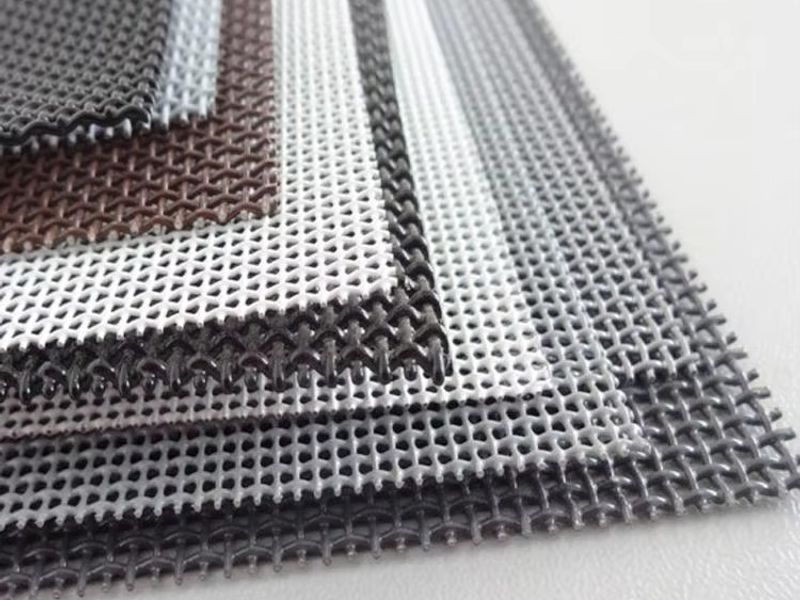
Plain and dutch weave wire mesh are the building blocks. Plain weave, with square apertures, gives the highest open area and is the natural choice for whirlpool screens and strainers. Dutch weave — a Dutch twill construction with fine wire tightly packed — delivers filtration down to a few microns while staying far stronger and more backflushable than a comparable cloth filter, which is why it often appears as the working layer in sintered laminates and as a pre-filter ahead of polish cartridges.
Sintered mesh takes woven cloth and bonds the layers into a rigid plate: multiple layers are diffusion-bonded under heat and pressure, producing a solid element with a defined pore size that can be cleaned aggressively, backflushed, and sterilised without flexing. Pleated stainless cartridges instead fold a single sheet of mesh to multiply filter area, giving high flow at medium ratings in a compact element.
| Media type | Typical brewing duty | Typical rating | Cleaning and reuse |
|---|---|---|---|
| Woven wire mesh (plain weave) | Whirlpool trub screens; in-line strainers; pre-filtration | 20–200 mesh (approx. 74–850 µm) | Hot caustic CIP; brushable; years of reuse |
| Dutch weave / twill mesh | Fine wort screening; rough-beer pre-filtration | Down to approx. 5 µm | Backflushable; steam-tolerant |
| Pleated stainless cartridge | Rough beer; yeast removal | 5–10 µm | Backflush + CIP; reusable |
| Sintered stainless cartridge | Polish / bright beer filtration | 1–5 µm | Steam-sterilisable; backflush; ultrasonic cleanable |
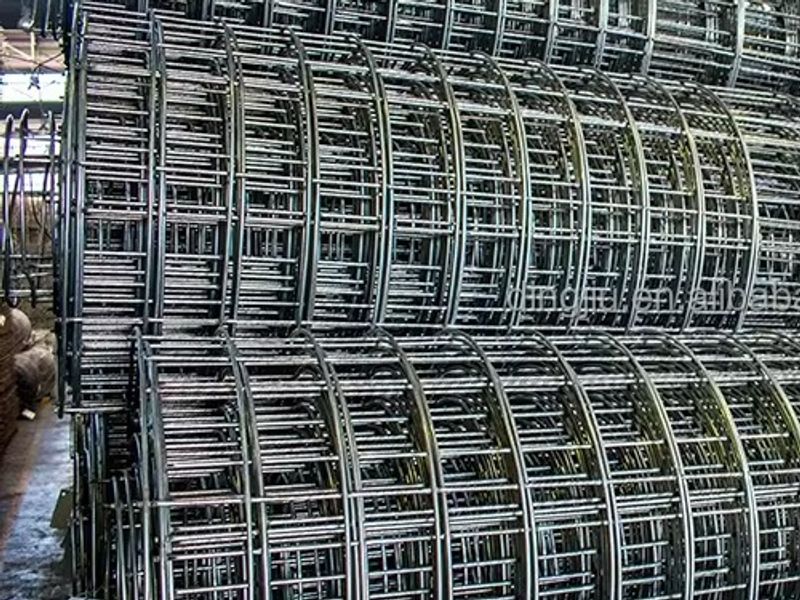
| Wedge-wire or perforated false bottom | Lauter tun; mash filtration | 0.7–1.2 mm slots / 1–3 mm perforations | Self-cleaning via grain bed; decades of service |
The general rule: the earlier and hotter the duty, the coarser and more open the media; the closer to packaging, the finer and more rigid. A brewer who buys the right element for each stage gets more throughput, fewer filter changes, and a shorter CIP.
All the food-contact stainless used in brewing comes from the 300 series. Type 304 is the default for hot-side screens and strainers, where chloride exposure is low and the cost saving is real. Type 316L adds 2–3 percent molybdenum, which sharply improves resistance to pitting in chloride-containing CIP solutions and to the aggressive alternating caustic-and-acid cycles of a brewery wash-up — the reason it is preferred for cold-side cartridges and for any product-contact component that sees phosphoric or citric acid at temperature.
The "L" in 316L is as important as the molybdenum. Low-carbon (max 0.03 percent) steel resists chromium carbide precipitation at the weld, so a welded cartridge keeps its corrosion resistance along the seams instead of becoming sensitised and prone to intergranular attack. Both grades are FDA food-contact compliant for repeated-use food equipment under US regulation, and the practical rule for brewers is simple: if the beer touches it and you are buying once for a long service life, specify 316L.
Stainless mesh earns its keep at clean-up time. A typical brewery CIP cycle runs 1–3 percent sodium hydroxide at 75–85 °C, followed by an acid rinse and a hot-water flush; sintered cartridges can additionally be steam-sterilised at 121 °C and backflushed to dislodge yeast cake. Metal survives thousands of these cycles. Polymer media — even PVDF — degrades under hot caustic, fatigues under repeated backpressure, and eventually sheds media into the beer. Over a five-year horizon, the stainless element usually wins on total cost despite a first purchase price several times higher than a disposable cartridge. The design choices that make a filter genuinely CIP-able — crevice-free welds, fully draining housings, no dead legs, sanitary connections — are covered in depth in our CIP-cleanable stainless steel filter design guide.
Oxygen control is the other reason the cold side is delicate. Dissolved oxygen above roughly 50 ppb at packaging measurably accelerates staling of the finished beer, and every filter is a potential oxygen ingress point. Closed, pressure-driven mesh filtration has a structural advantage over pre-coat filters here: there is no powder slurry to mix, no filter aid to pre-coat, and no open vessel during changeover. With gas-purged housings and proper venting, a modern stainless filter skid holds DO pickup well below the packaging target — batch after batch.
What mesh or slot size is used for a lauter tun false bottom? Wedge-wire false bottoms typically use 0.7–1.2 mm slot openings; woven stainless false bottoms run 20–60 mesh, an aperture range of roughly 0.25–0.85 mm. The grain bed does the actual filtering — the screen only supports it and provides drainage.
Can stainless steel mesh replace diatomaceous earth (kieselguhr) filtration? Yes. A 5–10 µm rough filter followed by a 1–5 µm polish removes yeast and haze without DE, eliminating crystalline-silica dust handling, spent-filter-aid disposal, and pre-coat labour. The stainless elements are backflushable and reusable, which is what pays for the higher upfront cost.
What micron rating makes beer bright? Most polish filtration runs at 1–5 µm, and some producers add a 0.45–0.65 µm sterile step before packaging. At 1–5 µm, sintered stainless cartridges remove haze-forming colloids and residual yeast, typically leaving the packaged beer below 1 EBC turbidity.
How long do sintered stainless steel cartridges last? With proper CIP and backflushing, several years of continuous brewery service — hundreds of filtration cycles — before replacement is needed. That reusability is the core economic case for stainless media versus disposable cartridges.
Is 304 or 316L stainless steel better for beer filtration? 316L is preferred for product-contact and cold-side duty because its molybdenum content resists chloride pitting and caustic/acid CIP stress-corrosion; 304 is a valid, lower-cost choice for low-chloride hot-side screens. When in doubt, choose 316L.
No two breweries run identical filtration trains — vessel geometry, haze profile, and packaging line speed all differ — so off-the-shelf elements rarely fit perfectly. That is exactly what KAIFIL manufactures: custom woven mesh, sintered cartridges, pleated elements, and perforated tubes built to your dimensions and micron spec, including drop-in replacements for imported cartridges so you are never locked to a single supplier. Whether you are a brewery upgrading its cellar or a brewing-equipment OEM specifying filtration for a new brewhouse, send us your flow rate, target micron rating, and connection size, and we will recommend the right media and quote a complete element set or filter skid. Contact KAIFIL today for a custom mesh specification and a price.
Square-opening woven wire mesh for screening, support layers and custom fabricated filter parts.
Dense woven wire mesh for fine filtration and custom screen packs in demanding process lines.
Cartridges / tubes / cylinders for reusable cartridge filtration with rigid sintered mesh media, supplied to drawing with material, size and packing details confirmed at RFQ stage.
Send drawings, dimensions, material, environment or operating conditions, and we will help confirm the right specification.
Uploaded reference files are included with the inquiry. For larger CAD packages, reply to the confirmation email or send them here:
Our team typically replies within 24 business hours.