Technical
EHEDG Food-Grade Filter Basket Spec: Welds, Finish & Mesh
Hygienic filter basket design for food lines: crevice-free EHEDG/3-A welds, Ra 0.8 finish, mesh selection, and an RFQ checklist. Get a quote from KAIFIL.
Hygienic filter basket design for food lines: crevice-free EHEDG/3-A welds, Ra 0.8 finish, mesh selection, and an RFQ checklist. Get a quote from KAIFIL.
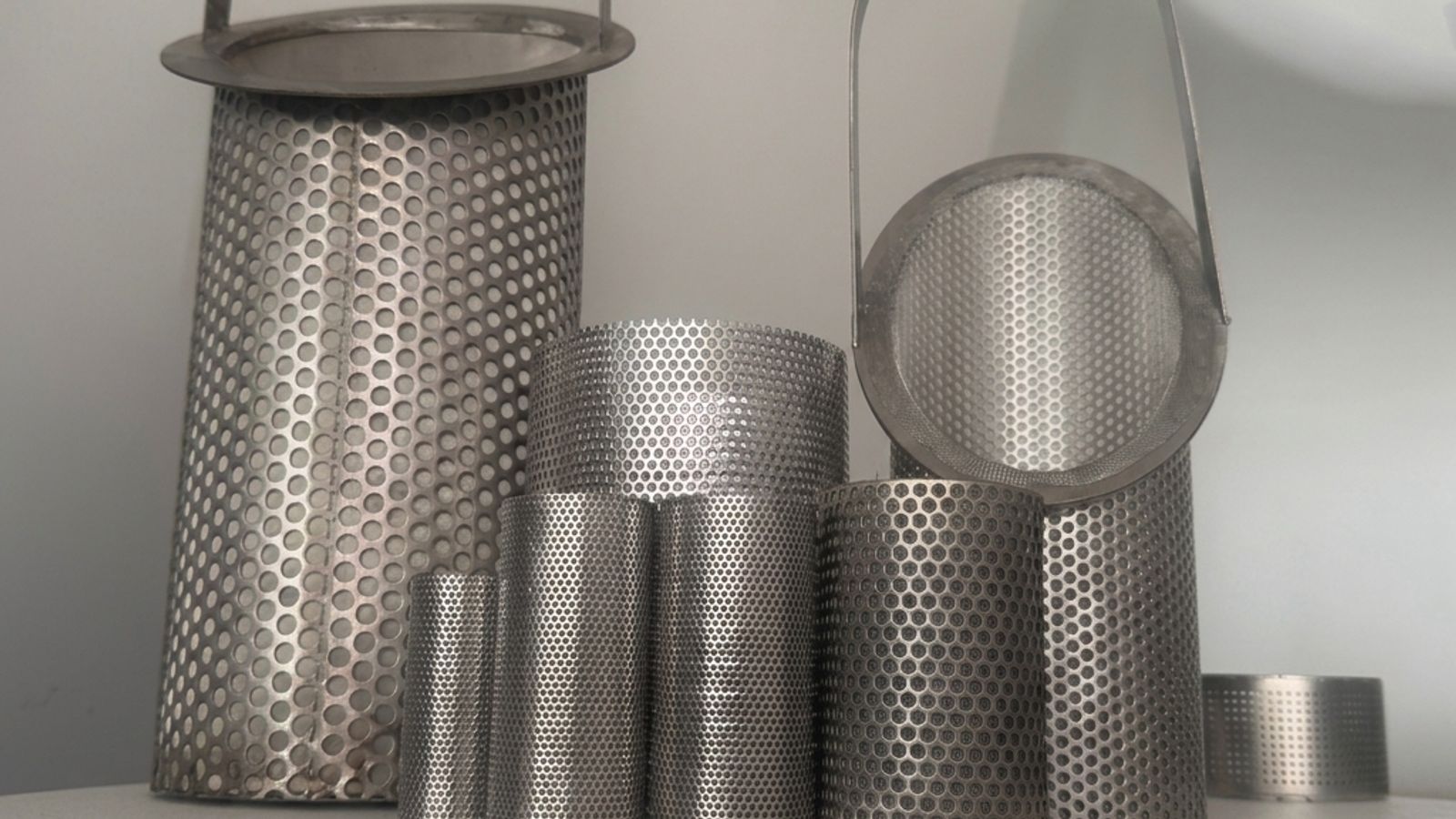
Hygienic design of stainless steel filter baskets is the set of fabrication decisions — weld execution, surface finish, mesh geometry, and joint construction — that lets a basket sit in a food or beverage line, survive repeated clean-in-place (CIP) cycles, and still satisfy a third-party auditor. A basket that traps a filter particle, a piece of product, or a droplet of cleaning chemical is a food-safety liability, not just a maintenance nuisance: EHEDG (European Hygienic Engineering & Design Group) hygiene criteria and 3-A Sanitary Standards both treat any inaccessible crevice, dead zone, or surface irregularity as a potential microbial harborage site. In practical specification terms, hygienic design means an internal surface finished to Ra 0.4–0.8 µm, welds with full penetration, no spatter and ground smooth to parent metal, a crevice-free joint between the mesh liner and the perforated support core, and a geometry that drains completely when the line is emptied. These requirements map directly onto the fabrication specification for a food-grade strainer: a double-layer construction of perforated core plus woven mesh liner, finished with sanitary flanges, handles, and lifting lugs that leave no pocket for residue. For buyers, the difference between a basket that sails through an audit and one that gets rejected is rarely the stainless grade alone — it is what is written on the purchase order. This guide covers the engineering spec behind hygienic basket design and what to write on your RFQ so the delivered basket passes EHEDG/3-A scrutiny and CIP cycling the first time.
A standard industrial strainer basket is built to trap particles and survive pressure. A hygienic basket is built to trap particles, survive pressure, and then give everything back — product, solids, and cleaning chemicals alike — when the line is flushed. The EHEDG design criteria (Doc 8, Hygienic Design Principles, and Doc 37, Welding of Stainless Steel for the food industry) and the 3-A Sanitary Standard for filter equipment rest on a short list of mechanical requirements:
For a basket, these principles resolve into concrete fabrication choices. The mesh liner is the filtering element; the perforated core behind it is the structural support; and the space between the two is the exact place where a poorly designed basket traps product. If the liner is a drop-in sleeve that can lift or buckle, if the core holes are punched with burrs on the food-contact side, or if the two are joined with tack welds that leave spatter, the "hygienic" label fails on inspection. The rest of this guide details the four specification points that determine whether a basket meets those criteria: surface finish, weld quality, mesh selection, and double-layer construction.
The internal surface finish of a food-contact filter basket is specified in Ra (roughness average), the arithmetic mean deviation of the surface profile. For hygienic stainless fabrication the accepted band is Ra 0.4–0.8 µm on all wetted surfaces; the most demanding dairy and pharmaceutical lines call for Ra ≤ 0.4 µm, while Ra 0.8 µm is the practical ceiling for food-contact equipment that must pass EHEDG-style inspection. The reasoning is microbial: surface irregularities below the profile band can shield bacteria and residual soil from CIP flow and sanitizer contact. Roughness in the 0.8–1.6 µm range is standard for mechanical (industrial) fabrication and is visibly different from a mechanically polished hygienic finish — which is why "Ra 0.8 µm max" must be written explicitly rather than assumed.
Finish is not only about the visible face of the wire or sheet; it is about what grinding and polishing leave behind:
The finish requirement interacts with the mesh liner in a way buyers often miss. Woven mesh is inherently rough — its Ra cannot be polished down to 0.4 µm — so hygienic design works by separating the rough filtering medium from the smooth structural surfaces. The mesh is the replaceable consumable; the core, flange, and housing are the permanent wetted surfaces held to Ra 0.4–0.8 µm. That separation is what makes a double-layer basket cleanable and auditable in a way a single mesh cylinder pressed into a housing is not. KAIFIL's stainless steel perforated filter baskets are fabricated with precisely this split in mind: the smooth, ground core carries the finish spec while the woven liner does the particle work.
Welding is where hygienic baskets are won or lost, and it is the most common reason an audited basket fails. The governing references are ISO 5817 (which defines weld quality levels B, C, and D, where B is the strictest) and AWS D1.6 (Structural Welding Code — Stainless Steel), and hygienic food fabrication is expected to be held to ISO 5817 level B/C with all wetted welds fully penetrating. "Full penetration" means the weld fuses through the entire joint thickness with no unfused root, so there is no hidden seam for liquid to wick into. On a basket, the critical welds are the seam where the rolled cylinder closes, the joints between the body and the base flange, and every attachment point for handles and lugs.
Beyond penetration, the rules that separate a hygienic weld from an industrial one:
The weld spec matters as much on the attachment hardware as on the basket body. Handles, flanges, and lugs are usually welded to the outside, but the weld that joins a flange to the basket still creates an internal root that must be fully penetrated and dressed. A basket that looks fine from the outside can hide a crevice at the flange-to-body root where CIP never reaches. This is precisely the failure mode covered in KAIFIL's guide to welded wire mesh filter assembly quality control: the difference between a strainer that holds together and one that holds bacteria is the discipline of the weld — purge, penetration, and post-weld dressing — not just the strength of the joint. For larger custom builds, specifying a welded wire mesh filter assembly with full-penetration wetted welds and documented QC (including dye-penetrant or visual inspection per the drawing) is the standard way to lock that discipline into the PO.
The filtering element of a hygienic basket is woven stainless wire, and for food-contact duty plain weave (one-over-one-under) from roughly 20 mesh up to 400 mesh covers nearly every product-particulate specification in the industry. Mesh count is the number of openings per linear inch, and it maps directly to micron rating: a 20-mesh screen has openings around 850 µm, 60 mesh around 250 µm, 100 mesh around 150 µm, 200 mesh around 74 µm, 325 mesh around 44 µm, and 400 mesh around 38 µm. For a food line, the mesh count is chosen so the screen retains the smallest product particle or unwanted contaminant while passing the product stream — a brew-kettle basket might run 60–100 mesh for hop and trub retention, while a fine clarification or recovery step can run 200–400 mesh.
Several food-specific considerations should be written into the spec, not left to the supplier:
Because the mesh liner is woven and inherently crevice-rich at the microscopic level, the food-contact design rule is to make it removable, visible, and interchangeable rather than trying to polish it. A basket whose liner pulls out for inspection and replacement is a basket that can be CIP-cleaned and audited; a liner that is permanently glued, pressed, or staked in place cannot be verified and will eventually be replaced along with the whole basket.
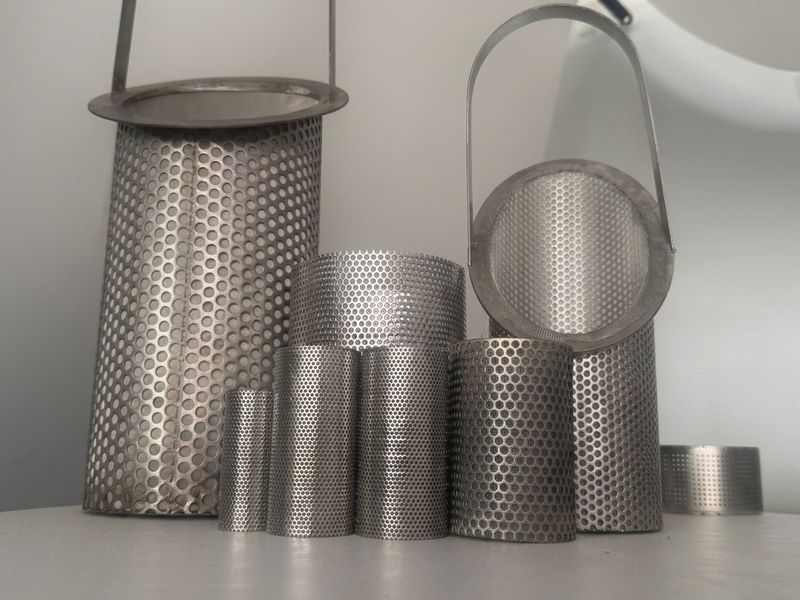
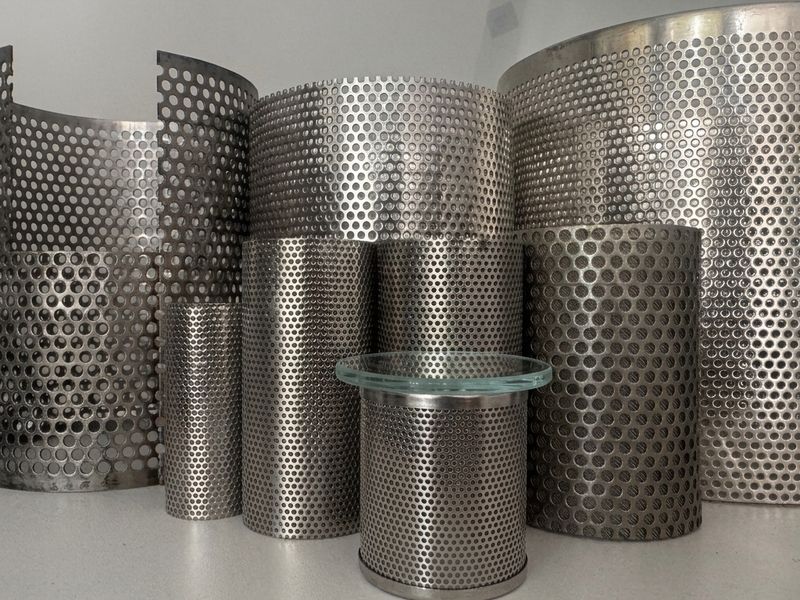
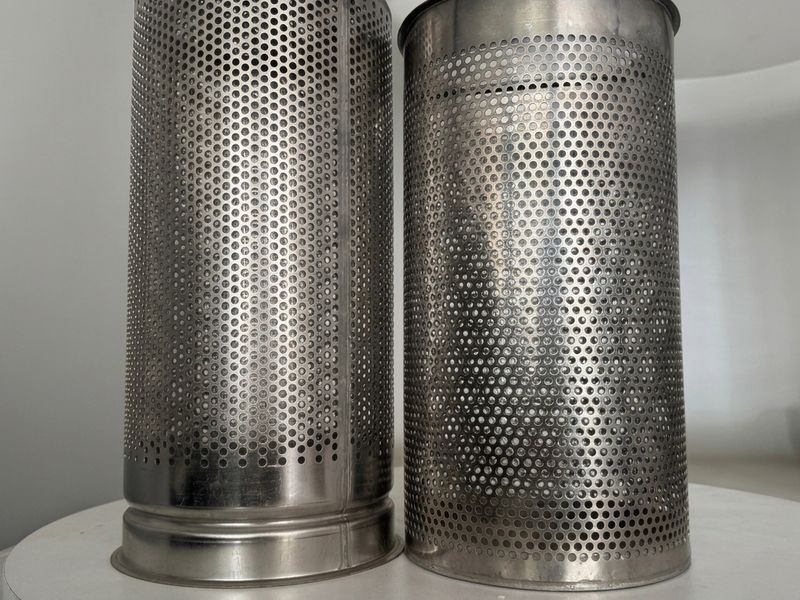
A food-grade basket is almost never a single sheet of mesh. It is a double-layer construction: a perforated stainless core that provides structure and a woven mesh liner that provides filtration, each layer doing the job the other cannot. The perforated core is a cylinder or cone of 304/316L sheet with punched or laser-cut holes — typically 3–6 mm openings — that holds the liner against pressure without blinding it; the woven liner sits inside (or outside) the core at the selected mesh count and does the actual particle retention. This pairing is why KAIFIL's double-layer perforated mesh baskets exist as a distinct product category: the two layers are separable, the liner is replaceable, and the core carries the structural and hygienic finish requirements.
The single-layer versus double-layer decision is a spec choice with real consequences for cleanability, pressure drop, and total cost of ownership:
| Spec point | Single-layer basket | Double-layer (core + mesh liner) basket |
|---|---|---|
| Structure | Mesh is the only structural element; needs heavier wire | Perforated core carries load; mesh can be fine and light |
| Pressure rating | Limited; fine mesh collapses or bows under differential pressure | Core supports liner; allows higher ΔP without collapse |
| Cleanability | Mesh surface is directly in product and hard to restore | Liner is removable for inspection; replacement; or separate cleaning |
| Filter fineness | Practical limit around 60–100 mesh before structural problems | Down to 325–400 mesh practical with the core doing the support |
| Failure mode | A torn panel compromises the whole element | A damaged liner is swapped without rebuilding the basket |
| Cost | Lower initial cost | Higher initial cost; lower replacement and maintenance cost |
For a hygienic basket, the double-layer build also solves the finish problem noted earlier: the permanently installed wetted parts (core, flange, handles) are polished to Ra 0.4–0.8 µm, while the mesh liner is treated as a cleanable, replaceable medium. The seam between liner and core is the one place a crevice can form, so the fabrication spec should require the liner to be secured by continuous or closely spaced tacks that close the gap between liner edge and core — never leaving an open pocket where a piece of product can lodge behind the liner.
The hardware attached to the basket completes the hygienic profile. Handles and lifting lugs should be designed so they do not trap liquid when the basket hangs or sits — a solid handle welded at both ends can form an un-drainable loop, so open or offset handle designs are preferred. Flanges and top rims must be flat, continuous, and gasketed on a full face, with no gasket overhang into the product stream, because a misaligned gasket creates exactly the dead zone and product trap the whole design is trying to eliminate. Basket perforations on the core, if any, should be deburred and oriented away from the product contact face. When these details are specified on the drawing — and held by inspection — the basket meets EHEDG/3-A expectations rather than just resembling a strainer.
The single most valuable sentence in this guide is this: auditors do not fail baskets, they fail specifications. A hygienic basket passes because the purchase order demanded the right finish, the right welds, and the right construction — and because those requirements were written so they can be verified. When you write an RFQ for food-contact strainer baskets, include the following line items so the supplier quotes, builds, and documents what the audit will check:
Two practical habits close the loop. First, hold the first article: before a production run, get a single basket built to the spec, verify finish readings and welds on the actual part, and confirm it passes your drain and CIP tests — because a drawing that looks hygienic can still produce a basket that is not. Second, audit the liner as a consumable: put the mesh count, micron rating, and weave on the drawing and in the replacement part number so every liner ever fitted is identical to the one that passed validation.
This is the fabrication-spec approach to hygienic design, and it is how KAIFIL quotes food-grade baskets: the engineering is in the construction detail — the finish band, the weld standard, the double-layer geometry — not in the product name. Our CIP-cleanable stainless steel filter design guidance walks through how those build details hold up through repeated cleaning cycles, and our work in food and beverage processing applications covers how the same baskets are specified for brewing, dairy, sauces, and edible-oil lines.
What surface finish is required for a food-contact filter basket? Ra 0.4–0.8 µm on all wetted permanent surfaces. Most hygienic installations specify Ra 0.8 µm max, and the most demanding (dairy, pharma-adjacent) lines require Ra 0.4 µm or better. The woven mesh liner is exempt because it is a replaceable medium; the core, flange, and housing carry the finish spec.
What weld standards apply to hygienic stainless steel baskets? ISO 5817 weld quality level B/C and AWS D1.6 for stainless steel structural welding. Wetted welds must be full penetration, spatter-free, ground flush to parent metal, and re-polished to the base-material Ra. GTAW (TIG) with root purge is the standard process.
How do I choose the mesh for a food-grade strainer basket? Start from the particle size you must retain. Plain weave 316L mesh from 20 mesh (≈850 µm) to 400 mesh (≈38 µm) covers food strainer duty; 60–100 mesh suits coarse removal like hop or trub, and 200–400 mesh suits fine clarification. Specify the mesh count, wire diameter, and micron rating on the drawing so the liner is repeatable and verifiable.
Why is a double-layer basket better for food processing than a single mesh layer? A perforated core supports the mesh liner, so a fine liner (200–400 mesh) can hold differential pressure without collapsing, and the liner is removable for inspection, cleaning, and replacement. The permanently installed surfaces are polished to the hygienic finish while the mesh is treated as a cleanable consumable — which is the only way to reconcile fine filtration with Ra 0.4–0.8 µm cleanability.
What should I put on an RFQ so my basket passes a hygiene audit? State the material (304L/316L), the surface finish band (Ra 0.4–0.8 µm, measured), the weld standard (ISO 5817 B/C, full penetration, no spatter, ground flush), the double-layer construction with the exact mesh count, full drainage geometry, and required documentation (mill certs, weld inspection report, finish readings, serial numbers). Require a first-article check before production.
If you are specifying strainer baskets for a food or beverage line and want the EHEDG/3-A detail handled correctly the first time, KAIFIL engineers build exactly to the fabrication spec you write — finish band, weld standard, and double-layer geometry included. We offer custom hygienic filter baskets, mesh liners, and welded assemblies with material certificates, weld inspection reports, and finish verification to support your audits and CIP cycles. Contact KAIFIL today with your drawing or process requirements for a free engineering review and quote.
Made-to-drawing SS304, SS316 and SS316L perforated baskets for liquid straining, equipment protection and removable process screens.
Made-to-drawing SS304 perforated cylinder for food-processing equipment where fit, cleanability and retention are defined by the application.
SS304 perforated pre-strainer basket for removing solid debris upstream of oil-water separation equipment.
Send drawings, dimensions, material, environment or operating conditions, and we will help confirm the right specification.
Uploaded reference files are included with the inquiry. For larger CAD packages, reply to the confirmation email or send them here:
Our team typically replies within 24 business hours.