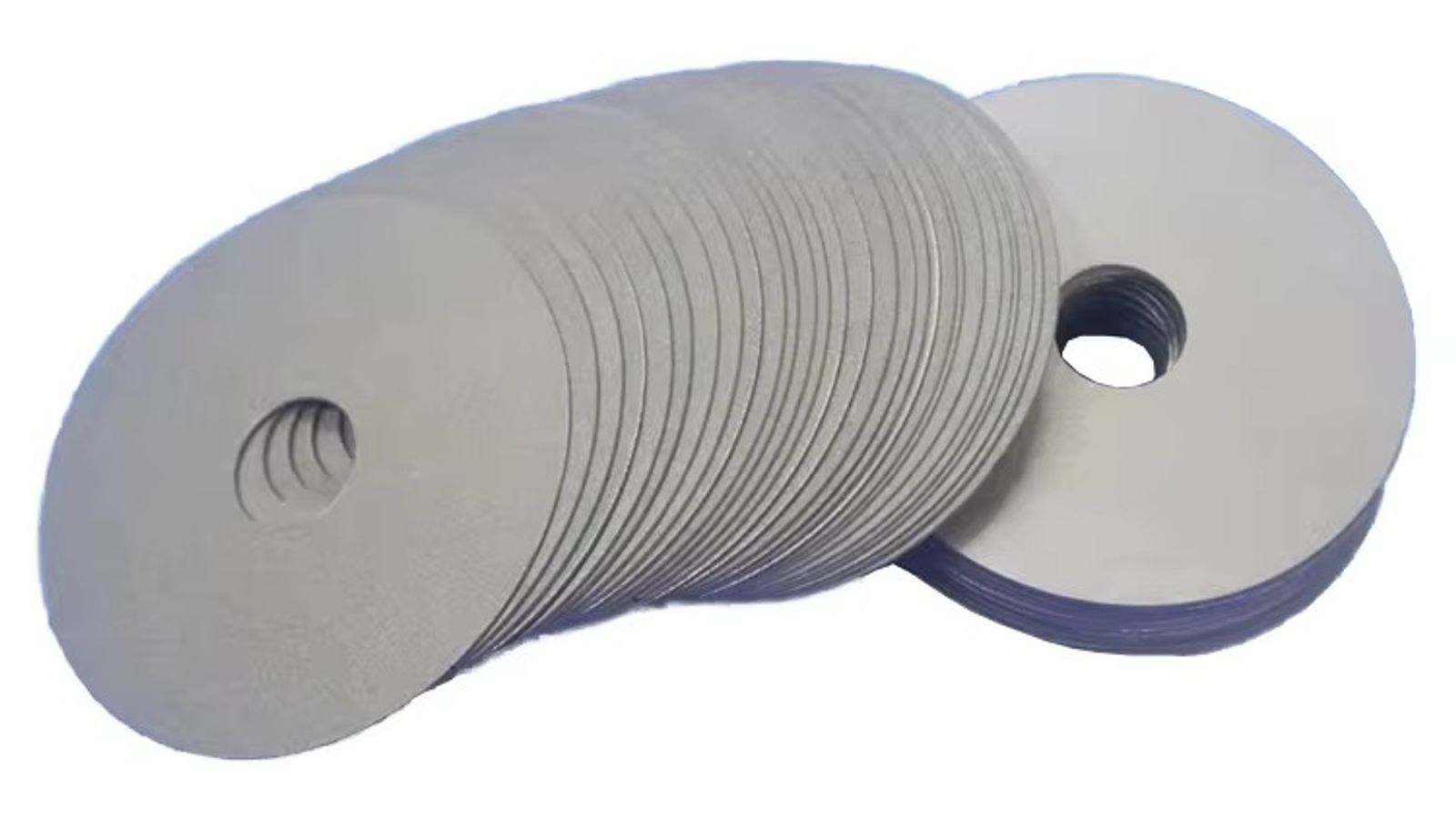
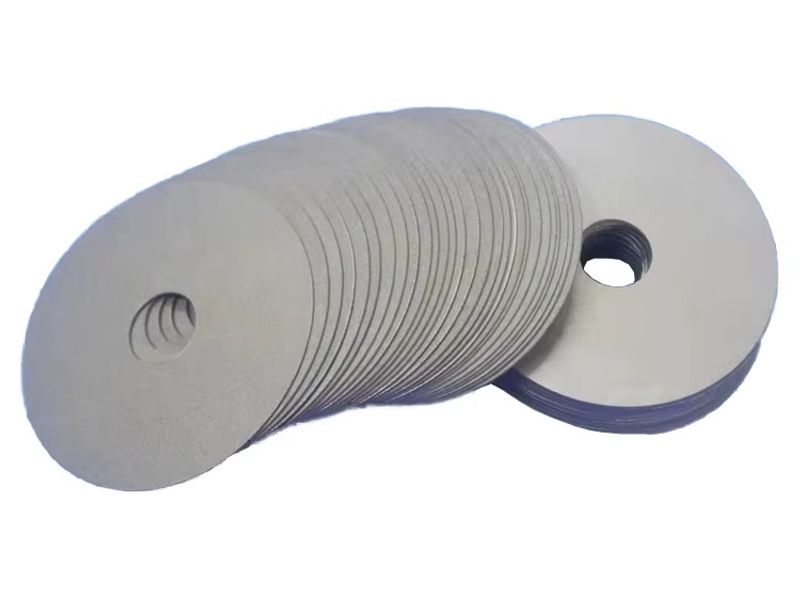
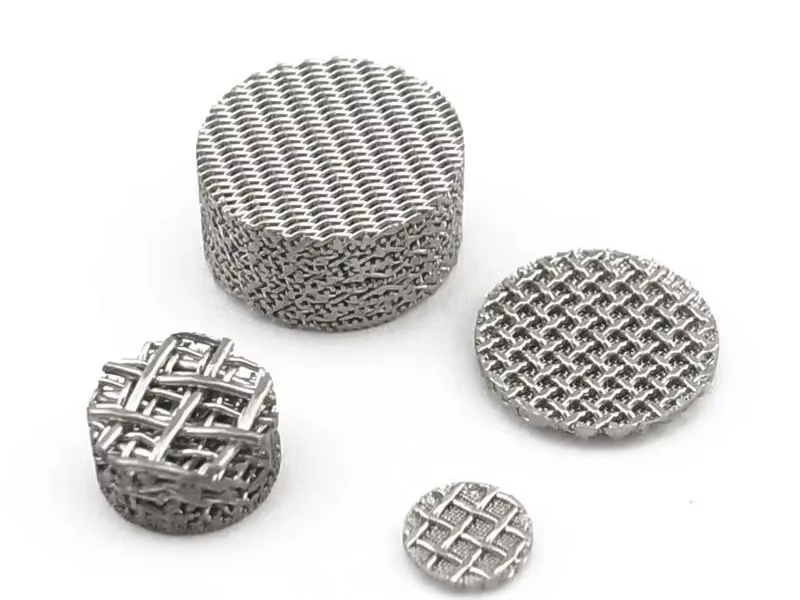
A sintered metal filter disc is a rigid, porous, disc-shaped filter element made by stacking and diffusion-bonding multiple layers of precision-woven stainless steel wire mesh into a single metallurgically fused sheet, then cutting and finishing it to a specified diameter. Typical five-layer sintered mesh discs achieve filtration ratings of 2 to 20 microns while retaining the structural strength of a solid metal plate, and SS316L sintered mesh elements are rated for continuous service up to about 480 degrees Celsius, with short-term peaks near 600 degrees Celsius. Because the layers are fused at roughly 1000 to 1300 degrees Celsius in a vacuum or controlled-atmosphere furnace, the finished disc contains no adhesives or binders, survives repeated cleaning, and holds its shape under differential pressure. For procurement and process engineers, sintered metal filter discs are the specification-critical component in pharmaceutical, chemical, polymer, and instrument-protection applications, and getting the specification right on the first purchase order is the difference between a filter that runs for years and one that is replaced in weeks.
Understanding the manufacturing steps helps you specify intelligently, because each step is tied to a parameter you will be asked to confirm.
Cutting the Mesh Layers
Production starts with rolls of precision-woven wire mesh in the chosen material grade and weave. Layers are cut to size and stacked in the exact order called for by the design — for a five-layer structure, two coarse protective layers, two transition layers, and a fine filtration core. Alignment matters: if layers shift before bonding, the pore structure and filtration rating become inconsistent across the disc.
Diffusion Bonding in a Furnace
The stacked layers are pressed together and heated in a vacuum or controlled-atmosphere furnace to approximately 1000 to 1300 degrees Celsius. At that temperature, atoms diffuse across every wire-to-wire contact point and grow a solid metallurgical bond between neighboring layers. This is diffusion bonding, not brazing or lamination — nothing is added, and the pores between the wires remain open because bonding occurs only at contact points. The result is a monolithic sheet with the permeability of a filter and the rigidity of a plate.
Laser Cutting to Diameter
Once the sintered sheet is produced, discs are laser-cut to the specified outer diameter. Laser cutting produces a clean, burr-free edge and holds tight dimensional tolerances, which matters when a disc must seat into a machined housing or a filter stack.
Edge Treatment
After cutting, the edge is finished to the specified type. A cut edge is the raw sintered edge, suitable for some seated or gasketed installations. A welded or rimmed edge is sealed by welding a solid rim onto the outer circumference, which prevents any layer separation or particle bypass at the edge and adds handling strength. Edge selection is one of the most commonly underestimated decisions in the specification.
Quality Inspection
Finished discs are inspected before release. The two tests you should ask about are the bubble point test and the pressure drop test. The bubble point test, typically performed to ASTM E128, wets the filter with a calibrated test liquid and slowly increases air pressure until the first steady stream of bubbles appears; the pressure at that point is converted, using the surface tension of the liquid, into a maximum pore diameter in microns. This confirms that the largest pore in the disc is within the rated specification. The pressure drop test measures airflow or liquid flow through the disc under a defined differential pressure to confirm permeability matches the design. Dimensional checks on diameter, thickness, flatness, and edge finish complete the inspection.
Specification Parameters You Must Define
When you request a quote for sintered filter discs, the manufacturer needs a complete parameter set. The table below shows what to define for every purchase order.
| Specification Parameter | What You Need to Specify | Typical Range or Example | Notes |
|---|
| Material grade | SS304; SS316L; or duplex 2205 | SS316L most common | Match corrosion resistance to the process fluid |
| Filtration rating | Nominal or absolute rating in microns | 2 to 20 microns for five-layer mesh | Confirm whether rating is nominal or bubble point absolute |
| Disc diameter | Outer diameter in mm or inches | 10 mm to 500 mm typical | Confirm whether the housing takes a standard or custom size |
| Thickness | Overall disc thickness in mm | 0.5 mm to 5 mm typical | Thicker discs are stronger but have higher pressure drop |
| Edge type | Cut edge; welded edge; or rimmed edge | Welded or rimmed for high pressure | Welded edges prevent layer separation and bypass |
| Number of layers | 3; 5; or custom layer counts | Five-layer sintered mesh is standard | More layers add strength and dirt-holding capacity |
| Flatness tolerance | Maximum deviation from flat in mm | 0.1 mm to 0.3 mm typical | Critical for gasketed or stacked disc assemblies |
| Dimensional tolerance | Diameter and thickness tolerance | 0.1 mm to 0.5 mm typical | Tighter tolerances raise cost |
| Operating temperature | Continuous and peak temperature | 480 degrees Celsius continuous for SS316L | Confirm peak exposure time and atmosphere |
| Operating pressure | Maximum differential pressure | Varies with thickness and support | Confirm whether the disc is supported in the housing |
| Chemical compatibility | Process fluid and concentration | Acidic; alkaline; or solvent service | SS304; SS316L; and duplex 2205 differ in resistance |
Material Grade
SS304 is the economical choice for mild service. SS316L is the default for most filtration duties because molybdenum improves resistance to chlorides and a broad range of process chemicals, and it carries the 480 degrees Celsius continuous service temperature rating most sintered mesh data sheets reference. Duplex 2205 adds higher strength and better resistance to stress corrosion cracking, which makes it a strong candidate for aggressive, high-pressure chemical and offshore service. Your filter manufacturer can advise on grade selection once the fluid chemistry, temperature, and pressure are defined.
Filtration Rating in Microns
The filtration rating is the retention target you are buying. For five-layer sintered mesh, the practical specification window is about 2 to 20 microns. Below that range you move into finer sintered metal powder or fiber media; above it, plain woven or Dutch weave meshes may be more economical. State whether you need nominal retention, which removes most particles above the rating, or absolute retention, which means the largest pore is verified by bubble point testing.
Disc Diameter and Thickness
Diameter is driven by the housing or equipment design and should be confirmed against the actual seating area. Thickness is a structural decision: thicker discs resist higher differential pressure and add rigidity, but they also add pressure drop and cost. If your housing has a defined groove or pocket depth, measure it and include it on the drawing.
Edge Type
A cut edge is acceptable for low-pressure, gasketed installations where the edge is fully covered by the seal. A welded edge or a rimmed edge with a solid metal ring is required when the disc sits in flowing fluid, faces backwash, or must be handled repeatedly, because it eliminates any chance of the sintered layers separating or particles slipping around the edge. For assemblies that will be cleaned and reused, most engineers choose a welded or rimmed edge.
Number of Layers
The layer count controls the balance between strength, dirt-holding capacity, and pressure drop. A five-layer structure is the workhorse because it combines a fine filtration core with protective coarse outer layers. A three-layer structure is lighter and lower in pressure drop for moderate duties. Custom layer stacks can be engineered when an application needs unusual combinations of retention and strength — discuss this with the manufacturer rather than assuming a standard stack will fit.
Flatness and Dimensional Tolerances
Flatness is often the most overlooked parameter. If a disc must seal against a gasket or sit in a stacked assembly, excessive bow or warp creates a bypass path. State the flatness limit you can tolerate, typically 0.1 to 0.3 mm, and confirm the manufacturer can hold it through sintering and finishing. Diameter and thickness tolerances should be realistic; tightening them beyond the process capability only adds cost without improving the filter.
Operating Conditions
Temperature, pressure, and chemical compatibility tie the material grade to the process. SS316L sintered mesh handles about 480 degrees Celsius continuously; verify your peak temperature and exposure time, because cycles above the rating can accelerate oxidation and sensitization. Confirm the maximum differential pressure the disc will see, including backwash pressure, and specify the fluid so the correct alloy is selected. A disc that is perfectly rated in microns but wrong in alloy will fail early in corrosive service.
How Five-Layer Sintered Mesh Achieves 2 to 20 Micron Filtration
Five-layer sintered mesh reaches 2 to 20 micron retention through a symmetrical architecture. A fine woven mesh at the core sets the filtration rating. On each side, a transition layer steps the aperture down gradually, and a heavy coarse outer layer protects the core from impact, abrasion, and large debris. After diffusion bonding, the five layers behave as one rigid part, and fluid follows a three-dimensional tortuous path through the thickness.
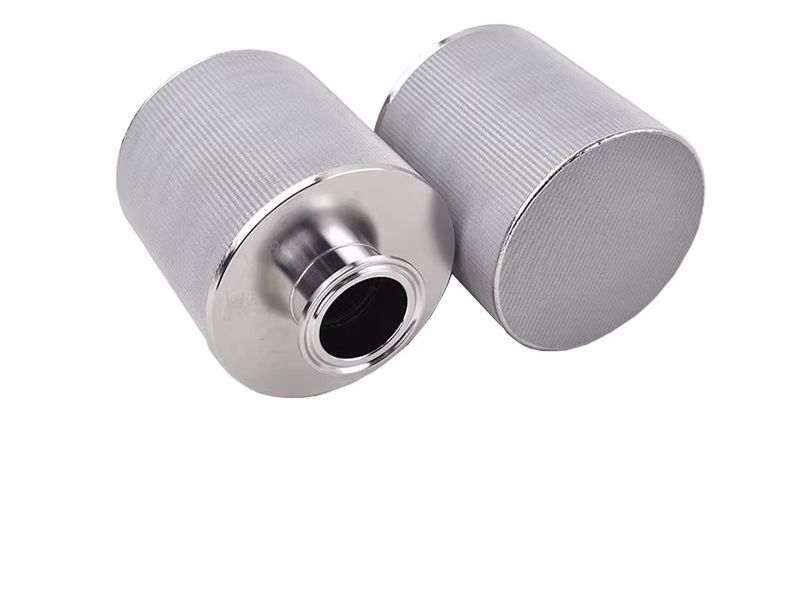
This depth-filtration behavior is what delivers the combination buyers want: high strength and low differential pressure. Because the contaminant is captured through the thickness of the structure rather than only on a single surface, the disc holds far more dirt before plugging than a single woven layer of the same rating. The coarse outer layers keep large particles from blinding the fine core, which keeps pressure drop low during service and makes the disc easier to backwash and regenerate. The metallurgical bonds transfer load across the whole structure, so the disc resists pressure pulsing and mechanical handling without deforming. That is why five-layer construction appears throughout filter discs, sintered metal filter elements, and cartridges rather than only in flat sheet form. For a deeper look at the layer architecture and its design trade-offs, see our guide to five-layer sintered mesh structure and uses.
Sintered Filter Disc vs Plain Woven Wire Mesh Disc vs Pleated Cartridge
Each medium has a place, and choosing correctly starts with understanding the differences.
| Attribute | Sintered Metal Filter Disc | Plain Woven Wire Mesh Disc | Pleated Cartridge |
|---|
| Typical micron range | 2 to 20 microns | 20 microns and coarser | 0.5 to 50 microns depending on media |
| Structure | Multi-layer; diffusion-bonded; rigid | Single woven layer; flexible | Pleated media on a supporting core |
| Strength and rigidity | High; holds shape under pressure | Low to moderate; may deform | Moderate; supported by a core |
| Maximum service temperature | About 480 degrees Celsius for SS316L | Similar alloy limits | Depends on media and seal materials |
| Cleanability | Excellent; backwashable and reusable | Limited by weave stability | Usually replaceable; not reusable |
| Differential pressure | Low for the rating | Low at coarse ratings | Moderate |
| Typical applications | Pharmaceutical; catalyst recovery; polymer melt; instrumentation | Pre-filtration; straining; simple screening | High-surface-area filtration in compact housings |
| Relative cost per element | Higher | Lower | Moderate to high |
For a more complete comparison of the two mesh-based options, see sintered metal filter vs wire mesh filter. As a general rule, choose a sintered disc when you need repeatable fine retention, high temperature, aggressive backwash, or a rigid element; choose a plain mesh disc when duty is coarse, low-pressure, and cost-sensitive; and choose a pleated cartridge when surface area and compactness matter more than cleanability.
Pharmaceutical API Filtration
Sintered filter discs are widely used in the filtration of active pharmaceutical ingredients and intermediates, where retention, cleanliness, and lot-to-lot consistency are regulated. The all-metal, binder-free construction withstands steam sterilization and aggressive cleaning-in-place chemistries, and the rigid disc supports high differential pressure without media migration. These same requirements apply across the pharmaceutical and chemical applications KAIFIL serves, where traceable, reproducible filtration is non-negotiable.
Chemical Catalyst Recovery
In catalytic processes, recovering fine catalyst particles from reaction liquor is both an economic and an environmental requirement. Sintered discs retain 2 to 20 micron catalyst fines at elevated temperature and pressure while surviving the backwash cycles used to discharge the collected solids. The ability to clean and reuse the discs over many cycles is what makes them cost-effective in this duty, and it is covered in more depth in our guide to sintered mesh backwash regeneration.
Polymer Melt Filtration
Polymer processors filter melt streams to remove gels, degraded resin, and contaminants before the polymer reaches the die. Sintered discs and their cartridge equivalents run at high temperature and pressure in extruder screen packs and melt filter housings, where their rigidity prevents deformation under the high differential pressures that develop as the screen loads. The 2 to 20 micron rating window covers the fine filtration many melt applications require.
Instrument Protection
In gas analyzers, pressure transmitters, and sampling systems, a sintered disc acts as a porous barrier that protects sensitive instrumentation from particulate and liquid droplets while allowing pressure or gas to pass. The disc provides a large, stable surface with low pressure drop, and its cleanability means it can be specified for the life of the instrument rather than as a consumable.
The Customization Workflow: From Drawing to Delivery
Custom sintered filter discs follow a structured path that keeps the specification clear from the first enquiry to the finished part.
- Send your drawing or purchase order. Provide the disc drawing, dimensional data, filtration rating, material grade, and operating conditions. If you do not have a drawing, a simple sketch with the housing dimensions and duty description is enough to start.
- Technical review and confirmation. The manufacturer reviews the specification against the process conditions, flags conflicts, and confirms parameters such as edge type, tolerances, and test requirements. This is the point where free technical consultation adds real value — an experienced reviewer will catch a rating that is too fine for the differential pressure or an alloy that is wrong for the chemistry.
- Quotation. You receive a quote covering material, fabrication, edge treatment, inspection, and lead time. For custom parts, a drawing review is typically included at no charge.
- Sampling and approval. For new designs, sample discs are produced and supplied for fit and performance testing. Confirm the sample against your bubble point and pressure drop expectations before production.
- Production and quality inspection. Full production runs through cutting, sintering, laser cutting, edge welding, and final inspection, including bubble point and pressure drop testing where specified.
- Packing and delivery. Discs are packed to prevent edge damage and shipped with the relevant inspection documentation.
If your application needs a non-round profile or unusual geometry, the same workflow applies to custom-shape wire mesh filter discs, which are produced from the same sintered and plain woven media families.
FAQ
Five-layer sintered mesh discs are typically available from about 2 to 20 microns. If you need finer retention, sintered metal powder or fiber media should be discussed with the manufacturer, and for coarser duty a plain woven or Dutch weave mesh disc is usually more economical.
What is the maximum service temperature of a 316L sintered mesh disc?
SS316L sintered mesh is generally rated for continuous service up to about 480 degrees Celsius, with short-term peaks near 600 degrees Celsius depending on the atmosphere. Confirm your peak temperature and exposure time with the manufacturer, because sustained exposure above the rating accelerates oxidation.
What is the difference between a cut edge and a welded or rimmed edge?
A cut edge is the raw sintered edge left after laser cutting, which is acceptable when the edge is fully covered by a gasket. A welded or rimmed edge has a solid metal rim fused around the circumference, which prevents layer separation and particle bypass at the edge and adds handling strength. For flowing, high-pressure, or backwashed service, a welded or rimmed edge is the safer choice.
How do I know which material grade to choose?
Start with the process fluid, temperature, and pressure. SS304 suits mild, low-chloride service; SS316L is the default for corrosive and high-temperature filtration; duplex 2205 provides higher strength and better stress-corrosion resistance for aggressive chemical service. Provide the fluid chemistry and operating conditions, and the manufacturer will confirm the grade.
What is the bubble point test?
The bubble point test, commonly performed to ASTM E128, wets the filter with a calibrated liquid and increases air pressure until the first steady stream of bubbles passes through. The pressure at that point is converted into a maximum pore diameter in microns, verifying that the largest pore in the disc meets the rated specification.
Get a Custom Sintered Filter Disc Quote
Every sintered filter disc starts with a specification, and a clear specification starts with a conversation. Whether you have a complete drawing or only a housing and a duty description, KAIFIL, a custom sintered metal filter manufacturer, can help you define the material grade, micron rating, edge type, tolerances, and test requirements for your process. Contact KAIFIL for a custom sintered filter disc quote, and take advantage of free technical consultation and drawing review — send your drawing or purchase order today and get a recommendation you can build a purchase order around.